## Code Snippet: LLVM IR-like Intermediate Representation
### Overview
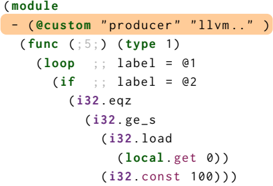
The image displays a structured text snippet that appears to be a low-level intermediate representation (IR) of code, resembling LLVM IR or a similar compiler intermediate language. It defines a module containing a function with a loop and conditional logic.
### Components/Axes
The text is structured hierarchically with indentation indicating scope:
- **Module Declaration**: The top-level container.
- **Function Definition**: A function with a specified type.
- **Control Flow**: A loop and a conditional branch within it.
- **Operations**: Memory loads, comparisons, and constant definitions.
### Detailed Analysis
The text is transcribed verbatim below, preserving all symbols, punctuation, and indentation:
```
(module
- (@custom "producer" "llvm..")
(func (;5;) (type 1)
(loop ;; label = @1
(if ;; label = @2
(i32.eqz
(i32.ge_s
(i32.load
(local.get 0))
(i32.const 100)))
```
**Line-by-Line Breakdown:**
1. `(module`: Declares the start of a module.
2. ` - (@custom "producer" "llvm..")`: A custom section metadata, likely indicating the producer is an LLVM-based toolchain. The text `"llvm.."` is truncated.
3. ` (func (;5;) (type 1)`: Defines a function with index `5` and a signature matching `type 1`.
4. ` (loop ;; label = @1`: Begins a loop construct, annotated with the label `@1`.
5. ` (if ;; label = @2`: Begins a conditional (`if`) statement within the loop, annotated with the label `@2`.
6. ` (i32.eqz`: The condition for the `if` statement: checks if the subsequent 32-bit integer value is equal to zero.
7. ` (i32.ge_s`: A "greater than or equal to, signed" comparison operation.
8. ` (i32.load`: Loads a 32-bit integer from memory.
9. ` (local.get 0))`: The address for the load is obtained from local variable at index `0`.
10. ` (i32.const 100)))`: The constant value `100` (32-bit integer) to compare against.
### Key Observations
- **Structure**: The code is a nested tree of operations. The `if` condition depends on a memory load and a comparison.
- **Labels**: Explicit labels (`@1`, `@2`) are provided for the loop and conditional, which are crucial for control flow analysis and optimization passes.
- **Type System**: Uses explicit 32-bit integer types (`i32`) for operations (`eqz`, `ge_s`, `load`, `const`).
- **Incomplete Context**: The snippet is a fragment. The body of the `if` statement and the rest of the loop/function are not shown. The `@custom` producer string is truncated.
### Interpretation
This snippet represents a fundamental control flow pattern in low-level code: a loop containing a conditional branch. The logic appears to be:
`if (load(local_0) >= 100) is false, then...` (since `i32.eqz` checks if the result of the comparison is zero/false).
**What it likely represents:**
- A bounds check or threshold comparison inside a loop. The code is checking if a value stored at the memory address held in local variable `0` is less than 100.
- The use of `local.get 0` suggests the address is passed as a function argument or is a local pointer.
- The `llvm..` producer tag strongly indicates this is output from an LLVM frontend (like Clang for C/C++, or another language compiler targeting LLVM IR) before final machine code generation.
**Why it matters:**
- This is the kind of IR that compilers manipulate for optimization (e.g., loop unrolling, branch prediction, strength reduction).
- Understanding such snippets is essential for compiler engineers, security researchers analyzing binary code, or developers working on language toolchains.
- The explicit labels and structured form make it more human-readable than raw binary, serving as a critical debugging and analysis artifact in the compilation pipeline.