## Screenshot: LLVM IR Code Snippet
### Overview
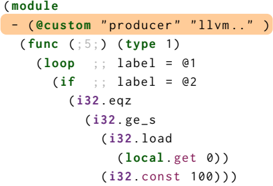
The image shows a snippet of code written in LLVM Intermediate Representation (IR), a low-level virtual instruction set used in compiler infrastructure. The code defines a module, a custom producer, and a function with control flow structures (loop, conditional).
### Components/Axes
- **Module Declaration**:
- `(module`
- **Custom Producer**:
- `- (@custom "producer" "llvm...")`
- **Function Definition**:
- `(func (;5;) (type 1)`
- **Control Flow**:
- `(loop ;: label = @1`
- `(if ;: label = @2`
- **Operations**:
- `(i32.eqz`
- `(i32.ge_s`
- `(i32.load`
- `(local.get 0)`
- `(i32.const 100)))`
### Detailed Analysis
1. **Module**:
- The code begins with `(module`, indicating the start of an LLVM module.
2. **Custom Producer**:
- `- (@custom "producer" "llvm...")` defines a custom producer with a name "producer" and a comment "llvm...".
3. **Function**:
- `(func (;5;) (type 1)` declares a function with 5 parameters (denoted by `;5;`) and a return type of `type 1` (likely `i32`).
4. **Loop**:
- `(loop ;: label = @1` introduces a loop with a label `@1`.
5. **Conditional**:
- `(if ;: label = @2` introduces an `if` statement with a label `@2`.
6. **Operations**:
- `(i32.eqz`: Checks if a value is zero.
- `(i32.ge_s`: Signed greater-than-or-equal comparison.
- `(i32.load`: Loads a value from memory.
- `(local.get 0)`: Retrieves the value at index 0 from the local variable list.
- `(i32.const 100))`: Creates a constant integer value of 100.
### Key Observations
- The code uses LLVM IR syntax, which is structured with parentheses and keywords like `func`, `loop`, `if`, and `local.get`.
- Labels `@1` and `@2` are used to mark control flow points (e.g., loop and conditional branches).
- The function includes memory operations (`i32.load`) and arithmetic operations (`i32.const`, `i32.eqz`).
### Interpretation
This code snippet represents a low-level implementation of a custom producer in LLVM IR. The `loop` and `if` statements suggest iterative or conditional logic, while `i32.load` and `i32.const` indicate memory and constant value handling. The custom producer (`"producer"`) likely generates or modifies code for a specific target, such as optimizing or translating high-level code into machine code. The use of `local.get 0` implies interaction with local variables, and `i32.const 100` provides a fixed value for computation.
The structure reflects typical LLVM IR patterns for control flow and data manipulation, emphasizing the modular and procedural nature of compiler design.