## Diagram: Prompting Strategy for Black-box API
### Overview
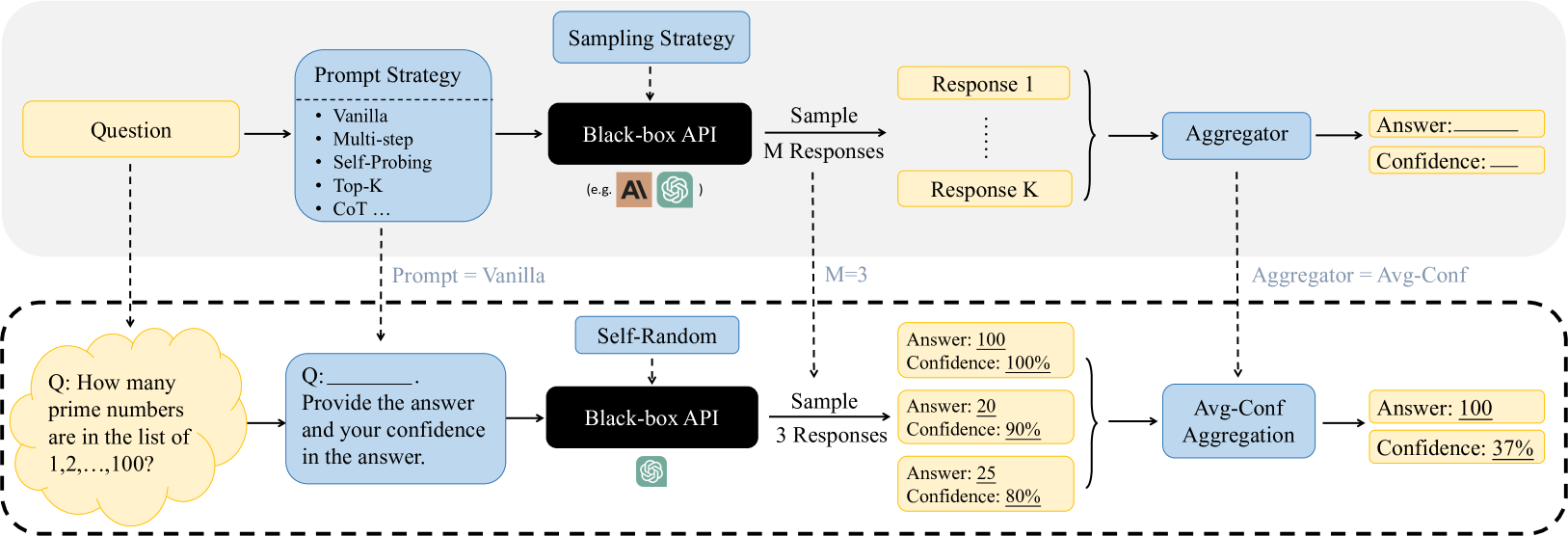
This diagram illustrates a prompting strategy for interacting with a black-box API (likely a Large Language Model). It depicts two distinct prompting approaches – a general "Sampling Strategy" and a specific "Self-Random" strategy – and how they lead to generating responses, aggregating them, and ultimately producing an answer with a confidence score. The diagram uses a flow-chart style with boxes representing processes and arrows indicating the flow of information.
### Components/Axes
The diagram is composed of several key components:
* **Question:** Represented by an oval shape, this is the initial input to the system. An example question is provided: "Q: How many prime numbers are in the list of 1,2,...,100?".
* **Prompt Strategy:** A rectangular box listing different prompting techniques: "Vanilla", "Multi-step", "Self-Probing", "Top-K", "CoT...".
* **Black-box API:** Represented by a black rectangle with the label "i.e. AI".
* **Sampling Strategy:** A light-yellow rounded rectangle indicating the overall approach.
* **Response 1 to Response K:** Represented by rectangles, these are the outputs from the Black-box API.
* **Aggregator:** A rectangular box that combines the responses.
* **Answer:** A light-blue rectangle representing the final output, accompanied by a "Confidence" score.
* **Self-Random:** A light-blue rounded rectangle representing a specific prompting approach.
* **Avg-Conf Aggregation:** A rectangular box indicating the aggregation method used in the Self-Random strategy.
### Detailed Analysis or Content Details
**Upper Branch (Sampling Strategy):**
1. A "Question" is fed into the "Prompt Strategy" box.
2. The "Prompt Strategy" is then sent to the "Black-box API".
3. The "Black-box API" generates "M Responses" (Response 1 to Response K). The number of responses is denoted by 'M'.
4. These responses are then passed to an "Aggregator".
5. The "Aggregator" produces an "Answer" with an associated "Confidence" score.
**Lower Branch (Self-Random):**
1. The "Prompt" is set to "Vanilla".
2. A modified "Question" is presented: "Q: Provide the answer and your confidence in the answer."
3. This modified question is sent to the "Black-box API" (represented by a swirling icon).
4. The "Black-box API" generates "3 Responses".
* Response 1: Answer: 100, Confidence: 100%
* Response 2: Answer: 20, Confidence: 90%
* Response 3: Answer: 25, Confidence: 80%
5. These responses are passed to an "Avg-Conf Aggregation" aggregator.
6. The "Avg-Conf Aggregation" produces a final "Answer: 100" with a "Confidence: 37%".
### Key Observations
* The diagram highlights two different approaches to prompting a black-box API.
* The "Self-Random" strategy explicitly requests confidence scores from the API.
* The "Avg-Conf Aggregation" suggests that the final confidence score is calculated as the average of the confidence scores from individual responses.
* The example question focuses on a mathematical problem (prime numbers).
* The confidence scores vary significantly across the responses in the "Self-Random" branch.
### Interpretation
The diagram demonstrates a method for improving the reliability of responses from a black-box API by employing multiple prompts and aggregating the results. The "Sampling Strategy" represents a more general approach, while the "Self-Random" strategy is a specific implementation that leverages confidence scores. The use of aggregation, particularly "Avg-Conf Aggregation", suggests an attempt to mitigate the impact of potentially inaccurate or unreliable responses from the API. The lower confidence score (37%) in the final answer of the "Self-Random" branch, despite the highest individual confidence score (100%), indicates that averaging confidence scores can sometimes lead to a lower overall confidence level, potentially due to conflicting responses. This suggests that a more sophisticated aggregation method might be needed in some cases. The diagram is a conceptual illustration of a prompting and response aggregation pipeline, likely intended for research or development in the field of AI and natural language processing.