## Image Description
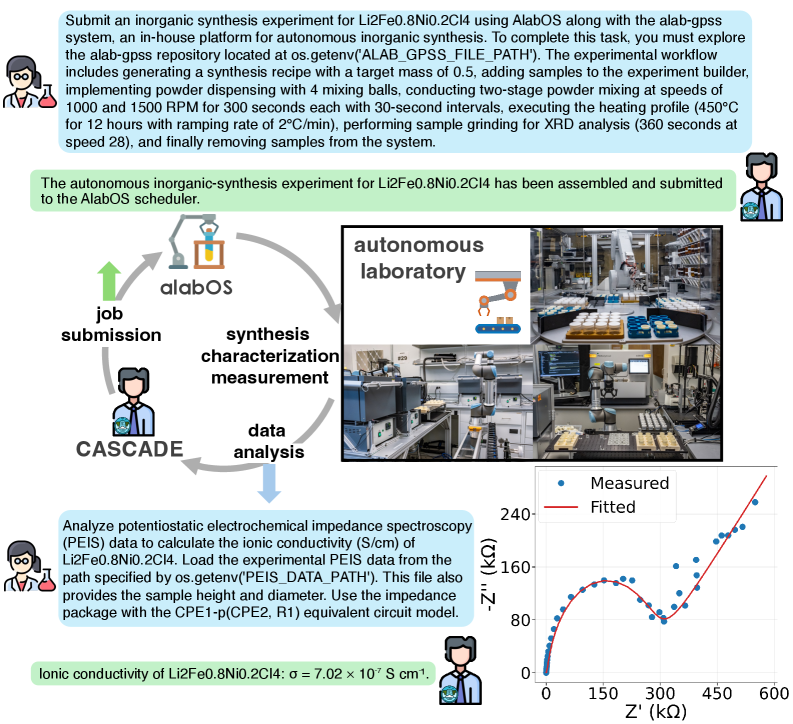
The image is a composite of several elements, including text, diagrams, and a screenshot. The primary focus is on an experimental setup for inorganic synthesis, specifically for the compound Li2Fe0.8Ni0.2Cl4. The image is divided into several sections, each containing different types of information.
### Textual Information
1. **Experimental Instructions**:
- The text provides a detailed description of the experimental workflow for synthesizing Li2Fe0.8Ni0.2Cl4 using AlabOS and the alab-gpss system.
- It outlines the steps involved in generating a synthesis recipe, adding samples to the experiment builder, conducting powder mixing, grinding samples, and removing them from the system.
- The experimental conditions include a target mass of 0.5, mixing speeds of 1000 and 1500 RPM, and a ramping rate of 2°C/min.
2. **Acknowledgment**:
- A note states that the autonomous inorganic-synthesis experiment for Li2Fe0.8Ni0.2Cl4 has been assembled and submitted to the AlabOS scheduler.
3. **Analysis and Measurement**:
- The text mentions the analysis of potentiostatic electrochemical impedance spectroscopy (PEIS) data to calculate the ionic conductivity of Li2Fe0.8Ni0.2Cl4.
- It specifies the use of the CPE1-p(CPE2, R1) equivalent circuit model and provides the ionic conductivity value as 7.02 x 10^-7 S cm^-1.
### Diagrams
1. **Flowchart**:
- The flowchart illustrates the experimental workflow, starting from job submission, through synthesis characterization measurement, and ending with data analysis.
- It uses arrows to indicate the sequence of steps and includes icons representing each stage.
2. **Graph**:
- A graph shows the impedance (Z') as a function of frequency (ω) for the synthesized Li2Fe0.8Ni0.2Cl4.
- The graph includes a measured data point and a fitted curve, indicating the analysis of PEIS data.
### Screenshot
1. **UI Elements**:
- The screenshot displays a user interface with various buttons and options, likely for managing the experimental workflow.
- It includes a search bar, a menu, and a status indicator.
### Interpretation
The image provides a comprehensive overview of the experimental setup and analysis for synthesizing Li2Fe0.8Ni0.2Cl4 using AlabOS and the alab-gpss system. The experimental workflow includes generating a synthesis recipe, conducting powder mixing, grinding samples, and removing them from the system. The analysis of potentiostatic electrochemical impedance spectroscopy (PEIS) data is used to calculate the ionic conductivity of the synthesized compound. The ionic conductivity value is provided as 7.02 x 10^-7 S cm^-1. The flowchart and graph illustrate the sequence of steps and the results of the analysis, respectively. The screenshot shows the user interface for managing the experimental workflow.