## Line Chart: Performance Comparison of SymDQN Variants
### Overview
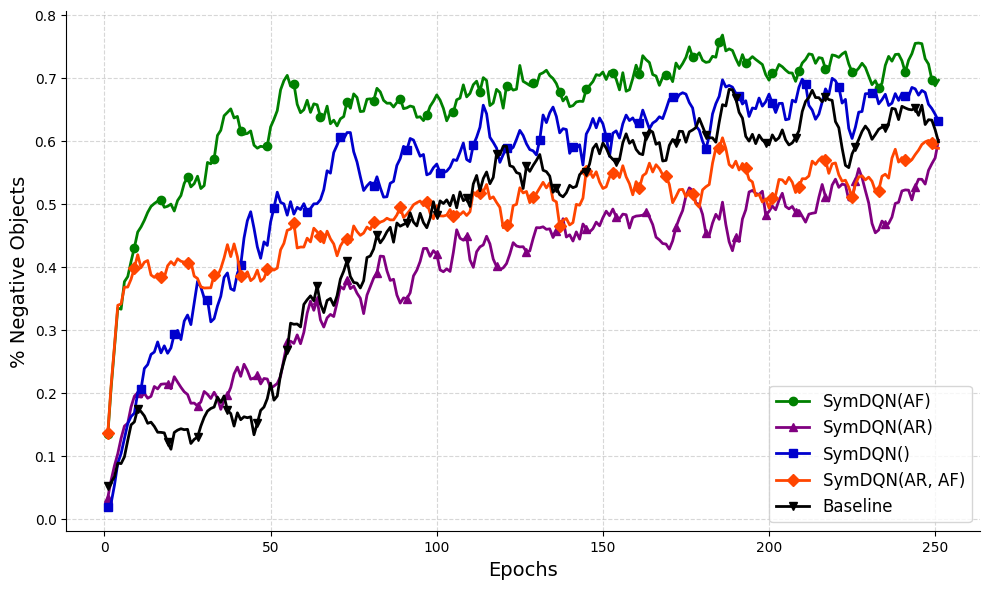
This image displays a line chart comparing the performance of five different reinforcement learning models, labeled as variants of "SymDQN" and a "Baseline," over the course of 250 training epochs. The Y-axis represents the "% Negative Objects" (presumably a metric of success or task completion), while the X-axis represents the training time in "Epochs."
### Components/Axes
* **X-Axis:** Labeled "Epochs," ranging from 0 to 250, with major grid lines every 50 epochs.
* **Y-Axis:** Labeled "% Negative Objects," ranging from 0.0 to 0.8, with major grid lines every 0.1 units.
* **Legend:** Located in the bottom-right quadrant of the chart.
* **SymDQN(AF):** Green line with circle markers.
* **SymDQN(AR):** Purple line with triangle markers.
* **SymDQN():** Blue line with square markers.
* **SymDQN(AR, AF):** Orange line with diamond markers.
* **Baseline:** Black line with inverted triangle markers.
### Detailed Analysis
The chart tracks the performance of five models. Below is the trend analysis for each series:
* **SymDQN(AF) (Green, Circles):**
* **Trend:** This model shows the most rapid initial growth and maintains the highest performance throughout the duration of the training.
* **Values:** It starts at approximately 0.15 at epoch 0, climbs steeply to ~0.5 by epoch 20, and continues a steady, fluctuating upward trend, peaking near 0.75 around epoch 180, before settling near 0.7 at epoch 250.
* **SymDQN() (Blue, Squares):**
* **Trend:** Shows a strong, consistent upward trajectory.
* **Values:** Starts near 0.02, rises to ~0.3 by epoch 30, and continues to climb, reaching ~0.6 by epoch 150. It fluctuates between 0.6 and 0.7 for the remainder of the training, ending near 0.63.
* **Baseline (Black, Inverted Triangles):**
* **Trend:** Starts with the lowest performance but exhibits a very strong, consistent upward slope, eventually overtaking the orange and purple lines.
* **Values:** Starts near 0.05, remains low until epoch 50 (~0.25), then accelerates significantly, reaching ~0.6 by epoch 250.
* **SymDQN(AR, AF) (Orange, Diamonds):**
* **Trend:** Starts with a very strong initial jump but plateaus earlier than the other models.
* **Values:** Starts at ~0.15, jumps to ~0.4 by epoch 10. It continues a slow, steady climb, reaching ~0.5 by epoch 100, and ends near 0.6 at epoch 250.
* **SymDQN(AR) (Purple, Triangles):**
* **Trend:** Generally the lowest performing model for the majority of the training duration.
* **Values:** Starts near 0.02, rises to ~0.2 by epoch 10, and maintains a slow, steady growth, ending near 0.58 at epoch 250.
### Key Observations
* **Dominance of AF:** The "AF" component appears to be the primary driver of high performance, as the `SymDQN(AF)` model is consistently the top performer.
* **Early vs. Late Performance:** The `SymDQN(AR, AF)` model demonstrates excellent "cold start" performance (rising quickly in the first 10 epochs) but fails to maintain that lead, being overtaken by the `SymDQN(AF)` and `SymDQN()` models.
* **Baseline Competitiveness:** The `Baseline` model is surprisingly robust, starting from the bottom but showing a consistent learning curve that eventually matches or exceeds the `SymDQN(AR)` and `SymDQN(AR, AF)` variants.
### Interpretation
The data suggests that the "AF" modification is highly beneficial for the model's ability to identify or process "Negative Objects." Conversely, the "AR" modification, when used alone (`SymDQN(AR)`), appears to hinder performance compared to the baseline.
The combination of both (`SymDQN(AR, AF)`) results in a model that learns very quickly initially but suffers from a lower performance ceiling compared to the `SymDQN(AF)` variant. This implies a potential trade-off: "AR" might help with early-stage exploration or stability, but "AF" is necessary for achieving higher accuracy in the later stages of training. The `Baseline` model's steady performance suggests that the `SymDQN` modifications (specifically AR) might introduce some instability or slower convergence in the mid-to-late training phases.