## Heatmap: Transition Probabilities Heatmap
### Overview
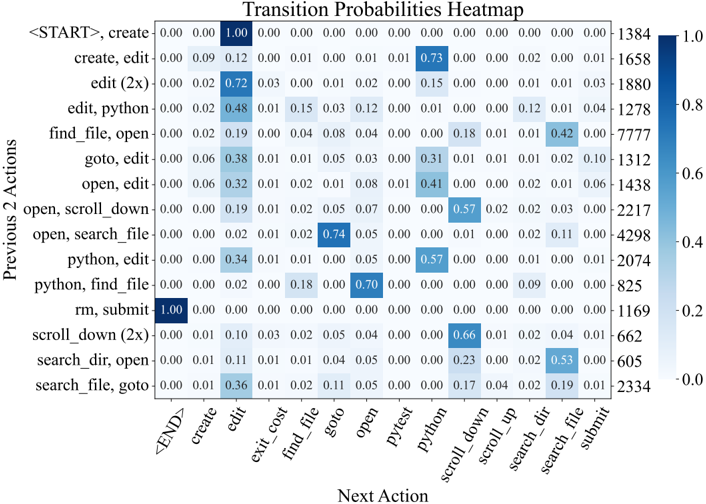
This heatmap visualizes transition probabilities between pairs of actions in a workflow or system. Each cell represents the likelihood of transitioning from a "Previous 2 Actions" (y-axis) to a "Next Action" (x-axis). Darker blue cells indicate higher probabilities, with values ranging from 0.0 to 1.0.
### Components/Axes
- **Y-Axis (Previous 2 Actions)**:
`<START>`, `create`, `create, edit`, `edit (2x)`, `edit, python`, `find_file, open`, `goto, edit`, `open, edit`, `open, scroll_down`, `open, search_file`, `python, edit`, `python, find_file`, `rm, submit`, `scroll_down (2x)`, `search_dir, open`, `search_file, goto`.
- **X-Axis (Next Action)**:
`<END>`, `create`, `edit`, `exit_cost`, `find_file`, `goto`, `open`, `pytest`, `python`, `scroll_down`, `scroll_up`, `search_dir`, `search_file`, `submit`.
- **Color Legend**:
A gradient from light blue (0.0) to dark blue (1.0), labeled on the right axis with values like 0.0, 0.2, 0.4, 0.6, 0.8, 1.0.
### Detailed Analysis
- **Key Values**:
- `<START> → create`: 1.00 (darkest blue, indicating certainty).
- `edit → edit`: 0.72 (high self-transition probability).
- `search_dir, open → search_file, goto`: 0.36 (moderate transition).
- `python, find_file → python`: 0.18 (low probability).
- `rm, submit → <END>`: 1.00 (terminal action).
- **Trends**:
- **Diagonal Dominance**: High probabilities along the diagonal (e.g., `create → create`, `edit → edit`) suggest habitual or sequential actions.
- **Low Off-Diagonal Values**: Most transitions between dissimilar actions (e.g., `python, find_file → python`) have low probabilities (<0.2).
- **Clustered Patterns**: Groups like `edit, python` and `search_file, goto` show moderate transitions to related actions (e.g., `edit, python → edit`: 0.48).
### Key Observations
1. **Terminal Actions**: `<START>` and `rm, submit` have 100% certainty for their immediate next actions (`create` and `<END>`, respectively).
2. **Repetition Bias**: Actions like `edit` and `python` frequently repeat (0.72 and 0.57, respectively).
3. **Low-Probability Transitions**: Rare transitions include `python, find_file → python` (0.18) and `search_dir, open → search_dir` (0.11).
4. **Ambiguity in `<END>`**: The `<END>` action only appears as a next action for `rm, submit`, with no reverse transitions.
### Interpretation
This heatmap reveals a **strong habitual bias** in action sequences, where users or systems tend to repeat actions (e.g., editing files) rather than switching tasks. The presence of terminal actions (`<START>` and `rm, submit`) suggests a structured workflow with clear entry and exit points. Low probabilities for dissimilar transitions (e.g., `python, find_file → python`) imply that context-switching is uncommon, possibly due to workflow design or user behavior. The absence of reverse transitions for `<END>` highlights its role as a definitive endpoint.
The data could inform system optimization by identifying bottlenecks (e.g., low-probability transitions) or reinforcing high-probability paths (e.g., automating repetitive tasks). Outliers like `search_dir, open → search_file, goto` (0.36) suggest potential for improving navigation between related actions.