\n
## Diagram: Deflate/Inflate Process
### Overview
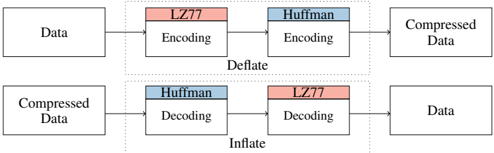
The image is a diagram illustrating the Deflate and Inflate processes, which are used for data compression and decompression respectively. It shows a two-stage process involving LZ77 and Huffman encoding/decoding. The diagram depicts a flow from "Data" to "Compressed Data" via Deflate, and from "Compressed Data" back to "Data" via Inflate.
### Components/Axes
The diagram consists of rectangular blocks representing processing stages, connected by arrows indicating the flow of data. The key components are:
* **Data:** The initial input.
* **Compressed Data:** The output after compression.
* **LZ77 Encoding:** A compression algorithm. The block is colored light red.
* **Huffman Encoding:** Another compression algorithm. The block is colored light blue.
* **LZ77 Decoding:** The decompression counterpart of LZ77 Encoding. The block is colored light red.
* **Huffman Decoding:** The decompression counterpart of Huffman Encoding. The block is colored light blue.
* **Deflate:** A label encompassing the LZ77 Encoding and Huffman Encoding stages.
* **Inflate:** A label encompassing the Huffman Decoding and LZ77 Decoding stages.
The arrows indicate the direction of data flow.
### Detailed Analysis or Content Details
The diagram shows two parallel processes:
**Deflate (Compression):**
1. Data flows from left to right.
2. First, it enters the "LZ77 Encoding" block (light red).
3. The output of LZ77 Encoding then flows into the "Huffman Encoding" block (light blue).
4. Finally, the output of Huffman Encoding results in "Compressed Data".
**Inflate (Decompression):**
1. "Compressed Data" flows from right to left.
2. First, it enters the "Huffman Decoding" block (light blue).
3. The output of Huffman Decoding then flows into the "LZ77 Decoding" block (light red).
4. Finally, the output of LZ77 Decoding results in "Data".
The diagram does not contain any numerical data or specific values. It is a conceptual representation of the process.
### Key Observations
The diagram highlights that Deflate uses a two-stage compression process, and Inflate reverses this process for decompression. The order of operations is crucial: LZ77 is applied before Huffman in compression, and Huffman is applied before LZ77 in decompression. The color coding (red for LZ77, blue for Huffman) is consistent throughout the diagram, aiding in understanding the flow.
### Interpretation
The diagram illustrates a common data compression technique. Deflate, as shown, combines the strengths of two different compression algorithms. LZ77 is effective at removing redundant sequences of data, while Huffman coding efficiently represents frequently occurring symbols with shorter codes. By combining these, Deflate achieves a good compression ratio. The Inflate process simply reverses these steps to recover the original data. This diagram is a high-level overview and doesn't delve into the specifics of how each algorithm works internally. It focuses on the overall flow and the relationship between the components. The diagram suggests a reversible process, meaning no data is lost during compression and decompression.