## Diagram: Diagnostic Reasoning with Knowledge Graph and Neural Network
### Overview
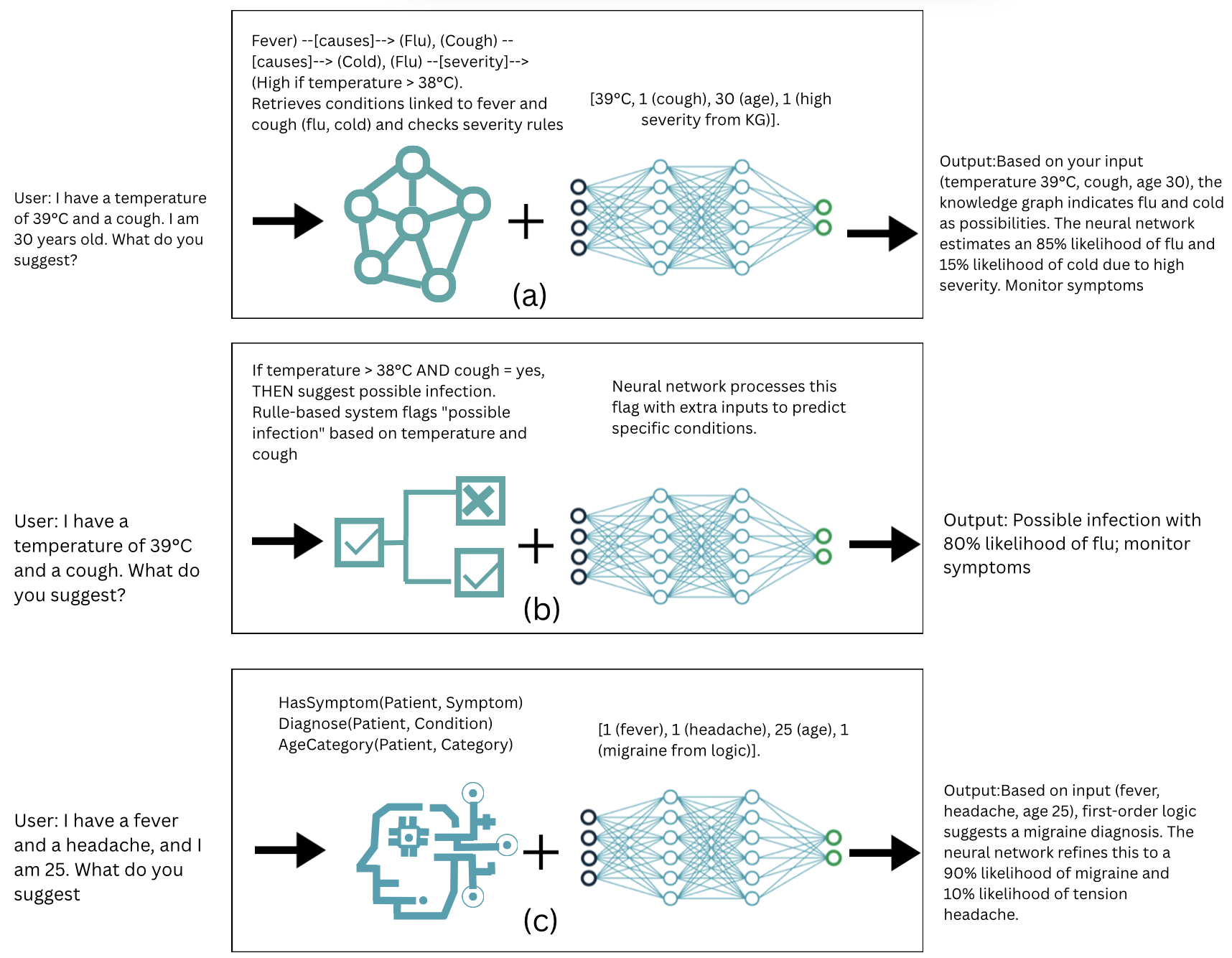
The image presents three scenarios (a, b, c) illustrating how a system diagnoses potential illnesses based on user-provided symptoms. Each scenario involves a combination of knowledge graphs, rule-based systems, and neural networks to arrive at a diagnosis and associated likelihoods.
### Components/Axes
**Scenario (a):**
* **User Input (Left):** "I have a temperature of 39°C and a cough. I am 30 years old. What do you suggest?"
* **Knowledge Graph (Center-Left):** A network representing relationships between fever, cough, flu, and cold. The graph includes the following rules:
* Fever --[causes]--> Flu, Cough
* Cough --[causes]--> Cold, Flu
* Flu --[severity]--> High (if temperature > 38°C)
* Text: "Retrieves conditions linked to fever and cough (flu, cold) and checks severity rules"
* **Neural Network (Center-Right):** A multi-layered perceptron.
* Input: [39°C, 1 (cough), 30 (age), 1 (high severity from KG)]
* **Output (Right):** "Based on your input (temperature 39°C, cough, age 30), the knowledge graph indicates flu and cold as possibilities. The neural network estimates an 85% likelihood of flu and 15% likelihood of cold due to high severity. Monitor symptoms."
**Scenario (b):**
* **User Input (Left):** "I have a temperature of 39°C and a cough. What do you suggest?"
* **Rule-Based System (Center-Left):** A system with the following rule:
* If temperature > 38°C AND cough = yes, THEN suggest possible infection.
* Text: "Rule-based system flags 'possible infection' based on temperature and cough"
* **Neural Network (Center-Right):** A multi-layered perceptron.
* Text: "Neural network processes this flag with extra inputs to predict specific conditions."
* **Output (Right):** "Possible infection with 80% likelihood of flu; monitor symptoms."
**Scenario (c):**
* **User Input (Left):** "I have a fever and a headache, and I am 25. What do you suggest?"
* **First-Order Logic (Center-Left):** A representation of symptoms and diagnoses.
* HasSymptom(Patient, Symptom)
* Diagnose(Patient, Condition)
* AgeCategory(Patient, Category)
* **Neural Network (Center-Right):** A multi-layered perceptron.
* Input: [1 (fever), 1 (headache), 25 (age), 1 (migraine from logic)]
* **Output (Right):** "Based on input (fever, headache, age 25), first-order logic suggests a migraine diagnosis. The neural network refines this to a 90% likelihood of migraine and 10% likelihood of tension headache."
### Detailed Analysis
Each scenario follows a similar pattern:
1. **User Input:** A description of symptoms and age.
2. **Reasoning System:** A knowledge graph, rule-based system, or first-order logic system processes the input.
3. **Neural Network:** A neural network refines the diagnosis and provides likelihood estimates.
4. **Output:** A diagnosis and associated likelihoods.
### Key Observations
* The system uses a combination of symbolic reasoning (knowledge graphs, rules, logic) and neural networks to diagnose illnesses.
* The neural network acts as a refinement step, adjusting the initial diagnosis based on additional factors.
* The likelihood estimates provide a measure of confidence in the diagnosis.
### Interpretation
The diagram illustrates a hybrid approach to medical diagnosis, combining the strengths of symbolic AI (knowledge representation, rule-based reasoning) and connectionist AI (neural networks). The symbolic systems provide an initial diagnosis based on established medical knowledge, while the neural network refines this diagnosis by considering additional factors and learning from data. This approach allows the system to provide more accurate and nuanced diagnoses than either approach could achieve alone. The use of likelihood estimates provides a measure of uncertainty, allowing clinicians to make informed decisions based on the available evidence.