## Hybrid AI Diagnostic Systems Diagram
### Overview
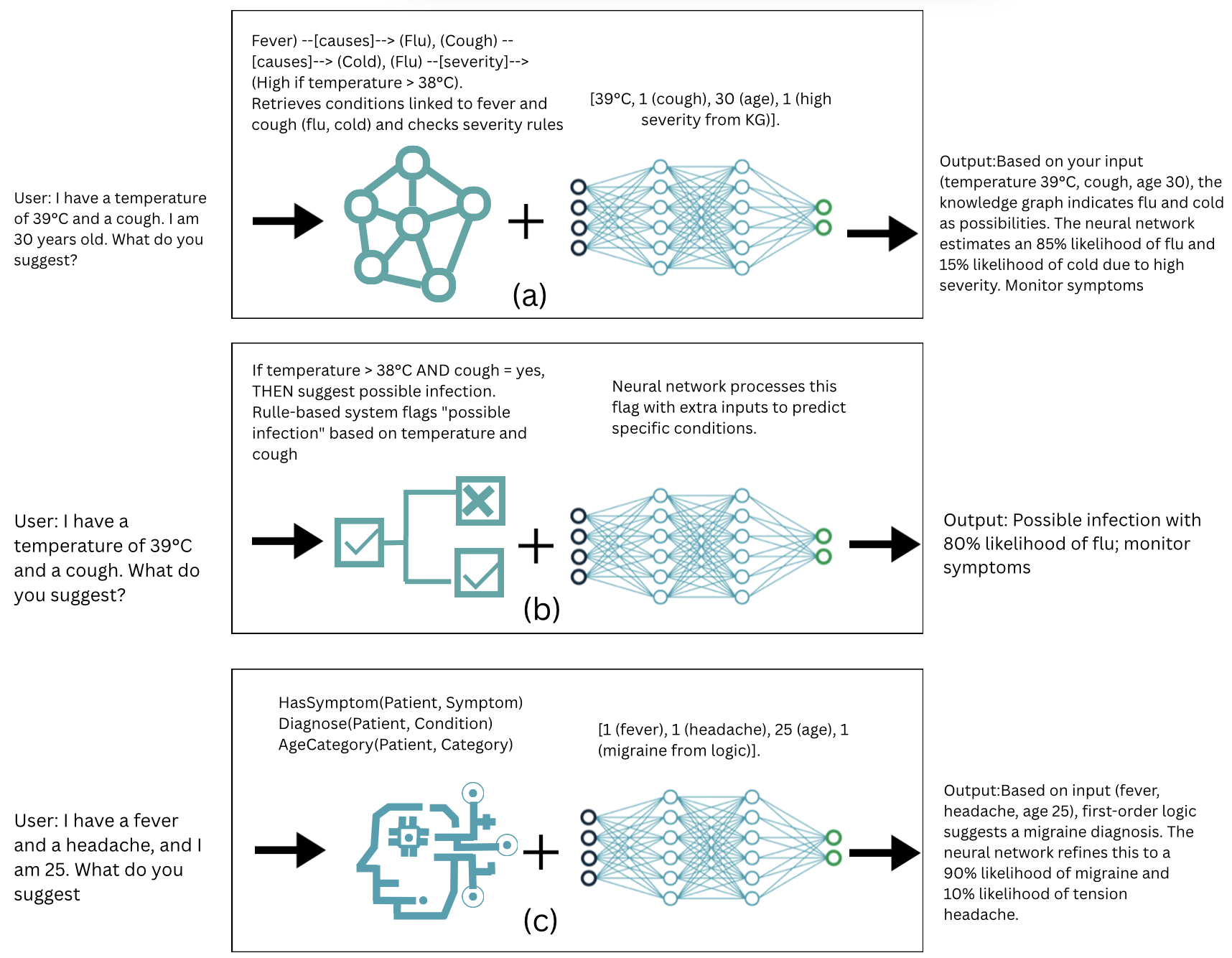
The image illustrates three distinct hybrid AI architectures for medical symptom diagnosis, each combining a symbolic AI component (Knowledge Graph, Rule-Based System, First-Order Logic) with a neural network. The diagram is structured into three horizontal panels, labeled (a), (b), and (c), each depicting a complete workflow from user query to diagnostic output.
### Components/Axes
The image is a technical diagram, not a chart. It contains no numerical axes. The primary components are:
* **User Query Text:** Positioned on the far left of each panel.
* **Symbolic AI Component:** Represented by distinct icons (a network graph, a decision tree, a logic symbol) in the center-left.
* **Neural Network:** A consistent multi-layer perceptron icon in the center-right.
* **Output Text:** Positioned on the far right of each panel.
* **Flow Arrows:** Black arrows indicating the direction of data processing from left to right.
* **Panel Labels:** "(a)", "(b)", and "(c)" centered below each respective panel.
### Detailed Analysis
#### Panel (a): Knowledge Graph + Neural Network
* **User Query (Left):** "User: I have a temperature of 39°C and a cough. I am 30 years old. What do you suggest?"
* **Symbolic Component (Center-Left):**
* **Icon:** A teal-colored network graph with interconnected nodes.
* **Text Above Icon:** "Fever) --[causes]--> (Flu), (Cough) --[causes]--> (Cold), (Flu) --[severity]--> (High if temperature > 38°C). Retrieves conditions linked to fever and cough (flu, cold) and checks severity rules"
* **Text Below Icon:** "(a)"
* **Neural Network Input (Center):** "[39°C, 1 (cough), 30 (age), 1 (high severity from KG)]."
* **Output (Right):** "Output:Based on your input (temperature 39°C, cough, age 30), the knowledge graph indicates flu and cold as possibilities. The neural network estimates an 85% likelihood of flu and 15% likelihood of cold due to high severity. Monitor symptoms"
#### Panel (b): Rule-Based System + Neural Network
* **User Query (Left):** "User: I have a temperature of 39°C and a cough. What do you suggest?"
* **Symbolic Component (Center-Left):**
* **Icon:** A teal-colored decision tree with checkmarks and an 'X'.
* **Text Above Icon:** "If temperature > 38°C AND cough = yes, THEN suggest possible infection. Rule-based system flags "possible infection" based on temperature and cough"
* **Text Below Icon:** "(b)"
* **Neural Network Description (Center):** "Neural network processes this flag with extra inputs to predict specific conditions."
* **Output (Right):** "Output: Possible infection with 80% likelihood of flu; monitor symptoms"
#### Panel (c): First-Order Logic + Neural Network
* **User Query (Left):** "User: I have a fever and a headache, and I am 25. What do you suggest"
* **Symbolic Component (Center-Left):**
* **Icon:** A teal-colored icon depicting a head profile with logic circuit elements.
* **Text Above Icon:** "HasSymptom(Patient, Symptom) Diagnose(Patient, Condition) AgeCategory(Patient, Category)"
* **Text Below Icon:** "(c)"
* **Neural Network Input (Center):** "[1 (fever), 1 (headache), 25 (age), 1 (migraine from logic)]."
* **Output (Right):** "Output:Based on input (fever, headache, age 25), first-order logic suggests a migraine diagnosis. The neural network refines this to a 90% likelihood of migraine and 10% likelihood of tension headache."
### Key Observations
1. **Consistent Hybrid Architecture:** All three systems follow the same pattern: a symbolic AI module processes raw input into structured, interpretable data or flags, which is then fed into a neural network alongside the original data for probabilistic refinement.
2. **Increasing Abstraction of Symbolic Component:** The symbolic systems progress from a data-rich Knowledge Graph (a), to a simple binary Rule-Based System (b), to abstract First-Order Logic predicates (c).
3. **Output Specificity:** The outputs vary in detail. Panel (a) provides a comparative likelihood between two conditions (flu vs. cold). Panel (b) gives a single likelihood for a flagged condition. Panel (c) provides a comparative likelihood between two related conditions (migraine vs. tension headache).
4. **Input Variation:** The user queries differ slightly. Panel (a) includes age, which is used in the neural network input. Panel (b) omits age. Panel (c) uses different symptoms (fever, headache) and age.
### Interpretation
This diagram demonstrates the concept of **neuro-symbolic AI** in a medical context. The core idea is to leverage the strengths of two AI paradigms:
* **Symbolic AI (Knowledge Graphs, Rules, Logic):** Provides **interpretability, structure, and reasoning**. It can encode medical knowledge (causes, severity rules, diagnostic predicates) and produce deterministic, explainable intermediate results (e.g., "possible infection," "migraine suggested").
* **Neural Networks:** Provide **probabilistic prediction and pattern recognition**. They take the structured output from the symbolic system and the raw data to calculate nuanced likelihoods, handling uncertainty and potentially learning from data patterns beyond the explicit rules.
The progression from (a) to (c) suggests different trade-offs. The Knowledge Graph (a) is the most knowledge-intensive and detailed. The Rule-Based system (b) is simpler and more direct but less nuanced. The First-Order Logic system (c) is highly abstract and formal, suitable for integrating with logical reasoning engines. The hybrid approach aims to create diagnostic systems that are both accurate (via neural networks) and trustworthy/explainable (via symbolic components), addressing a key limitation of pure "black-box" neural networks in critical fields like healthcare.