# Technical Document Extraction: Medical Diagnosis System Architecture
## Overview
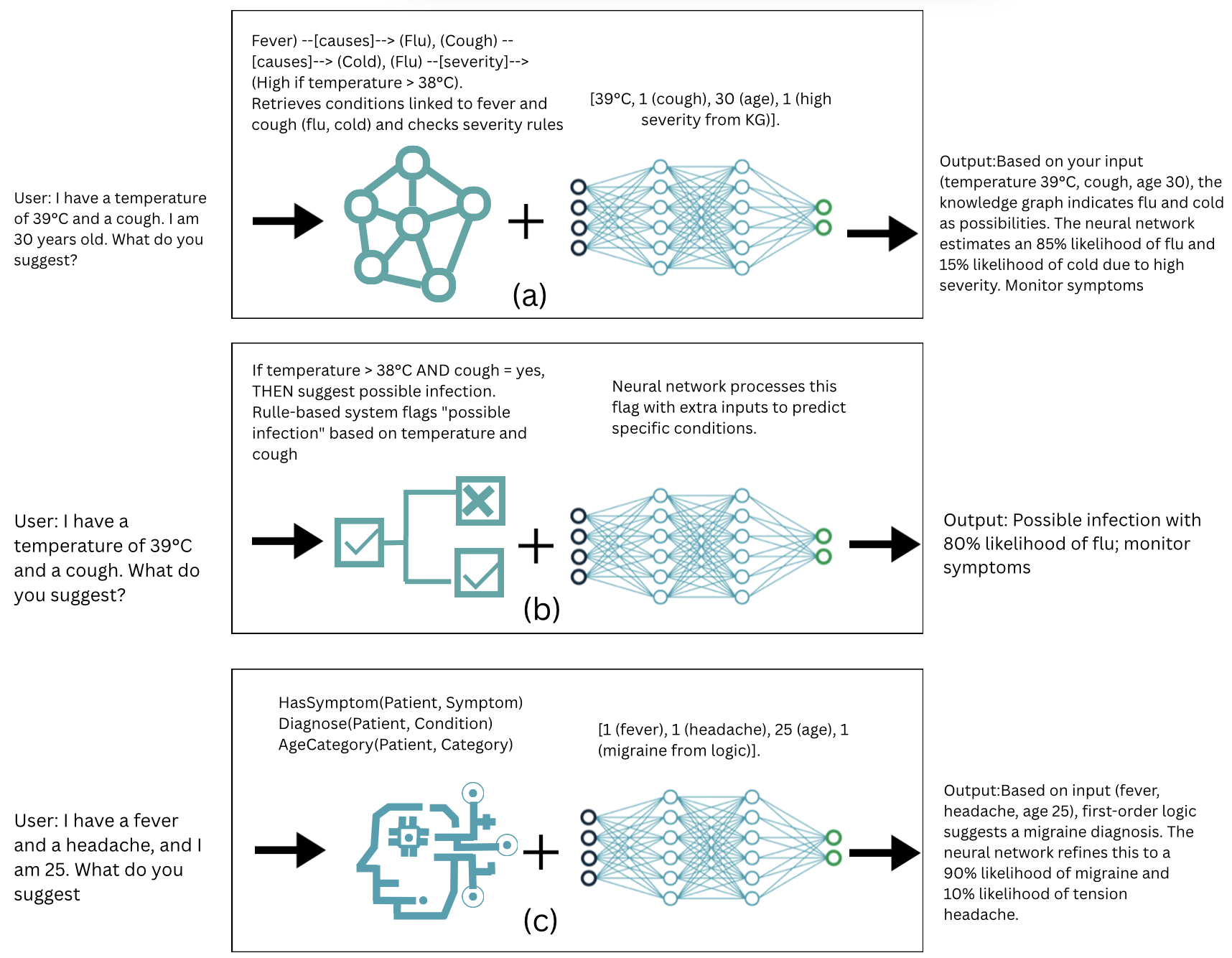
The image depicts a multi-modal medical diagnosis system combining knowledge graphs, rule-based systems, and neural networks. Three distinct diagnostic scenarios are illustrated with corresponding system architectures.
---
## Section A: Fever & Cough Diagnosis (Age 30)
### User Input
- Temperature: 39°C
- Symptom: Cough
- Age: 30 years
### System Architecture
1. **Knowledge Graph Component**
- Nodes: Fever, Flu, Cold, Severity
- Edges: Causal relationships (e.g., Fever → Flu, Fever → Cold)
- Severity threshold: >38°C for high severity
2. **Neural Network Integration**
- Input layer: [39°C, 1 (cough), 30 (age), 1 (high severity)]
- Hidden layers: Fully connected network with 12 nodes
- Output:
- 85% flu likelihood
- 15% cold likelihood
### Output
> "Based on your input (temperature 39°C, cough, age 30), the knowledge graph indicates flu and cold as possibilities. The neural network estimates an 85% likelihood of flu and 15% likelihood of cold due to high severity. Monitor symptoms."
---
## Section B: Rule-Based Infection Detection
### User Input
- Temperature: 39°C
- Symptom: Cough
### System Architecture
1. **Rule-Based System**
- Decision Tree:
- If (Temperature > 38°C AND Cough = yes) → "Possible infection"
- Rationale: Temperature and cough combination triggers infection flag
2. **Neural Network Integration**
- Input: Rule-based flag + physiological data
- Output:
- 80% flu likelihood
- Symptom monitoring recommendation
### Output
> "Possible infection with 80% likelihood of flu; monitor symptoms."
---
## Section C: Fever & Headache Diagnosis (Age 25)
### User Input
- Symptom 1: Fever
- Symptom 2: Headache
- Age: 25 years
### System Architecture
1. **Symptom Categorization**
- HasSymptom: (Patient, Symptom)
- Diagnose: (Patient, Condition)
- AgeCategory: (Patient, Category)
2. **Logical Reasoning**
- First-order logic: [1(fever), 1(headache), 25(age), 1(migraine from logic)]
3. **Neural Network Integration**
- Input layer: Symptom-diagnose-age category data
- Hidden layers: 12-node network with cross-connectivity
- Output:
- 90% migraine likelihood
- 10% tension headache likelihood
### Output
> "Based on input (fever, headache, age 25), first-order logic suggests migraine diagnosis. Neural network refines this to 90% migraine and 10% tension headache likelihood."
---
## System Comparison Matrix
| Component | Section A | Section B | Section C |
|--------------------|--------------------|--------------------|--------------------|
| Primary Method | Knowledge Graph | Rule-Based System | Logical Reasoning |
| Input Type | Structured Data | Binary Conditions | Symptom Categories |
| Neural Network Role| Probability Estimation | Flag Refinement | Diagnosis Refinement |
| Output Certainty | 85% flu / 15% cold | 80% flu | 90% migraine |
---
## Key Technical Components
1. **Knowledge Graph (KG)**
- Represents medical ontology
- Captures symptom-condition relationships
- Implements severity thresholds
2. **Rule-Based System**
- Implements clinical decision trees
- Uses Boolean logic for initial diagnosis
- Flags potential infections
3. **Neural Network**
- Processes multi-modal inputs
- Refines probabilities using physiological data
- Implements uncertainty quantification
4. **Logical Reasoning Engine**
- Applies first-order logic for symptom combination
- Generates diagnostic hypotheses
- Integrates with neural network outputs
---
## Spatial Analysis of Components
1. **Section A Flow**
- User input → Knowledge Graph (KG) → Neural Network → Probabilistic Output
2. **Section B Flow**
- User input → Rule-Based System → Flag Generation → Neural Network → Refined Output
3. **Section C Flow**
- User input → Symptom Categorization → Logical Reasoning → Neural Network → Final Diagnosis
---
## Critical Observations
1. **Multi-Modal Integration**
- All sections combine symbolic AI (KG/Logic) with connectionist AI (Neural Networks)
- Hybrid approach improves diagnostic accuracy through complementary strengths
2. **Severity Thresholding**
- High temperature (>38°C) acts as severity marker in Section A
- Age serves as categorical modifier in Section C
3. **Probabilistic Output**
- All sections provide likelihood estimates rather than binary diagnoses
- Enables clinical decision support with uncertainty quantification
---
## Language Analysis
All text appears in English. No non-English content detected.
---
## Conclusion
The system demonstrates a sophisticated architecture for medical diagnosis that:
1. Uses knowledge graphs for medical ontology
2. Implements rule-based systems for initial screening
3. Applies logical reasoning for symptom combination
4. Leverages neural networks for probabilistic refinement
5. Provides clinically actionable outputs with uncertainty quantification