## Text-Based Comparison of MCQA Models
### Overview
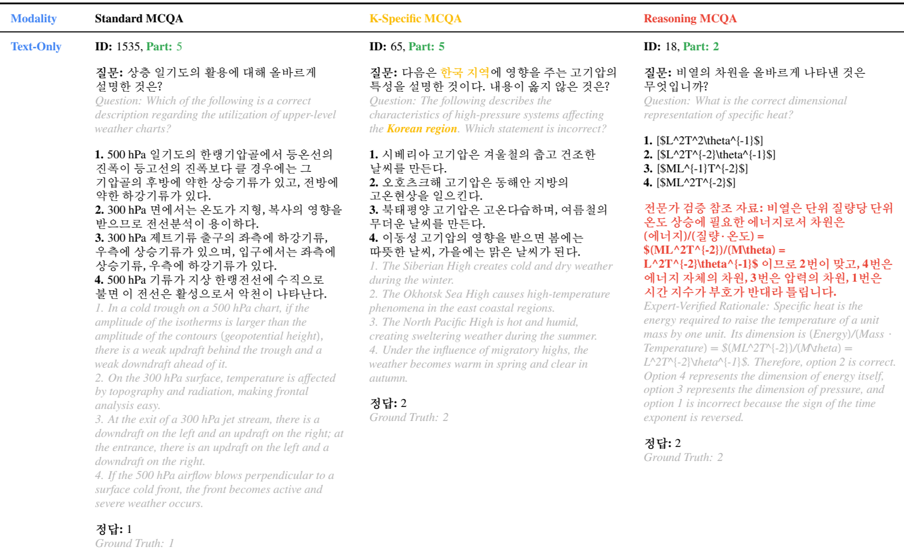
The image presents a comparative analysis of three multiple-choice question answering (MCQA) models: **Standard MCQA**, **K-Specific MCQA**, and **Reasoning MCQA**. Each model is represented by two sections (ID and Part numbers) with Korean text content, including questions, answer options, and ground truth labels. The structure emphasizes linguistic and reasoning capabilities across different configurations.
---
### Components/Axes
- **Columns**: Three vertical sections labeled by model type:
1. **Standard MCQA** (Text-Only modality)
2. **K-Specific MCQA** (Korean-specific adaptation)
3. **Reasoning MCQA** (Expert-verified rationale)
- **Rows**: Each model section contains:
- **ID/Part**: Unique identifiers for question sets (e.g., ID: 15355, Part: 5).
- **Question**: A Korean-language query with embedded technical context.
- **Answer Options**: Four labeled choices (1–4) in Korean.
- **Ground Truth**: Correct answer indicator (정답) with numerical value.
---
### Detailed Analysis
#### Standard MCQA (ID: 15355, Part: 5)
- **Question**:
"질문: 상층 일기도의 활용에 대해 올바르게 설명한 것은?"
*Translation*: "Which of the following correctly describes the utilization of upper-level weather charts?"
- **Options**:
1. 500 hPa 일기도의 한랭기압골에서 등온선의 전폭이 등고선의 전폭보다 클 경우에...
2. 300 hPa 면에서는 온도가 지형, 복사의 영향을 받으므로 전선분석이 용이하다.
3. 300 hPa 제트기류 출구의 좌측에 하강기류, 우측에 상승기류가 있으며...
4. 500 hPa 기류가 지상 한랭전선에 수직으로 불면 이 전선은 활성으로서 악천이 나타난다.
- **Ground Truth**: 정답: 1
*Translation*: Correct answer: 1
#### K-Specific MCQA (ID: 65, Part: 5)
- **Question**:
"질문: 다음은 한국 지역에 영향을 주는 고기압의 특성을 설명한 것이다. 다음이 옳지 않은 것은?"
*Translation*: "Which statement is incorrect regarding high-pressure systems affecting the Korean region?"
- **Options**:
1. 시베리아 고기압은 겨울철의 춥고 건조한 날씨를 만든다.
2. 오호츠크해 고기압은 동해안 지방의 고온현상을 일으킨다.
3. 북태평양 고기압은 고온다습하며, 여름철의 무더운 날씨를 만든다.
4. 이동성 고기압의 영향을 받으면 봄에는 따뜻한 날씨, 가을에는 맑은 날씨가 된다.
- **Ground Truth**: 정답: 2
*Translation*: Correct answer: 2
#### Reasoning MCQA (ID: 18, Part: 2)
- **Question**:
"질문: 비열의 차원을 올바르게 나타낸 것은 무엇입니까?"
*Translation*: "What is the correct dimensional representation of specific heat?"
- **Options**:
1. [SL^2T^2\\theta^(-1)]
2. [SL^2T^(-2)\\theta^(-1)]
3. [SML^(-1)T^(-2)]
4. [SML^2T^(-2)]
- **Ground Truth**: 정답: 2
*Translation*: Correct answer: 2
- **Expert Verification**:
- Option 2 matches the formula for specific heat:
$ \text{Specific Heat} = \frac{\text{Energy}}{\text{Mass} \cdot \Delta\text{Temperature}} $
- Option 1 reverses the time exponent, making it incorrect.
---
### Key Observations
1. **Standard MCQA** focuses on atmospheric phenomena (e.g., jet streams, temperature gradients).
2. **K-Specific MCQA** emphasizes regional meteorological impacts (e.g., Siberian High, Okhotsk Sea).
3. **Reasoning MCQA** tests dimensional analysis and formula derivation (e.g., specific heat units).
---
### Interpretation
- The **Standard MCQA** evaluates foundational knowledge of weather systems, while the **K-Specific MCQA** tailors questions to Korean geographic and climatic contexts.
- The **Reasoning MCQA** introduces mathematical rigor, requiring understanding of physical formulas (e.g., specific heat capacity).
- The inclusion of **ground truth labels** (정답) suggests these are test datasets for model evaluation, with Part 5 and Part 2 likely representing different difficulty tiers or question categories.
- The **Reasoning MCQA** explicitly references "Expert-Verified Rationale," indicating a focus on logical deduction rather than rote memorization.
This structure highlights how each model adapts to linguistic specificity, regional relevance, and analytical depth, providing a framework for evaluating MCQA performance across diverse cognitive demands.