## Chart Type: Line Chart: Proportion of Flips by Iteration for Qwen2.5-3B
### Overview
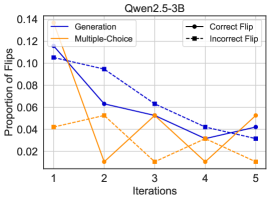
This image displays a line chart titled "Qwen2.5-3B", illustrating the "Proportion of Flips" across five "Iterations" for four different data series. The chart uses distinct line styles (solid vs. dashed) and colors (dark blue vs. orange) with unique markers (squares vs. circles) to represent these series.
### Components/Axes
* **Chart Title**: "Qwen2.5-3B" (positioned at the top-center).
* **Y-axis Label**: "Proportion of Flips" (positioned vertically along the left side).
* **Y-axis Scale**: Ranges from 0.00 to 0.14, with major tick marks at 0.02 intervals (0.02, 0.04, 0.06, 0.08, 0.10, 0.12, 0.14).
* **X-axis Label**: "Iterations" (positioned horizontally at the bottom-center).
* **X-axis Scale**: Ranges from 1 to 5, with major tick marks at each integer (1, 2, 3, 4, 5).
* **Legend**: Positioned at the top-center of the plot area, visually divided into two boxes.
* **Left Legend Box**:
* **Generation**: Represented by a solid dark blue line with square markers.
* **Multiple-Choice**: Represented by a solid orange line with circle markers.
* **Right Legend Box**:
* **Correct Flip**: Represented in the legend by a solid dark blue line with circle markers.
* **CRITICAL DISCREPANCY**: On the actual chart, the line corresponding to "Correct Flip" is a **dashed orange line with circle markers**. The legend's visual representation for "Correct Flip" (solid dark blue line with circle markers) does not match the plotted data series.
* **Incorrect Flip**: Represented by a dashed dark blue line with square markers.
### Detailed Analysis
The chart presents four data series, tracking their "Proportion of Flips" over five "Iterations":
1. **Generation** (Solid dark blue line with square markers):
* **Trend**: This series generally shows a decreasing trend.
* **Data Points**:
* Iteration 1: Approximately 0.105
* Iteration 2: Approximately 0.063
* Iteration 3: Approximately 0.055
* Iteration 4: Approximately 0.042
* Iteration 5: Approximately 0.032
* **Observation**: Starts as one of the highest values, drops sharply by Iteration 2, then continues a more gradual decline to its lowest point at Iteration 5.
2. **Multiple-Choice** (Solid orange line with circle markers):
* **Trend**: This series exhibits a highly volatile, oscillating pattern.
* **Data Points**:
* Iteration 1: Approximately 0.115
* Iteration 2: Approximately 0.010
* Iteration 3: Approximately 0.052
* Iteration 4: Approximately 0.010
* Iteration 5: Approximately 0.052
* **Observation**: Starts as the highest value, drops dramatically to its minimum at Iteration 2, rises significantly by Iteration 3, drops sharply again to its minimum at Iteration 4, and then rises significantly again by Iteration 5, ending at the same value as Iteration 3.
3. **Correct Flip** (Dashed orange line with circle markers - *Note: Legend visual is solid dark blue circle*):
* **Trend**: This series also shows an oscillating pattern, somewhat inverse to "Multiple-Choice" in its later stages.
* **Data Points**:
* Iteration 1: Approximately 0.042
* Iteration 2: Approximately 0.053
* Iteration 3: Approximately 0.010
* Iteration 4: Approximately 0.010
* Iteration 5: Approximately 0.053
* **Observation**: Starts at a moderate level, rises slightly by Iteration 2, then drops sharply to its minimum at Iteration 3 and remains there for Iteration 4, before rising sharply by Iteration 5 to its highest point.
4. **Incorrect Flip** (Dashed dark blue line with square markers):
* **Trend**: This series generally shows a decreasing trend, with a slight rebound at the end.
* **Data Points**:
* Iteration 1: Approximately 0.105
* Iteration 2: Approximately 0.095
* Iteration 3: Approximately 0.063
* Iteration 4: Approximately 0.032
* Iteration 5: Approximately 0.042
* **Observation**: Starts high, shows a consistent downward trend until Iteration 4, where it reaches its lowest point, then slightly increases by Iteration 5.
### Key Observations
* At Iteration 1, "Multiple-Choice" has the highest proportion of flips (~0.115), followed closely by "Generation" and "Incorrect Flip" (both ~0.105). "Correct Flip" is significantly lower (~0.042).
* "Generation" and "Incorrect Flip" (both dark blue lines) generally show decreasing trends, suggesting a reduction in "flips" over iterations for these categories, although "Incorrect Flip" sees a slight increase at Iteration 5.
* "Multiple-Choice" and "Correct Flip" (both orange lines) exhibit highly volatile, oscillating behavior, with sharp drops and rises.
* "Multiple-Choice" and "Correct Flip" both reach their minimum "Proportion of Flips" at Iterations 2 and 4, and Iterations 3 and 4 respectively, indicating periods of very low flip rates.
* At Iteration 5, "Multiple-Choice" and "Correct Flip" both show a significant increase in the proportion of flips, reaching approximately 0.052-0.053.
* The "Generation" line consistently decreases, ending as the lowest proportion of flips at Iteration 5 (~0.032).
* The "Incorrect Flip" line crosses below the "Generation" line between Iteration 4 and 5.
### Interpretation
The chart titled "Qwen2.5-3B" likely presents performance metrics related to a model or system, where "flips" represent a specific type of event or error, and "iterations" denote stages of training, refinement, or testing.
The general downward trend for "Generation" and "Incorrect Flip" suggests that the Qwen2.5-3B model, when operating in a "Generation" mode or experiencing "Incorrect Flips," tends to reduce the proportion of these flips as iterations progress. This could imply improvement or stabilization in these aspects. The slight increase in "Incorrect Flip" at Iteration 5 might warrant further investigation, as it deviates from the overall decreasing trend.
The highly volatile behavior of "Multiple-Choice" and "Correct Flip" is particularly notable. The sharp drops to near-zero proportions at certain iterations, followed by significant rebounds, suggest an unstable or highly sensitive process. It's possible that the "Multiple-Choice" task or the mechanism for "Correct Flips" is subject to significant fluctuations, perhaps due to hyperparameter changes, data batch variations, or inherent complexities of the task. The inverse relationship observed between "Multiple-Choice" and "Correct Flip" at Iterations 3-5 (where "Multiple-Choice" rises while "Correct Flip" drops, then both rise together) could indicate a complex interplay between these two metrics.
The discrepancy in the legend for "Correct Flip" (showing a solid dark blue line with circle markers, while the actual line is dashed orange with circle markers) is a significant flaw in the chart's presentation. Assuming the dashed orange line with circle markers *is* "Correct Flip," its behavior, alongside "Multiple-Choice," highlights areas of instability compared to the more consistent, decreasing trends of "Generation" and "Incorrect Flip." This suggests that the "flip" behavior is highly dependent on the task context ("Generation" vs. "Multiple-Choice") and the outcome ("Correct Flip" vs. "Incorrect Flip"). Further analysis would be needed to understand the underlying causes of these fluctuations and their implications for the Qwen2.5-3B model's overall performance.