## Flowchart: Academic Paper Analysis System
### Overview
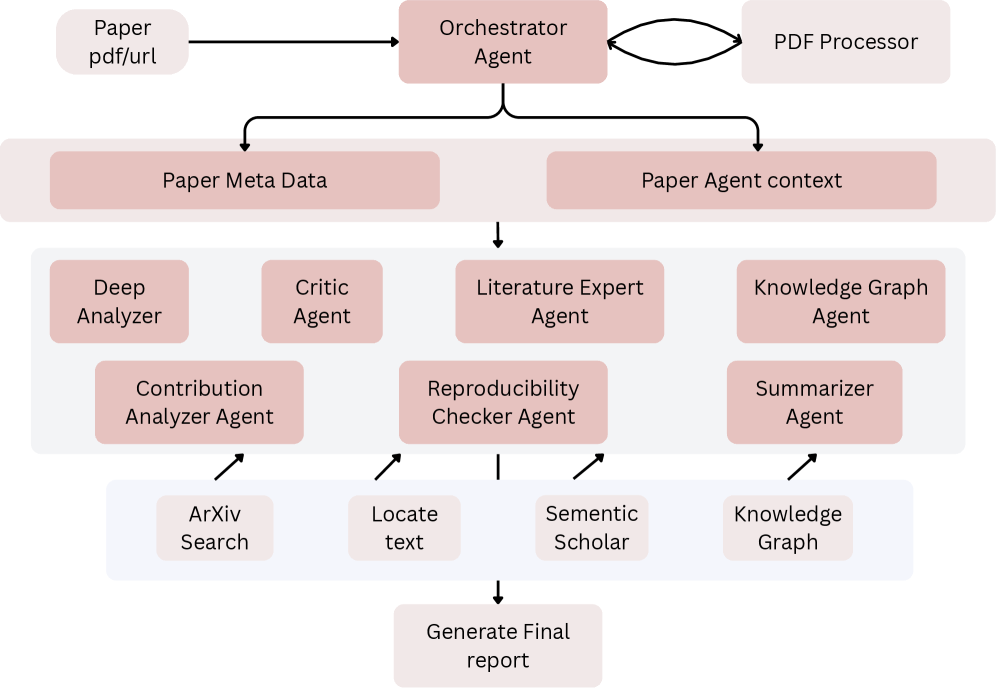
The flowchart depicts a multi-agent system for analyzing academic papers, starting from a PDF/URL input and culminating in a final report. The system employs hierarchical processing through specialized agents, with feedback loops and cross-agent dependencies.
### Components/Axes
1. **Input Layer**
- Paper (pdf/url) → Orchestrator Agent
- Orchestrator Agent → PDF Processor (feedback loop)
2. **Core Processing**
- Orchestrator Agent → Paper Meta Data
- Orchestrator Agent → Paper Agent context
3. **Specialized Agents**
- **Deep Analyzer** (inputs: Paper Meta Data)
- **Critic Agent** (inputs: Paper Meta Data)
- **Literature Expert Agent** (inputs: Paper Meta Data)
- **Knowledge Graph Agent** (inputs: Paper Meta Data)
- **Contribution Analyzer Agent** (inputs: Deep Analyzer)
- **Reproducibility Checker Agent** (inputs: Critic Agent, Literature Expert Agent)
- **Summarizer Agent** (inputs: Knowledge Graph Agent)
4. **Sub-Components**
- ArXiv Search (inputs: Reproducibility Checker Agent)
- Locate text (inputs: Reproducibility Checker Agent)
- Semantic Scholar (inputs: Reproducibility Checker Agent)
- Knowledge Graph (inputs: Summarizer Agent)
5. **Output**
- Generate Final report (inputs: All specialized agents)
### Detailed Analysis
- **Color Coding**:
- Light pink boxes represent input/output nodes (Paper, PDF Processor, Generate Final report)
- Medium pink boxes denote agent components
- Dark pink boxes indicate sub-components
- **Flow Direction**:
- Top-to-bottom hierarchy with left-to-right branching
- Feedback loop from Orchestrator Agent to PDF Processor
- **Dependencies**:
- Reproducibility Checker Agent integrates inputs from two distinct paths
- Knowledge Graph Agent feeds directly into Summarizer Agent
- Final report aggregates outputs from all specialized agents
### Key Observations
1. **Hierarchical Structure**:
- Orchestrator Agent acts as central coordinator
- Specialized agents operate in parallel but feed into common sub-components
2. **Cross-Functional Integration**:
- Reproducibility Checker Agent combines Critic Agent and Literature Expert Agent outputs
- Knowledge Graph Agent serves as both input and output node
3. **Feedback Mechanism**:
- PDF Processor receives input from Orchestrator Agent while also providing initial processing
### Interpretation
This system demonstrates a modular approach to academic paper analysis, where:
1. **Specialization Drives Efficiency**: Each agent focuses on specific aspects (e.g., contribution analysis, reproducibility) while sharing common resources like Paper Meta Data
2. **Knowledge Graph Centrality**: The Knowledge Graph Agent acts as both processor and repository, suggesting its critical role in synthesizing information
3. **Reproducibility Emphasis**: The dedicated Reproducibility Checker Agent highlights the system's focus on methodological rigor
4. **Iterative Processing**: The feedback loop between Orchestrator Agent and PDF Processor implies continuous refinement of input processing
The architecture suggests a balance between depth (through specialized agents) and breadth (through cross-agent integration), with the Knowledge Graph serving as the system's memory and synthesis engine.