## Diagram: Comparison of Vanilla MoE and ExpertFlow Architectures
### Overview
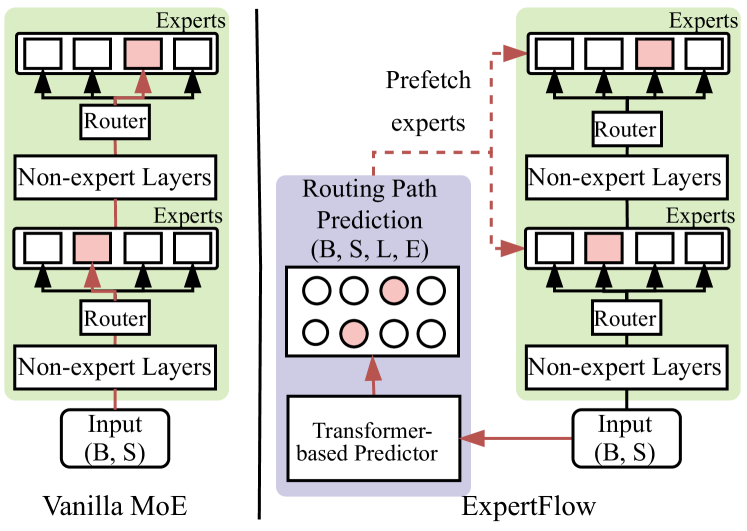
The diagram contrasts two Mixture-of-Experts (MoE) architectures: **Vanilla MoE** (left) and **ExpertFlow** (right). Both models use routers, non-expert layers, and experts, but ExpertFlow introduces a **Transformer-based Predictor** and **prefetching mechanisms** for dynamic routing.
### Components/Axes
#### Vanilla MoE (Left Side)
- **Input**: Labeled `(B, S)` (batch size, sequence length).
- **Non-expert Layers**: Stacked layers with bidirectional arrows (black) indicating data flow.
- **Routers**: Three routers (black arrows) directing data to **Experts** (pink boxes).
- **Experts**: Four experts per layer, with one highlighted in pink per layer.
#### ExpertFlow (Right Side)
- **Input**: Also labeled `(B, S)`.
- **Non-expert Layers**: Similar to Vanilla MoE but with bidirectional arrows.
- **Routers**: Three routers (black arrows) directing data to **Experts**.
- **Experts**: Four experts per layer, with one highlighted in pink per layer.
- **Transformer-based Predictor**: Central purple box with routing path prediction `(B, S, L, E)`.
- **Routing Path Prediction**: Visualized as six circles (two rows of three), with two filled in pink.
- **Prefetch experts**: Dashed red arrows from the predictor to experts.
### Detailed Analysis
1. **Routing Path Prediction**:
- The predictor outputs `(B, S, L, E)`, where `L` (layer) and `E` (expert) are additional dimensions compared to Vanilla MoE’s `(B, S)`.
- Pink-filled circles in the predictor suggest active/expert selection logic.
2. **Prefetching Mechanism**:
- Dashed red arrows from the predictor to experts indicate asynchronous prefetching, bypassing immediate router decisions.
3. **Component Flow**:
- **Vanilla MoE**: Input → Non-expert Layers → Router → Expert → Output.
- **ExpertFlow**: Input → Non-expert Layers → Router → Expert (direct) or Prefetch (via predictor).
### Key Observations
- **ExpertFlow adds complexity**: The inclusion of a transformer-based predictor and prefetching introduces additional decision-making steps.
- **Dynamic Routing**: Prefetching experts (dashed arrows) suggests ExpertFlow anticipates future routing needs, unlike Vanilla MoE’s static routing.
- **Routing Variables**: ExpertFlow’s `(B, S, L, E)` prediction expands context beyond batch/sequence to include layer and expert indices.
### Interpretation
The diagram highlights ExpertFlow’s innovation in MoE architectures:
- **Efficiency**: Prefetching experts reduces latency by preloading resources before router decisions.
- **Adaptability**: The transformer-based predictor uses richer context (`L`, `E`) to optimize routing, potentially improving performance in dynamic workloads.
- **Trade-offs**: While ExpertFlow adds computational overhead (predictor, prefetching), it may enhance throughput in scenarios with variable expert demands.
The Vanilla MoE serves as a baseline, emphasizing simplicity, while ExpertFlow prioritizes proactive resource management at the cost of architectural complexity.