## Technical Document Extraction: Ecological Niche Question & AI Responses
### Overview
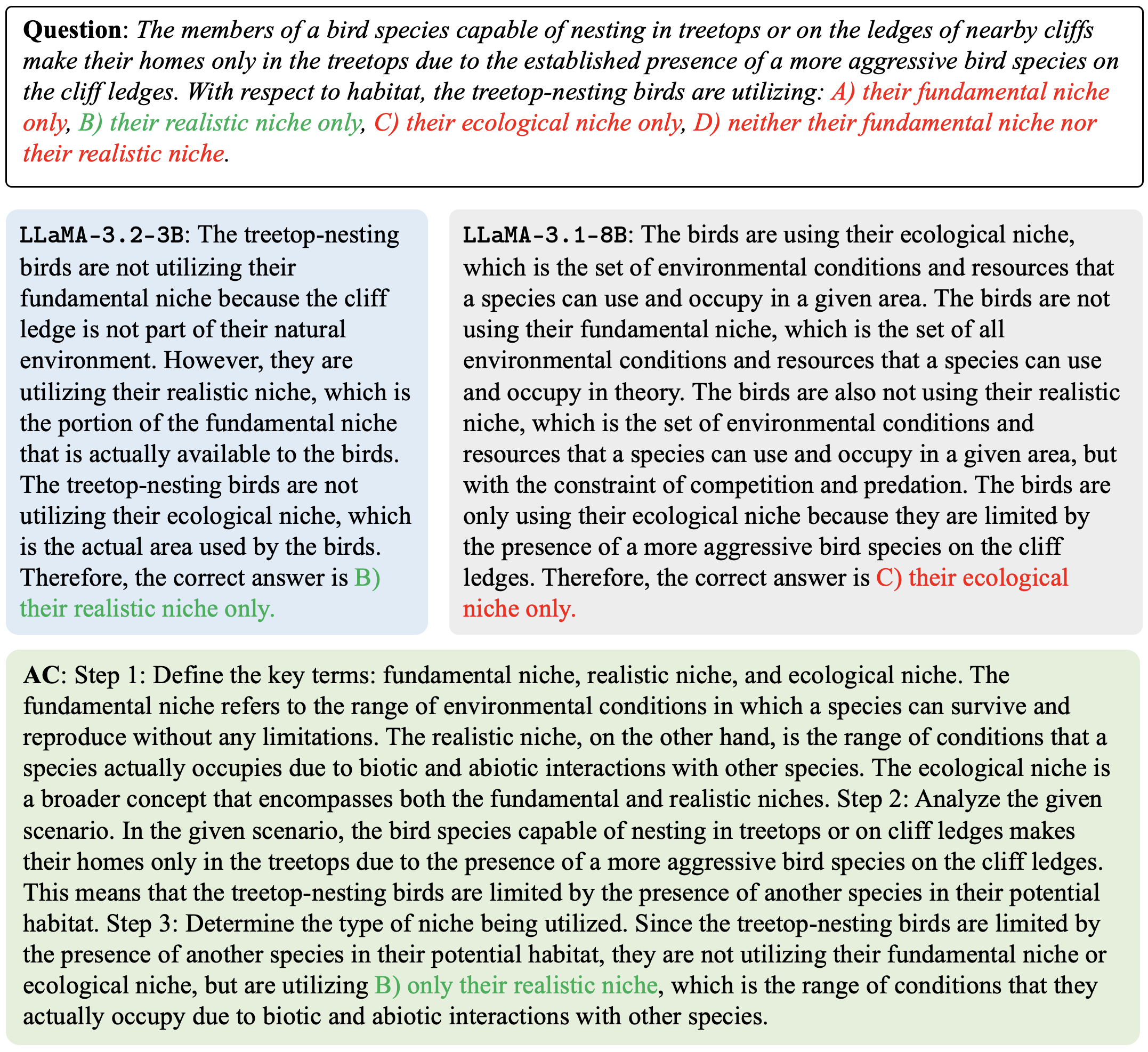
The image displays a structured comparison of answers from three different AI models to a multiple-choice question about ecological niches. The content is presented in a clear, compartmentalized layout with a question block at the top and three distinct response blocks below, each with a unique background color and label.
### Components/Axes
The image is segmented into four primary regions:
1. **Question Block (Top):** A white box with a black border containing the core question and multiple-choice options.
2. **LLaMA-3.2-3B Response (Middle-Left):** A light blue box.
3. **LLaMA-3.1-8B Response (Middle-Right):** A light gray box.
4. **AC Response (Bottom):** A light green box.
**Textual Elements & Formatting:**
* **Question Text:** Black, serif font.
* **Multiple-Choice Options:** The letters (A, B, C, D) and their corresponding text are in red, except for option B, which is in green.
* **Response Labels:** "LLaMA-3.2-3B:", "LLaMA-3.1-8B:", and "AC:" are in bold black text.
* **Emphasized Text in Responses:** Key conclusions and selected answers are highlighted in green or red text within the response bodies.
### Detailed Analysis / Content Details
**1. Question Block Transcription:**
* **Question:** "The members of a bird species capable of nesting in treetops or on the ledges of nearby cliffs make their homes only in the treetops due to the established presence of a more aggressive bird species on the cliff ledges. With respect to habitat, the treetop-nesting birds are utilizing:"
* **Options:**
* A) their fundamental niche only (Red text)
* B) their realistic niche only (Green text)
* C) their ecological niche only (Red text)
* D) neither their fundamental niche nor their realistic niche (Red text)
**2. LLaMA-3.2-3B Response Transcription:**
* **Answer Given:** B) their realistic niche only (Highlighted in green).
* **Reasoning Summary:** Defines the cliff ledge as not part of the birds' "natural environment." States the birds are utilizing their "realistic niche" (the portion of the fundamental niche actually available) but not their "ecological niche" (the actual area used).
**3. LLaMA-3.1-8B Response Transcription:**
* **Answer Given:** C) their ecological niche only (Highlighted in red).
* **Reasoning Summary:** Defines "ecological niche" as the set of conditions/resources a species can use in an area. Defines "fundamental niche" as the theoretical set of conditions. Defines "realistic niche" as the set of conditions with constraints like competition. Concludes the birds are using their ecological niche because they are limited by competition (the aggressive species).
**4. AC Response Transcription:**
* **Answer Given:** B) only their realistic niche (Highlighted in green).
* **Reasoning Summary:** Provides a three-step analysis.
* **Step 1 (Definitions):**
* *Fundamental niche:* Range of conditions for survival/reproduction without limitations.
* *Realistic niche:* Range of conditions actually occupied due to biotic/abiotic interactions.
* *Ecological niche:* A broader concept encompassing both fundamental and realistic niches.
* **Step 2 (Analysis):** The birds are limited by the presence of another species (competition).
* **Step 3 (Conclusion):** Therefore, they are not utilizing their fundamental niche but are utilizing their realistic niche.
### Key Observations
1. **Contradictory Answers:** The models provide two different correct answers (B and C), based on differing definitions of the core ecological terms.
2. **Definitional Discrepancy:** The central conflict lies in the definition of "ecological niche."
* LLaMA-3.2-3B and AC treat "ecological niche" as synonymous with the *realized* or *actual* space used.
* LLaMA-3.1-8B treats "ecological niche" as the *broader* concept of a species' role and requirements in its environment, which is then constrained to form the "realistic niche."
3. **Consensus on Constraint:** All three models agree that the presence of the aggressive bird species (competition) is the key biotic interaction limiting the treetop-nesting birds from using the cliff ledges.
4. **Visual Emphasis:** The use of green text for option B in the question and in the LLaMA-3.2-3B and AC responses suggests a visual alignment or potential indication of a "correct" answer within the context of this comparison.
### Interpretation
This image is not a data chart but a **comparative analysis of AI model reasoning** on a conceptual ecology problem. It demonstrates how variations in the precise definition of scientific terminology ("ecological niche" vs. "realistic niche") can lead to different logical conclusions, even when analyzing the same factual scenario.
The data suggests:
* **The Core Ecological Principle:** The scenario illustrates the difference between a **fundamental niche** (the full potential habitat: treetops + cliffs) and a **realized niche** (the actual habitat used: treetops only), due to interspecific competition.
* **The Linguistic/Conceptual Challenge:** The disagreement stems from whether "ecological niche" is considered the overarching concept (as in AC and LLaMA-3.1-8B's broader definition) or the specific, realized outcome (as in LLaMA-3.2-3B's definition). The AC response attempts to resolve this by explicitly defining "ecological niche" as the broader umbrella term.
* **Model Performance Insight:** The image serves as a case study in AI model behavior, showing that different models can have embedded, differing "knowledge bases" or interpretive frameworks for the same scientific terms, leading to divergent outputs. The side-by-side presentation allows for direct comparison of reasoning chains and definitional starting points.