## Screenshot: Ecological Niche Question and Model Responses
### Overview
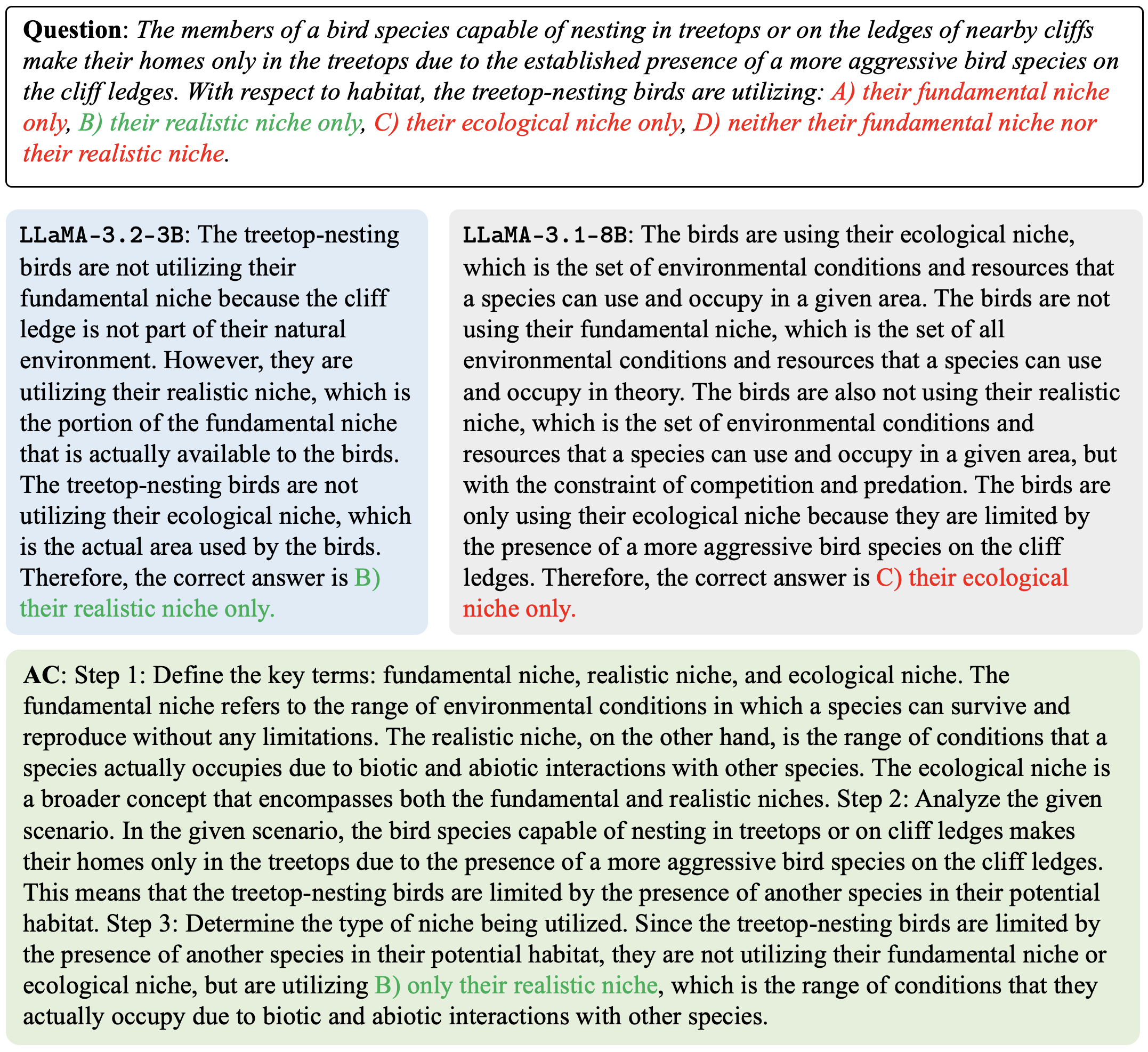
The image contains a multiple-choice question about ecological niches, followed by two model responses (LLaMA-3.2-3B and LLaMA-3.1-8B) and an annotated analysis (AC) explaining the reasoning. The question involves habitat utilization by bird species, with options labeled A-D. The AC section provides a step-by-step breakdown of niche definitions and scenario analysis.
---
### Components/Axes
- **Question Text**:
"The members of a bird species capable of nesting in treetops or on the ledges of nearby cliffs make their homes only in the treetops due to the established presence of a more aggressive bird species on the cliff ledges. With respect to habitat, the treetop-nesting birds are utilizing:
A) their fundamental niche only,
B) their realistic niche only,
C) their ecological niche only,
D) neither their fundamental niche nor their realistic niche."
- **Model Responses**:
- **LLaMA-3.2-3B**: Argues the birds use their **realistic niche only** (B), as they avoid the cliff ledges due to competition.
- **LLaMA-3.1-8B**: Argues the birds use their **ecological niche only** (C), constrained by competition.
- **AC Section**:
- **Step 1**: Definitions of fundamental niche (unlimited survival/reproduction), realistic niche (actual occupancy due to interactions), and ecological niche (broader concept combining both).
- **Step 2**: Analysis of the scenario: Birds avoid cliffs due to aggression, limiting their habitat.
- **Step 3**: Conclusion: Birds utilize their **realistic niche only** (B), as their actual occupancy is restricted by biotic interactions.
---
### Detailed Analysis
- **Question Structure**:
- Four options (A-D) test understanding of niche concepts.
- Key terms: *fundamental niche* (theoretical potential), *realistic niche* (actual occupancy), *ecological niche* (broader concept).
- **Model Responses**:
- **LLaMA-3.2-3B**: Focuses on the birds’ avoidance of cliffs (realistic niche) but incorrectly dismisses ecological niche.
- **LLaMA-3.1-8B**: Correctly identifies the constraint of competition but misattributes it to the ecological niche.
- **AC Breakdown**:
- Step 1 clarifies niche definitions, emphasizing that the ecological niche includes both fundamental and realistic components.
- Step 2 links the scenario to biotic interactions (aggressive species on cliffs).
- Step 3 concludes that the birds’ actual habitat (treetops) reflects their **realistic niche only** (B), as their fundamental niche (unrestricted habitat) is unutilized.
---
### Key Observations
1. **Highlighted Answer**: The AC section explicitly states the correct answer is **B) their realistic niche only**, with the term "realistic niche" highlighted in green.
2. **Model Discrepancy**: The two models disagree on the answer (B vs. C), reflecting differing interpretations of niche constraints.
3. **Terminology Clarity**: The AC section resolves ambiguity by defining terms, showing that the ecological niche is a superset of the other two.
---
### Interpretation
- **Ecological Concept**: The question tests the distinction between theoretical (fundamental) and actual (realistic) niches. The birds’ behavior (avoiding cliffs) demonstrates biotic constraints, aligning with the **realistic niche**.
- **Model Limitations**:
- LLaMA-3.2-3B correctly identifies the realistic niche but overlooks the broader ecological niche.
- LLaMA-3.1-8B misapplies the ecological niche, which inherently includes both fundamental and realistic components.
- **AC’s Role**: The annotated analysis provides a structured framework to resolve ambiguity, emphasizing that the ecological niche is not a separate category but a composite concept.
This scenario underscores the importance of precise niche definitions in ecological modeling and highlights how AI models may interpret constraints differently based on training data.