## Flowchart Diagram: System Relationship Structure
### Overview
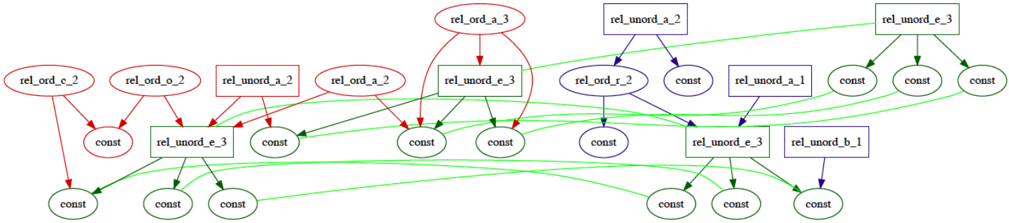
The image depicts a complex flowchart diagram illustrating relationships between nodes labeled with "rel_ord" (ordered relationships) and "rel_unord" (unordered relationships). The diagram uses color-coded arrows (red, green, blue) to represent different types of connections between nodes, with "const" nodes serving as terminal points.
### Components/Axes
- **Nodes**:
- Labeled with identifiers like `rel_ord_c_2`, `rel_unord_e_3`, `rel_ord_a_3`, etc.
- Two node types:
- Red-bordered ovals (e.g., `rel_ord_c_2`)
- Green-bordered rectangles (e.g., `rel_unord_e_3`)
- **Arrows**:
- Red arrows (→) connecting ordered relationship nodes
- Green arrows (→) connecting unordered relationship nodes
- Blue arrows (→) connecting cross-node relationships
- **Terminal Nodes**:
- Labeled "const" (constant) at the bottom of the diagram
### Detailed Analysis
1. **Left Section (Red Arrows)**:
- `rel_ord_c_2` → `rel_ord_o_2` → `rel_unord_a_2` → `rel_unord_e_3`
- All connections use red arrows, suggesting ordered relationship dependencies
2. **Center Section (Green Arrows)**:
- `rel_unord_e_3` connects to multiple "const" nodes via green arrows
- Branching structure indicates multiple unordered relationship outcomes
3. **Right Section (Blue Arrows)**:
- `rel_unord_a_2` → `rel_ord_r_2` → `rel_unord_a_1` → `rel_unord_b_1`
- Cross-node relationships shown through blue arrows
4. **Terminal Connections**:
- All paths eventually terminate at "const" nodes
- Multiple "const" nodes per relationship type suggest parallel processing paths
### Key Observations
- **Color Consistency**: Red arrows only connect ordered relationships, green only unordered, blue only cross-node
- **Node Hierarchy**: Ordered relationships (red) appear to feed into unordered relationships (green)
- **Complexity**: 12+ nodes with 20+ connections create a dense network
- **Terminal Pattern**: All paths end at "const" nodes, suggesting final state determination
### Interpretation
This diagram appears to model a system where:
1. Ordered relationships (red) establish initial parameters
2. These parameters feed into unordered relationship processing (green)
3. Cross-node relationships (blue) enable system-wide coordination
4. All processes ultimately resolve to constant states ("const")
The color-coding suggests a strict separation of relationship types, with ordered relationships serving as input to unordered processing. The multiple terminal "const" nodes per relationship type implies parallel processing paths or alternative resolution states. The absence of feedback loops suggests a linear progression toward final states, though the dense connections indicate complex intermediate processing.