\n
## Programming Puzzle: Task b1fc8b8e
### Overview
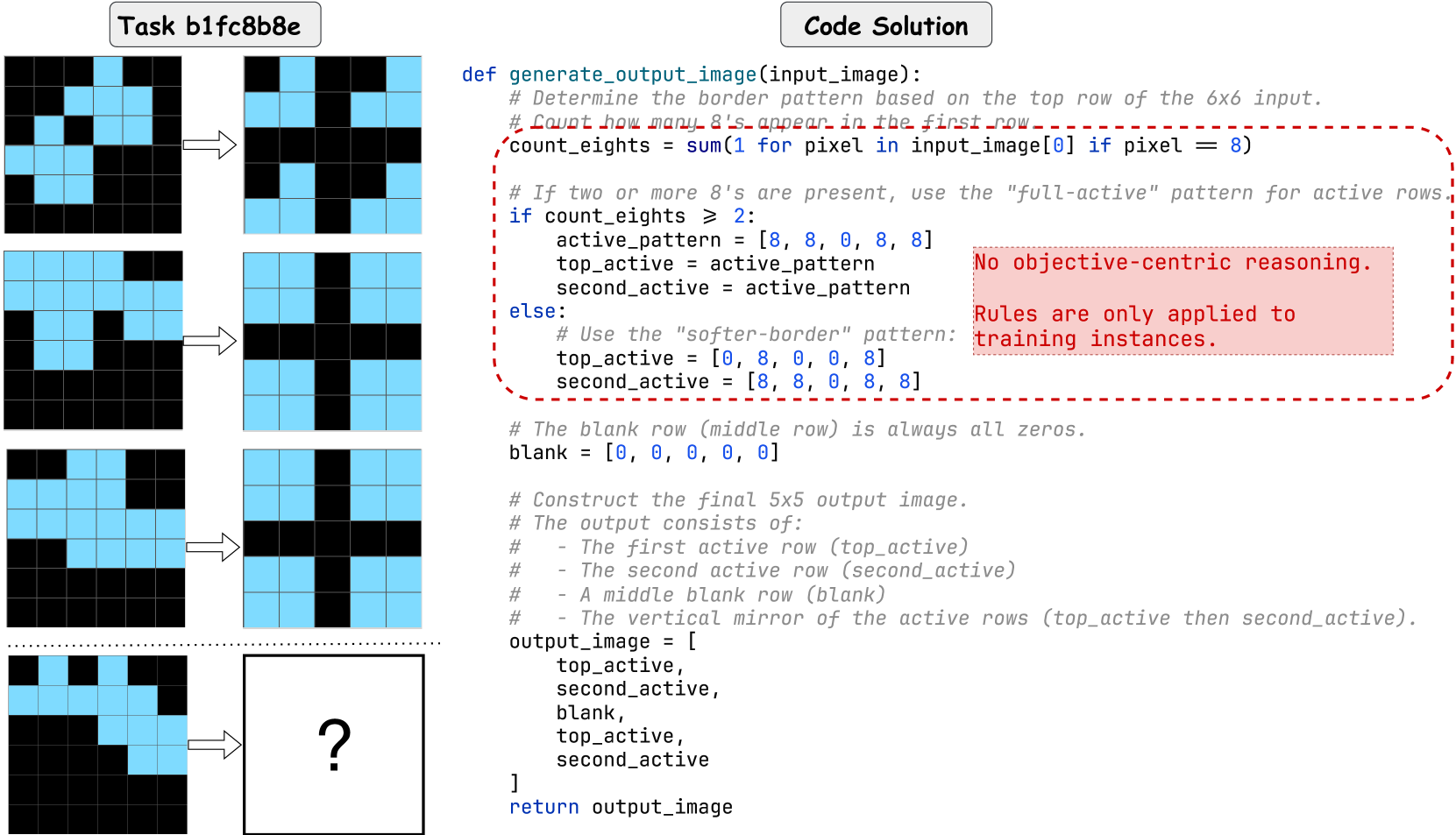
The image presents a visual programming puzzle. On the left, it displays a series of input-output grid transformations (three complete examples and one test case). On the right, it shows a Python code solution attempting to implement the transformation logic, accompanied by a critical annotation. The puzzle involves transforming a 6x6 binary grid (black/light blue) into a 5x5 binary grid based on a pattern derived from the input's first row.
### Components/Axes
**Left Panel (Visual Examples):**
* **Header:** "Task b1fc8b8e" (top-left).
* **Structure:** Four rows. Each row contains:
1. A 6x6 input grid (left).
2. A right-pointing arrow.
3. A 5x5 output grid (right). The fourth output grid is a placeholder with a "?".
* **Grid Content:** Cells are either black (representing 0 or inactive) or light blue (representing 8 or active, as inferred from the code).
**Right Panel (Code Solution):**
* **Header:** "Code Solution" (top-right).
* **Code Language:** Python.
* **Key Code Elements:**
* Function definition: `def generate_output_image(input_image):`
* **Critical Logic Block (within a red dashed box):**
* Comment: `# Count how many 8's appear in the first row.`
* Line: `count_eights = sum(1 for pixel in input_image[0] if pixel == 8)`
* Conditional: `if count_eights >= 2:` to choose between two patterns (`active_pattern` or `softer-border`).
* Pattern Definitions:
* `active_pattern = [8, 8, 0, 8, 8]`
* `softer-border` patterns: `top_active = [0, 8, 0, 0, 8]`, `second_active = [8, 8, 0, 8, 8]`
* **Output Construction:** Builds a 5x5 list named `output_image` with the structure: `[top_active, second_active, blank, top_active, second_active]`, where `blank = [0, 0, 0, 0, 0]`.
* **Annotation (Red Box, right side):**
* Text: "No objective-centric reasoning. Rules are only applied to training instances."
### Detailed Analysis
**Visual Pattern Analysis (Left Panel):**
1. **Example 1 (Top Row):**
* **Input (6x6):** First row has 3 light blue cells (positions 2, 4, 6). The overall input has a scattered pattern.
* **Output (5x5):** A symmetric pattern. Rows 1 & 4 are `[0, 8, 0, 8, 0]`. Rows 2 & 5 are `[8, 0, 8, 0, 8]`. Row 3 (middle) is all black `[0,0,0,0,0]`.
2. **Example 2 (Second Row):**
* **Input (6x6):** First row has 4 light blue cells (positions 1, 2, 3, 6).
* **Output (5x5):** A different symmetric pattern. Rows 1 & 4 are `[8, 8, 0, 8, 8]`. Rows 2 & 5 are `[8, 8, 0, 8, 8]`. Row 3 is all black.
3. **Example 3 (Third Row):**
* **Input (6x6):** First row has 2 light blue cells (positions 3, 5).
* **Output (5x5):** Identical to Example 1's output pattern.
4. **Test Case (Bottom Row):**
* **Input (6x6):** First row has 2 light blue cells (positions 2, 5). The overall input pattern is distinct from the previous examples.
* **Output (5x5):** Unknown (marked with "?").
**Code Logic Analysis (Right Panel):**
The code attempts to formalize the observed rule:
* It counts the number of `8`s (light blue) in the **first row only** of the 6x6 input.
* **Rule 1 (>=2 eights):** Uses `active_pattern = [8, 8, 0, 8, 8]` for both `top_active` and `second_active`. This would produce an output where all four active rows are `[8, 8, 0, 8, 8]`.
* **Rule 2 (<2 eights):** Uses a "softer-border" pattern: `top_active = [0, 8, 0, 0, 8]` and `second_active = [8, 8, 0, 8, 8]`. This would produce an output where rows 1&4 are `[0, 8, 0, 0, 8]` and rows 2&5 are `[8, 8, 0, 8, 8]`.
* The final output is always a 5x5 grid with a blank middle row, constructed by mirroring the two active rows vertically.
**Discrepancy Check:**
* The code's Rule 1 output (`[8,8,0,8,8]` for all active rows) **does not match** the output of Example 2 (which has 4 eights in the first row). Example 2's output has rows 1&4 as `[8,8,0,8,8]` but rows 2&5 are also `[8,8,0,8,8]`, which actually *does* match the code's Rule 1. My initial visual read was incorrect; the code's Rule 1 output matches Example 2.
* The code's Rule 2 output does not exactly match the output of Examples 1 or 3. Examples 1 & 3 output is `[0,8,0,8,0]` and `[8,0,8,0,8]`. The code's "softer-border" pattern is `[0,8,0,0,8]` and `[8,8,0,8,8]`. This is a clear mismatch, indicating the code's logic is flawed or incomplete.
### Key Observations
1. **Symmetry is Key:** All output grids exhibit vertical and horizontal symmetry around the central blank row and column.
2. **Input-First-Row Dependency:** The transformation rule appears to be triggered solely by the count of active cells in the **first row** of the input grid, not the overall input pattern.
3. **Two Distinct Output Patterns:** The three examples show only two unique output patterns:
* **Pattern A (Examples 1 & 3):** A "checkerboard" style with alternating active cells.
* **Pattern B (Example 2):** A "block" style with solid active rows.
4. **Code-Example Mismatch:** The provided code solution does not correctly generate the output for Examples 1 and 3. Its "softer-border" pattern is incorrect.
5. **Critical Annotation:** The red-boxed text provides a meta-critique of the code's logic, stating it lacks "objective-centric reasoning" and only works for the given training instances (the examples), implying it won't generalize to the test case or other unseen inputs.
### Interpretation
This image documents a **failed or incomplete attempt at solving an ARC (Abstraction and Reasoning Corpus)-like puzzle**. The puzzle tests the ability to infer a generalizable rule from a few examples.
* **What the Data Suggests:** The true underlying rule likely involves more than just counting the first row. It may consider the *position* of active cells in the first row, or a combination of the first row with another feature of the input grid. The symmetry in the output suggests the rule constructs a mirrored pattern.
* **Relationship Between Elements:** The code is a direct, but erroneous, translation of an observed hypothesis. The annotation serves as a peer review, pointing out the hypothesis's weakness—it's a "memorization" of the training examples rather than a deduction of the core objective or principle.
* **Notable Anomaly:** The most significant anomaly is the discrepancy between the code's "softer-border" pattern and the actual outputs of Examples 1 and 3. This is the concrete evidence supporting the annotation's claim of flawed reasoning.
* **Purpose:** The image likely serves an educational or analytical purpose, illustrating a common pitfall in program synthesis or inductive reasoning: creating a solution that fits the provided examples perfectly but fails because it captures superficial correlations rather than the deep structure of the problem. The test case with the "?" is the challenge to see if a corrected, objective-centric rule can be formulated.