## Line Chart: Experienced Items Ratio vs Environment Steps
### Overview
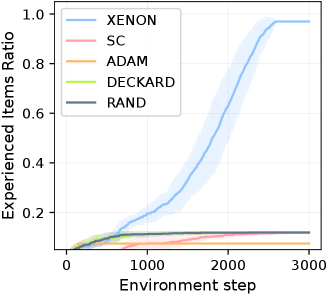
The chart displays the performance of five algorithms (XENON, SC, ADAM, DECKARD, RAND) over environment steps, measured as the "Experienced Items Ratio" (0-1.0 scale). XENON dominates with a sharp upward trend, while other algorithms remain stagnant below 0.2.
### Components/Axes
- **X-axis**: "Environment step" (0–3000), linear scale.
- **Y-axis**: "Experienced Items Ratio" (0.0–1.0), linear scale.
- **Legend**: Top-left corner, color-coded labels:
- **XENON**: Blue line with shaded uncertainty band.
- **SC**: Pink line.
- **ADAM**: Orange line.
- **DECKARD**: Green line.
- **RAND**: Gray line.
### Detailed Analysis
1. **XENON**:
- Starts at 0.0 at step 0.
- Rises sharply to ~1.0 by step 2000.
- Plateaus at 1.0 from step 2000 onward.
- Shaded blue band indicates uncertainty (widening slightly near step 1000).
2. **SC**:
- Flat line at ~0.1 throughout all steps.
3. **ADAM**:
- Flat line at ~0.05 throughout all steps.
4. **DECKARD**:
- Flat line at ~0.15 throughout all steps.
5. **RAND**:
- Flat line at ~0.1 throughout all steps.
### Key Observations
- **XENON** achieves near-perfect performance (1.0) by step 2000, with no further improvement.
- All other algorithms remain below 0.2, showing no meaningful improvement over 3000 steps.
- XENON’s uncertainty band suggests higher variability in early steps (0–1000), stabilizing afterward.
### Interpretation
The data demonstrates that **XENON** is orders of magnitude more effective than other algorithms in this environment. Its rapid convergence to 1.0 suggests superior optimization or learning efficiency. In contrast, SC, ADAM, DECKARD, and RAND exhibit stagnation, implying either suboptimal design, insufficient training, or inherent limitations in their approach. The lack of improvement in non-XENON algorithms raises questions about their scalability or adaptability in this context. The shaded uncertainty band for XENON highlights confidence in its performance after step 1000, reinforcing its reliability.