## Histogram: Length of Reasoning Chains in Tokens, Comparative Illusion vs. Control
### Overview
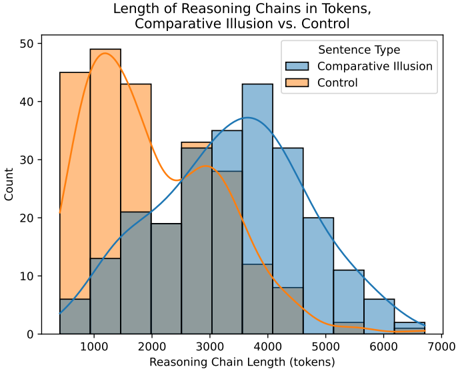
This image presents a histogram comparing the distribution of reasoning chain lengths (measured in tokens) for two sentence types: "Comparative Illusion" and "Control". The x-axis represents the reasoning chain length in tokens, and the y-axis represents the count (frequency) of reasoning chains within each length range. The data is visualized using stacked histograms with overlaid probability density curves.
### Components/Axes
* **Title:** "Length of Reasoning Chains in Tokens, Comparative Illusion vs. Control" (Top-center)
* **X-axis Label:** "Reasoning Chain Length (tokens)" (Bottom-center)
* Scale: Ranges from approximately 0 to 7000 tokens. Markers are present at 1000, 2000, 3000, 4000, 5000, and 6000 tokens.
* **Y-axis Label:** "Count" (Left-center)
* Scale: Ranges from 0 to 50.
* **Legend:** Located in the top-right corner.
* "Sentence Type"
* "Comparative Illusion" - Represented by a light blue color.
* "Control" - Represented by a light orange color.
* **Overlaid Curves:** Two smooth curves are overlaid on the histograms, representing the probability density functions for each sentence type. The blue curve corresponds to "Comparative Illusion", and the orange curve corresponds to "Control".
### Detailed Analysis
The "Control" data (orange) is concentrated in the lower reasoning chain length range, peaking around 1000-1500 tokens. The count at the peak is approximately 48. The distribution decreases steadily as the reasoning chain length increases. The curve representing the control group is centered around 1200 tokens, with a rapid decline after 2000 tokens.
The "Comparative Illusion" data (blue) is shifted towards higher reasoning chain lengths, peaking around 4000-4500 tokens. The count at the peak is approximately 42. The distribution is more spread out than the "Control" data, with a longer tail extending to higher reasoning chain lengths. The curve representing the comparative illusion group is centered around 4200 tokens, with a slower decline after the peak.
Here's a breakdown of approximate counts at key reasoning chain lengths:
| Reasoning Chain Length (tokens) | Comparative Illusion (Count) | Control (Count) |
|---|---|---|
| 1000 | ~5 | ~45 |
| 2000 | ~18 | ~20 |
| 3000 | ~25 | ~32 |
| 4000 | ~42 | ~10 |
| 5000 | ~32 | ~5 |
| 6000 | ~8 | ~2 |
| 7000 | ~1 | ~0 |
### Key Observations
* The "Comparative Illusion" sentence type generally requires longer reasoning chains than the "Control" sentence type.
* The distributions are not symmetrical. Both distributions are skewed to the right, but the "Comparative Illusion" distribution is more heavily skewed.
* There is some overlap between the two distributions, indicating that some "Control" sentences also require relatively long reasoning chains, and some "Comparative Illusion" sentences require shorter ones.
* The peak of the "Control" distribution is significantly higher than the peak of the "Comparative Illusion" distribution, suggesting that shorter reasoning chains are more common in the "Control" condition.
### Interpretation
The data suggests that processing "Comparative Illusion" sentences involves more extensive reasoning processes compared to processing "Control" sentences. This is evidenced by the shift in the distribution towards longer reasoning chain lengths. The longer reasoning chains required for "Comparative Illusion" sentences may be due to the inherent complexity of comparative statements, which often require more cognitive effort to evaluate and understand. The overlaid probability density curves visually reinforce this difference, showing a clear separation in the typical reasoning chain lengths for the two sentence types. The fact that the distributions overlap suggests that the effect is not absolute, and individual sentence characteristics can also influence reasoning chain length. The difference in peak heights indicates that shorter reasoning chains are more typical for control sentences, while longer chains are more typical for comparative illusion sentences. This could be due to the nature of the illusion itself requiring more steps to resolve.