\n
## Diagram: Flow Representation with Symbols
### Overview
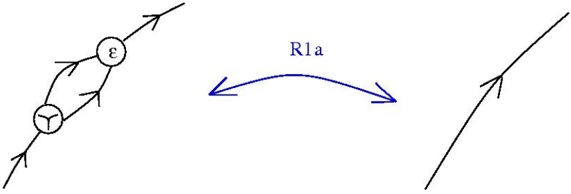
The image depicts a diagram illustrating a flow or transformation between two states. The left side shows a configuration with two circular nodes connected by arrows, while the right side shows a single, straight line with arrows. A curved blue arrow with the label "Rla" connects the two configurations, indicating a transformation.
### Components/Axes
The diagram consists of the following components:
* **Circular Nodes:** Two circular nodes, labeled "ε" (epsilon) and "Y" (gamma).
* **Arrows:** Arrows indicating flow or direction. These are present within the circular node configuration and as a curved arrow connecting the two configurations.
* **Label:** "Rla" – a label associated with the curved arrow.
* **Straight Line:** A straight line with arrows indicating flow.
### Detailed Analysis or Content Details
The left side of the diagram shows two circular nodes. The top node is labeled "ε" and the bottom node is labeled "Y". Arrows flow into and out of both nodes, creating a loop-like structure. Specifically:
* Arrows enter the "ε" node from the left.
* Arrows exit the "ε" node to the right and downwards towards the "Y" node.
* Arrows enter the "Y" node from above (from the "ε" node).
* Arrows exit the "Y" node to the left.
The right side of the diagram shows a single straight line with arrows indicating flow from bottom-left to top-right.
The curved blue arrow labeled "Rla" originates approximately from the center of the "ε" node and points towards the straight line, indicating a transformation or mapping from the circular node configuration to the straight line configuration.
### Key Observations
The diagram visually represents a transformation from a complex, looped system (represented by the circular nodes) to a simpler, linear system (represented by the straight line). The label "Rla" likely denotes the specific operation or rule governing this transformation. The diagram does not contain any numerical data or scales.
### Interpretation
The diagram likely represents a simplification or reduction process. The "Rla" transformation could be a rule or operation that removes the complexity represented by the looped system of "ε" and "Y", resulting in a more straightforward flow. The symbols "ε" and "Y" could represent variables, states, or components within a larger system. Without further context, the precise meaning of the diagram remains speculative, but it clearly illustrates a change in system structure or state. The diagram suggests a process of abstraction or simplification, where a complex interaction is reduced to a single flow. The use of Greek letters suggests a mathematical or scientific context.