## Diagram: Bidirectional System Interaction
### Overview
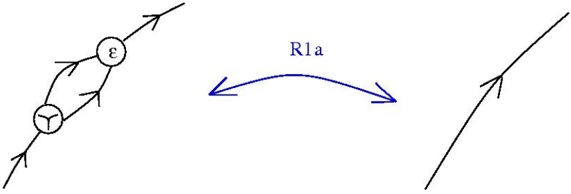
The image depicts two interconnected diagrams linked by a bidirectional arrow labeled "R1a". The left diagram contains two nodes with symbols "ε" and "Y", while the right diagram contains a single node with a "T" symbol. Arrows indicate directional relationships between components.
### Components/Axes
- **Left Diagram**:
- Node 1: Circular node with "ε" (epsilon) symbol
- Node 2: Circular node with "Y" symbol (resembling a branching point)
- Arrows: Multiple directional arrows connecting nodes
- **Right Diagram**:
- Node: Single node with "T" symbol
- **Connecting Element**:
- Bidirectional arrow labeled "R1a" between diagrams
### Detailed Analysis
- **Left Diagram**:
- "ε" node appears to be a source or origin point
- "Y" node shows branching structure with three outgoing arrows
- Arrows form a closed loop between the two nodes
- **Right Diagram**:
- "T" node has two outgoing arrows
- Positioned separately from left diagram
- **R1a Relationship**:
- Bidirectional connection between diagrams
- Suggests two-way interaction between systems
### Key Observations
1. The "Y" node in the left diagram acts as a decision point with multiple pathways
2. The "T" node in the right diagram appears to be a terminal or target node
3. The bidirectional "R1a" connection implies mutual influence between systems
4. Closed loop in left diagram suggests cyclical processes
### Interpretation
This diagram likely represents a system architecture where:
- The left diagram shows an error/exception handling system ("ε") interacting with a decision-making process ("Y")
- The right diagram represents a target system ("T") that both receives and sends information
- "R1a" could represent a communication protocol or data exchange mechanism
- The closed loop in the left diagram indicates feedback mechanisms within the error/exception system
- The branching structure of "Y" suggests multiple possible outcomes or processing paths
The bidirectional relationship implies that decisions from the "Y" node affect the target system "T", while feedback from "T" influences the decision-making process. This could represent a control system with error correction and adaptive decision-making capabilities.