## Flow Diagram: Automated Pull Request Processing
### Overview
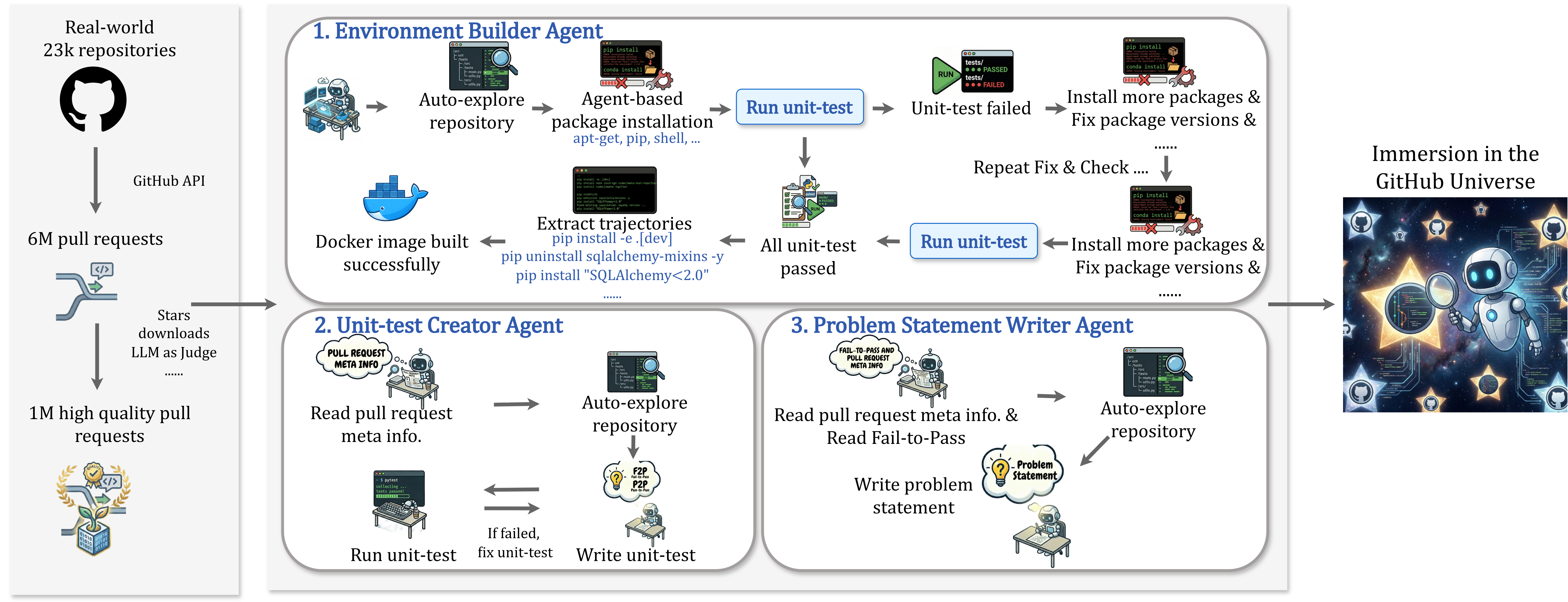
The image is a flow diagram illustrating an automated process for handling pull requests in a software development environment, likely GitHub. It outlines three main agents: Environment Builder Agent, Unit-test Creator Agent, and Problem Statement Writer Agent. The process starts with real-world repositories and culminates in an "Immersion in the GitHub Universe."
### Components/Axes
* **Left Side**: Represents the initial stage of the process, starting with "Real-world 23k repositories" and progressing through "6M pull requests" to "1M high quality pull requests."
* **Agent 1: Environment Builder Agent**: Focuses on setting up the environment for testing.
* **Agent 2: Unit-test Creator Agent**: Deals with creating and fixing unit tests.
* **Agent 3: Problem Statement Writer Agent**: Generates problem statements based on pull request information.
* **Right Side**: Represents the final stage, "Immersion in the GitHub Universe."
### Detailed Analysis
**1. Real-world Repositories and Pull Requests (Left Side)**
* "Real-world 23k repositories" at the top-left, indicating the starting point.
* "GitHub API" is mentioned below the repositories, suggesting the use of the GitHub API to access the repositories.
* "6M pull requests" are processed.
* "Stars downloads LLM as Judge" indicates that stars, downloads, and a Large Language Model (LLM) are used to judge the quality of pull requests.
* "1M high quality pull requests" are the result of the initial filtering.
**2. Environment Builder Agent**
* **Auto-explore repository**: The agent starts by exploring the repository. A file explorer window is shown with files like `.src`, `.tests`, `.main.py`, and `.utils.py`.
* **Agent-based package installation**: Installs necessary packages using tools like `apt-get`, `pip`, and shell scripts.
* **Run unit-test**: Executes the unit tests.
* **Unit-test failed**: If the unit tests fail, the process moves to "Install more packages & Fix package versions &". A terminal window shows `pip install` and `conda install`.
* **Repeat Fix & Check**: The process repeats the installation and checking until the unit tests pass.
* **All unit-test passed**: If the unit tests pass, the process moves on.
* **Docker image built successfully**: A Docker image is built.
* **Extract trajectories**: Extracts trajectories using `pip install -e.[dev]`, `pip uninstall sqlalchemy-mixins -y`, and `pip install "SQLAlchemy<2.0"`.
**3. Unit-test Creator Agent**
* **Read pull request meta info**: Reads metadata from the pull request. The text "PULL REQUEST META INFO" is present.
* **Auto-explore repository**: Explores the repository. A file explorer window is shown with files like `.src`, `.tests`, `.main.py`, and `.utils.py`.
* **Run unit-test**: Executes the unit tests. A terminal window shows `$ pytest collecting ...`.
* **If failed, fix unit-test**: If the unit tests fail, the unit tests are fixed.
* **Write unit-test**: Writes the unit tests. The text "F2P" and "P2P" are present, possibly indicating "Fail-to-Pass" and "Pass-to-Pass".
**4. Problem Statement Writer Agent**
* **Read pull request meta info. & Read Fail-to-Pass**: Reads metadata from the pull request and information about failures. The text "FAIL-TO-PASS AND PULL REQUEST META INFO" is present.
* **Auto-explore repository**: Explores the repository. A file explorer window is shown with files like `.src`, `.tests`, `.main.py`, and `.utils.py`.
* **Write problem statement**: Writes a problem statement. The text "Problem Statement" is present.
**5. Immersion in the GitHub Universe (Right Side)**
* The final stage is represented by an image of a robot with a magnifying glass, surrounded by stars and GitHub logos, symbolizing immersion in the GitHub universe.
### Key Observations
* The diagram illustrates an automated workflow for processing pull requests, involving environment setup, unit test creation/fixing, and problem statement generation.
* The process uses a combination of automated tools and potentially LLMs to assess and improve the quality of pull requests.
* The iterative nature of the environment building and unit testing phases is emphasized.
### Interpretation
The diagram depicts a sophisticated system designed to streamline and enhance the pull request review process. By automating environment setup, unit test creation, and problem statement generation, the system aims to reduce the manual effort required from developers and improve the overall quality of code contributions. The use of LLMs as judges suggests an attempt to incorporate more intelligent and nuanced assessments of code quality. The "Immersion in the GitHub Universe" symbolizes a state where the system seamlessly integrates with the development workflow, providing valuable insights and automation to developers.