## Diagram: Parallel Processing of Input-Output Cases
### Overview
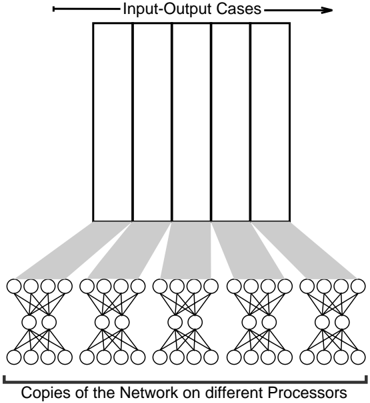
The image illustrates a parallel processing architecture where multiple copies of a neural network are deployed on different processors to handle multiple input-output cases simultaneously. The diagram shows the flow of data from input-output cases to the network copies.
### Components/Axes
* **Title:** The diagram does not have an explicit title, but the elements suggest it represents parallel processing.
* **Top:** "Input-Output Cases" - Represents the input data being processed. This is depicted as a large rectangle divided into five equal vertical sections.
* **Bottom:** "Copies of the Network on different Processors" - Represents the multiple instances of the neural network.
* **Connections:** Gray shaded areas connect each section of the "Input-Output Cases" to a corresponding network copy.
* **Network Structure:** Each network copy consists of three layers of nodes. The first layer has 4 nodes, the second layer has 2 nodes, and the third layer has 4 nodes. All nodes are fully connected to the nodes in the adjacent layers.
### Detailed Analysis
* **Input-Output Cases:** The rectangle at the top is divided into five equal sections, implying five distinct input-output cases being processed in parallel.
* **Network Copies:** There are five identical neural network structures at the bottom, each representing a copy of the network running on a different processor.
* **Data Flow:** The gray shaded areas indicate the flow of data from each input-output case to its corresponding network copy. The shading suggests a distribution or mapping of the input data to the network.
* **Network Architecture:** Each network has a simple feedforward architecture. The connections between the layers are fully connected.
### Key Observations
* The diagram emphasizes the parallel nature of the processing, with each input-output case being handled by a separate network copy.
* The network architecture is relatively simple, consisting of only three layers.
* The diagram does not provide specific details about the type of neural network or the nature of the input-output cases.
### Interpretation
The diagram illustrates a basic parallel processing approach for handling multiple input-output cases using neural networks. By deploying multiple copies of the network on different processors, the system can process multiple inputs simultaneously, potentially improving performance and throughput. The diagram highlights the concept of data parallelism, where the input data is divided and processed concurrently. The use of a simple network architecture suggests that this approach could be applied to a variety of tasks where parallel processing is beneficial. The diagram does not provide information about the specific application or the performance characteristics of the system.