## Diagram: Distributed Network Processing Architecture
### Overview
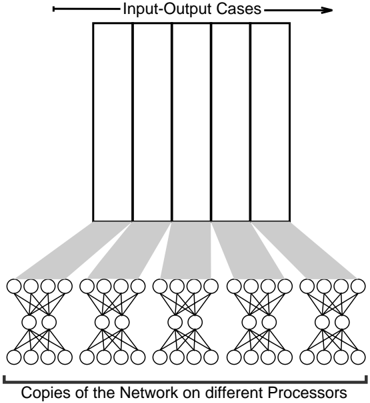
The diagram illustrates a distributed computing architecture where input-output cases are processed across multiple copies of a network distributed on different processors. Data flows bidirectionally between the input/output cases and the network copies, suggesting iterative or feedback-driven processing.
### Components/Axes
- **Top Section**:
- **Label**: "Input-Output Cases" (horizontal arrow pointing right).
- **Elements**: Four vertically stacked rectangles (no explicit labels or numerical values).
- **Bottom Section**:
- **Label**: "Copies of the Network on different Processors" (horizontal arrow pointing left).
- **Elements**: Five clusters of interconnected nodes (circles and lines), representing network copies.
- **Flow Arrows**:
- Bidirectional arrows connect the top "Input-Output Cases" to the bottom "Network Copies," indicating data exchange.
### Detailed Analysis
- **Input-Output Cases**:
- Four unlabeled rectangles suggest discrete data units or scenarios. No numerical values or scales are provided.
- **Network Copies**:
- Five clusters of nodes (no explicit labels or identifiers). Each cluster contains multiple interconnected nodes, implying parallel processing.
- **Flow Direction**:
- Arrows point both upward (from network copies to input-output cases) and downward (from input-output cases to network copies), indicating bidirectional data transfer.
### Key Observations
1. **Symmetry**: The five network clusters are evenly spaced, suggesting uniform distribution across processors.
2. **Bidirectional Flow**: The presence of two-way arrows implies feedback loops or iterative refinement in processing.
3. **No Numerical Data**: The diagram lacks quantitative metrics (e.g., latency, throughput), focusing instead on structural relationships.
### Interpretation
This diagram represents a **parallel distributed system** where input data is processed across multiple network instances on separate processors. The bidirectional flow suggests:
- **Iterative Processing**: Data may be refined through repeated cycles between input/output cases and network copies.
- **Load Balancing**: The uniform distribution of network copies hints at load-sharing across processors.
- **Scalability**: The modular design (five network copies) implies the system can scale horizontally by adding more processors.
The absence of specific labels or metrics indicates this is a conceptual model, emphasizing architectural relationships over implementation details. The bidirectional arrows highlight the importance of feedback mechanisms in distributed computing workflows.