## Neural Network Architecture Diagram: Multi-Layer Processing Flow
### Overview
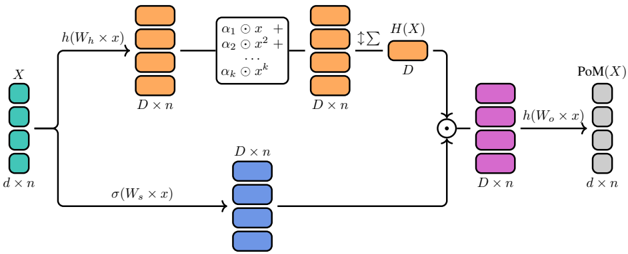
The diagram illustrates a multi-stage neural network architecture with input processing, hidden layers, summation operations, pooling, and output generation. The flow progresses from left to right, with color-coded components representing different processing stages.
### Components/Axes
1. **Input Layer (Teal)**
- Dimensions: `d x n`
- Represents raw input data `X`
2. **Hidden Layers (Orange)**
- Dimensions: `D x n`
- Labeled `h(W_h × x)` indicating activation function `h` applied to weights `W_h` and input `x`
3. **Summation Block (Black Box)**
- Mathematical operation: `α₁·x + α₂·x² + ... + αₖ·xᵏ`
- Combines weighted input terms with coefficients α₁ to αₖ
4. **Second Hidden Layer (Orange)**
- Dimensions: `D x n`
- Labeled `H(X)` indicating processed output from summation block
5. **Pooling Layer (Purple)**
- Operation: `PoM(X)` (likely "Pooling of Maxima")
- Reduces dimensionality while preserving key features
6. **Output Layer (Gray)**
- Dimensions: `d x n`
- Final processed output
7. **Activation Functions**
- Sigmoid (`σ`) in blue layer
- Rectified Linear Unit (`h`) in orange/purple layers
### Detailed Analysis
- **Input Processing**: Raw data `X` (d x n) passes through initial hidden layer with activation `h(W_h × x)`
- **Feature Combination**: Summation block applies polynomial-like combination of input features with learned coefficients
- **Dimensionality Preservation**: Second hidden layer maintains `D x n` dimensions before pooling
- **Spatial Reduction**: Pooling layer (`PoM(X)`) reduces spatial dimensions while retaining critical features
- **Output Matching**: Final output matches input dimensions (`d x n`), suggesting regression/classification task
### Key Observations
1. **Architectural Symmetry**: Input and output dimensions match (`d x n`), while hidden layers use larger `D x n` dimensions
2. **Non-Linear Transformation**: Multiple activation functions (`h`, `σ`) introduce non-linearity
3. **Custom Operation**: Summation block implements explicit feature combination not typical in standard neural networks
4. **Dimensionality Control**: Pooling layer strategically reduces feature map size while preserving spatial hierarchy
### Interpretation
This architecture appears designed for tasks requiring:
- Feature extraction through multiple hidden layers
- Explicit feature combination via the summation block (potentially for attention mechanisms or custom operations)
- Spatial hierarchy preservation through controlled pooling
- Output matching input dimensions for direct regression/classification
The presence of both sigmoid and ReLU activations suggests a hybrid approach to non-linearity handling. The summation block's polynomial-like combination of features indicates intentional modeling of specific feature interactions, possibly for specialized tasks like time-series analysis or spatial pattern recognition. The pooling operation's "Maxima" focus suggests interest in dominant features rather than average values, common in computer vision applications.