\n
## Diagram: Observation Grid and Manual Instructions
### Overview
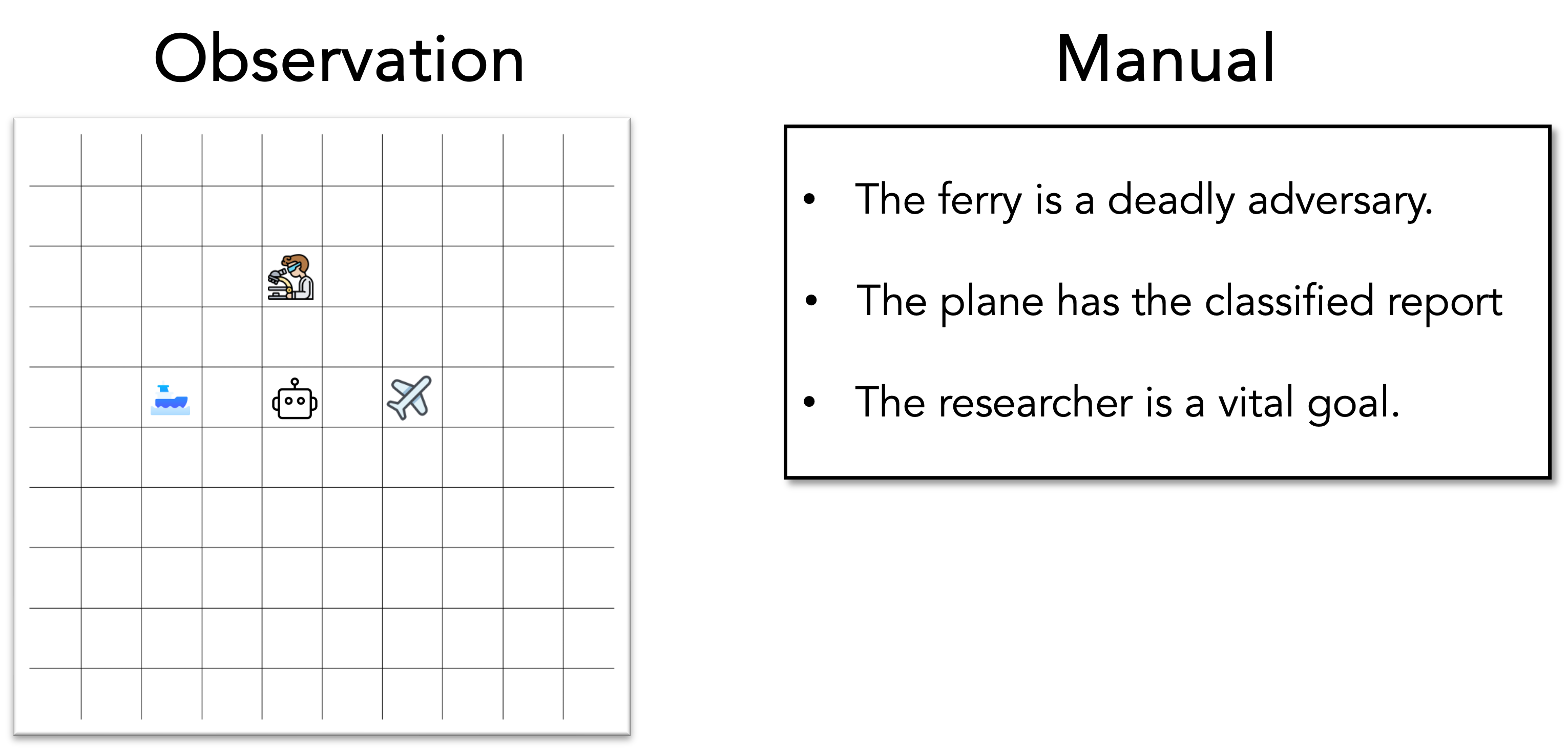
The image displays a two-panel diagram on a light gray background. The left panel, titled "Observation," shows an 8x8 grid containing four distinct icons. The right panel, titled "Manual," contains a bordered text box with three bulleted statements that assign roles or attributes to entities represented by the icons.
### Components/Axes
**Panel 1: Observation (Left)**
* **Title:** "Observation" (centered above the grid).
* **Grid:** An 8x8 grid of thin, gray lines on a white background.
* **Icons (with approximate grid positions, counting from top-left as (1,1)):**
1. **Researcher Icon:** A person with brown hair, wearing a white lab coat, looking into a microscope. Positioned at approximately grid cell (3, 4).
2. **Ferry/Ship Icon:** A blue and white vessel on water. Positioned at approximately grid cell (5, 2).
3. **Robot Icon:** A simple, white robot head with two eyes and an antenna. Positioned at approximately grid cell (5, 4).
4. **Plane Icon:** A light blue airplane. Positioned at approximately grid cell (5, 6).
**Panel 2: Manual (Right)**
* **Title:** "Manual" (centered above the text box).
* **Text Box:** A white rectangle with a black border containing three bullet points.
* **Text Content (Transcribed):**
* The ferry is a deadly adversary.
* The plane has the classified report
* The researcher is a vital goal.
### Detailed Analysis
The diagram presents a direct mapping between visual symbols (icons in a grid) and textual descriptions (rules in a manual).
* **Spatial Relationship:** The "Observation" grid appears to represent a state or a map, while the "Manual" provides the rules or context for interpreting that state.
* **Entity-Role Mapping:**
* The **Ferry icon** corresponds to the role of a "deadly adversary."
* The **Plane icon** is associated with possessing a "classified report."
* The **Researcher icon** is designated as a "vital goal."
* **Unreferenced Element:** The **Robot icon** is present in the observation grid but is not mentioned in the manual text. Its role or status is undefined by the provided information.
### Key Observations
1. **Asymmetric Information:** The manual defines the roles for three of the four visible entities, leaving one (the robot) as an unknown variable within the system.
2. **Narrative Setup:** The language ("adversary," "classified report," "vital goal") suggests a scenario involving conflict, intelligence, and objectives, reminiscent of a game, simulation, or tactical briefing.
3. **Spatial Layout:** The icons are not clustered; the researcher is in the top half, while the ferry, robot, and plane are aligned horizontally in the middle row, separated by empty cells. This spacing may imply distance or separation in the conceptual space.
### Interpretation
This diagram functions as a **legend or key for a scenario-based system**. It establishes a foundational relationship between observable symbols and their semantic meanings within a specific context.
* **What it demonstrates:** It shows how abstract icons are given concrete narrative significance. The "Observation" is the raw data (what is seen), and the "Manual" is the intelligence or rulebook (what it means).
* **Relationships:** The core relationship is a **direct assignment of attributes** from the manual to the icons. The grid itself may imply a coordinate system or a field of play, but without axis labels, its specific function (e.g., a map, a state matrix) is not explicitly defined.
* **Notable Anomaly:** The omission of the robot from the manual is the most significant outlier. This creates intentional ambiguity. In a practical application, this could mean the robot is a neutral element, a player-controlled unit, or an entity whose properties are defined elsewhere. Its presence without definition is a critical piece of information, highlighting that the provided manual is incomplete.
* **Underlying Purpose:** The image likely serves as an instructional or setup slide for a game, a logic puzzle, or a training simulation. It efficiently communicates the core stakes (adversary, objective, asset) and the visual language needed to understand a subsequent, more complex display or interaction. The viewer is meant to internalize these associations to interpret future "observations."