## Code Snippet: Theorem Definition
### Overview
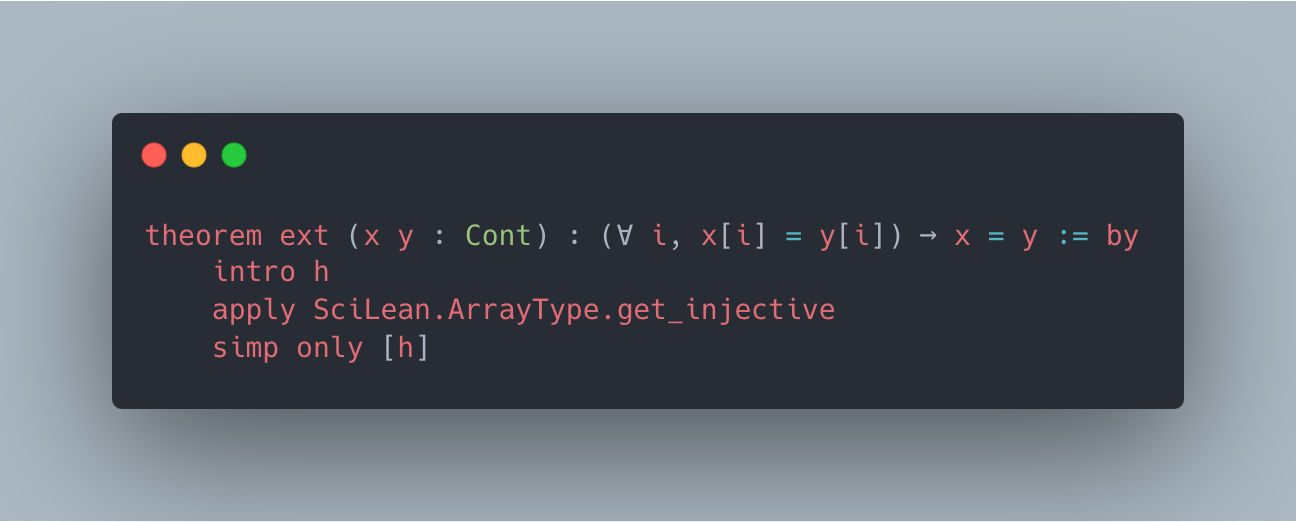
The image shows a code snippet defining a theorem named "ext" within a programming environment, likely a proof assistant or theorem prover. The code uses tactics like "intro", "apply", and "simp" to prove the theorem.
### Components/Axes
* **Code Block:** The main area containing the code.
* **Syntax Highlighting:** Different keywords and variables are highlighted with different colors.
* **Top-Left Indicators:** Three circles (red, yellow, green) are present in the top-left corner, resembling window control buttons.
### Detailed Analysis or ### Content Details
The code snippet contains the following lines:
1. `theorem ext (x y : Cont) : (∀i, x[i] = y[i]) → x = y := by`
* This line defines a theorem named "ext".
* It takes two arguments, `x` and `y`, both of type `Cont`.
* The theorem states: "For all `i`, if `x[i]` equals `y[i]`, then `x` equals `y`."
* The `:= by` indicates the start of the proof.
2. `intro h`
* This line introduces a hypothesis `h`.
3. `apply SciLean.ArrayType.get_injective`
* This line applies the `get_injective` property from `SciLean.ArrayType`.
4. `simp only [h]`
* This line simplifies the goal using the hypothesis `h`.
### Key Observations
* The code snippet appears to be written in a language designed for formal verification or theorem proving.
* The theorem "ext" likely relates to the extensionality of arrays or some similar data structure.
* The `SciLean` namespace suggests the code is part of a larger library or framework.
### Interpretation
The code snippet defines and proves a theorem related to the equality of two objects (`x` and `y`) based on the equality of their elements at every index `i`. The theorem leverages the `get_injective` property of `SciLean.ArrayType`, indicating that the elements of the array uniquely determine the array itself. The proof uses tactics like `intro` and `simp` to manipulate the goal and hypotheses, ultimately proving the theorem. This type of code is commonly found in formal verification and theorem proving environments, where rigorous mathematical proofs are constructed and verified by a computer.