## Code Snippet: Lean Theorem Proof
### Overview
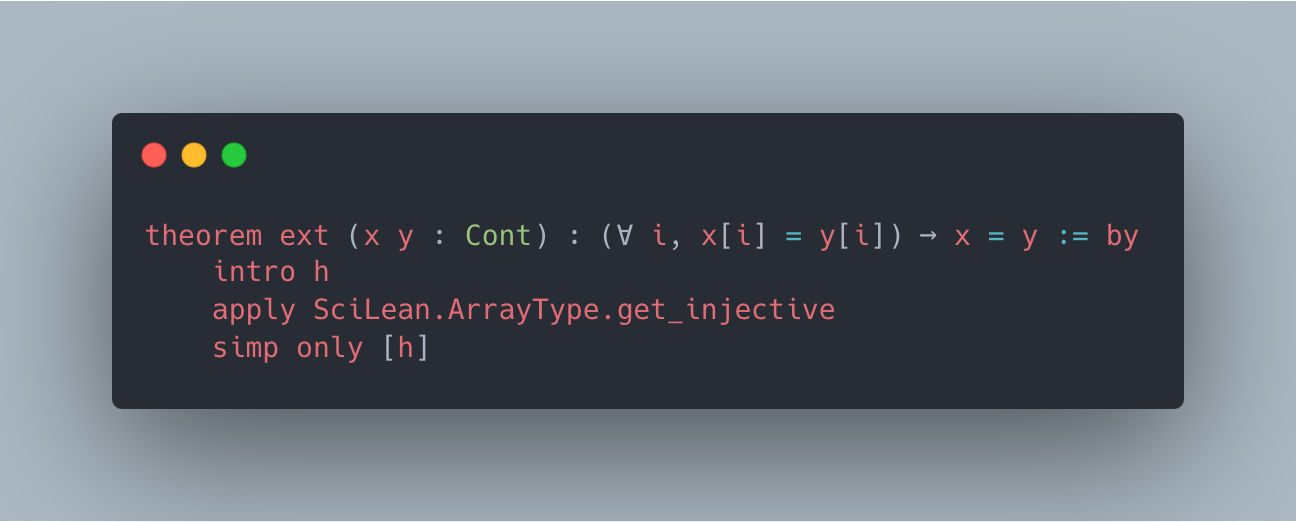
The image displays a screenshot of a code editor window containing a formal theorem statement and its proof in a language that appears to be Lean or a similar dependent type theory proof assistant. The code is presented in a dark-themed editor with syntax highlighting.
### Components/Axes
The image consists of a single, centered code block within a window frame.
1. **Window Frame:**
* A dark gray rectangular window with rounded corners.
* Top-left corner: Three colored window control dots (from left to right: red, yellow, green).
* The window is set against a light gray, slightly gradient background.
2. **Code Content:**
* The text is monospaced, typical for code editors.
* Syntax highlighting is applied:
* Keywords (`theorem`, `by`, `intro`, `apply`, `simp`, `only`) are in a salmon/pink color.
* The type `Cont` is in a teal/green color.
* The theorem name `ext` and the hypothesis name `h` are in the default text color (light gray/white).
* The proof term `SciLean.ArrayType.get_injective` is in the default text color.
* Logical symbols (`∀`, `→`, `:=`, `[`, `]`) and punctuation are in the default text color.
### Detailed Analysis / Content Details
The complete textual content of the code block is transcribed below. The language is English, with embedded mathematical notation.
**Line 1 (Theorem Statement):**
`theorem ext (x y : Cont) : (∀ i, x[i] = y[i]) → x = y := by`
* **Transcription:** `theorem ext (x y : Cont) : (∀ i, x[i] = y[i]) → x = y := by`
* **Breakdown:**
* `theorem ext`: Declares a theorem named `ext` (likely short for "extensionality").
* `(x y : Cont)`: Declares two variables, `x` and `y`, of type `Cont` (likely a type representing containers or arrays).
* `:`: Introduces the type/claim of the theorem.
* `(∀ i, x[i] = y[i])`: The premise/hypothesis. It states: "For all indices `i`, the element at index `i` in `x` is equal to the element at index `i` in `y`."
* `→`: Logical implication ("implies").
* `x = y`: The conclusion. It states: "Therefore, `x` is equal to `y`."
* `:= by`: Begins the proof script.
**Line 2 (Proof Step 1):**
` intro h`
* **Transcription:** ` intro h`
* **Breakdown:** This tactic introduces the hypothesis `(∀ i, x[i] = y[i])` into the context and names it `h`.
**Line 3 (Proof Step 2):**
` apply SciLean.ArrayType.get_injective`
* **Transcription:** ` apply SciLean.ArrayType.get_injective`
* **Breakdown:** This tactic applies a lemma or theorem named `get_injective` from the `SciLean.ArrayType` module. The name suggests this lemma states that the "get" operation (element access via index) is injective—meaning if two arrays have the same elements at all indices, they are the same array. This is precisely the extensionality principle being proven.
**Line 4 (Proof Step 3):**
` simp only [h]`
* **Transcription:** ` simp only [h]`
* **Breakdown:** This is a simplification tactic. `simp only [h]` tells the system to simplify the goal using *only* the hypothesis `h`. In this context, it likely discharges the remaining goal generated by the `apply` tactic by directly using the equality provided by `h`.
### Key Observations
1. **Proof Structure:** The proof is concise and follows a common pattern in proof assistants: introduce the hypothesis, apply a relevant lemma, and simplify.
2. **Underlying Library:** The reference to `SciLean.ArrayType` indicates this code is part of or depends on a library named "SciLean," which likely provides formalized mathematics and data structures for scientific computing in Lean.
3. **Theorem Purpose:** The theorem `ext` establishes **functional extensionality for the container type `Cont`**. It proves that two containers are equal if and only if all their elements are equal at every index. This is a fundamental property for reasoning about equality of arrays or similar data structures in formal verification.
4. **Visual Context:** The syntax highlighting and window controls suggest this is a screenshot from a modern code editor or IDE (like VS Code with a Lean extension) rather than a plain text document.
### Interpretation
This image captures a fundamental moment in formal mathematics and software verification. The theorem being proven is not just a line of code; it's a **machine-checked guarantee** about the behavior of a data structure.
* **What it demonstrates:** It shows the process of encoding a basic mathematical intuition—"two things are the same if all their parts are the same"—into a rigorous, computer-verifiable proof. The proof relies on a pre-existing lemma (`get_injective`), highlighting how formal systems build complex truths from simpler, previously established facts.
* **How elements relate:** The hypothesis `h` (the premise of element-wise equality) is the sole input to the proof. The `apply` tactic connects this specific instance to a general principle (injectivity of the getter function). The `simp` tactic then performs the final logical connection. The entire proof is a chain of dependency from the specific goal back to foundational axioms and lemmas.
* **Significance:** In the context of the SciLean library, this theorem is likely a cornerstone for proving more complex properties about scientific computations involving arrays. It ensures that when two arrays are observed to have identical contents, they can be treated as identical for all subsequent reasoning, preventing subtle bugs in verified software. The existence of such a theorem is a hallmark of a mature formalization effort, where basic properties are explicitly proven to support higher-level development.