## Technical Diagram: Comparison of Sequential vs. Parallel Scaling Methodologies
### Overview
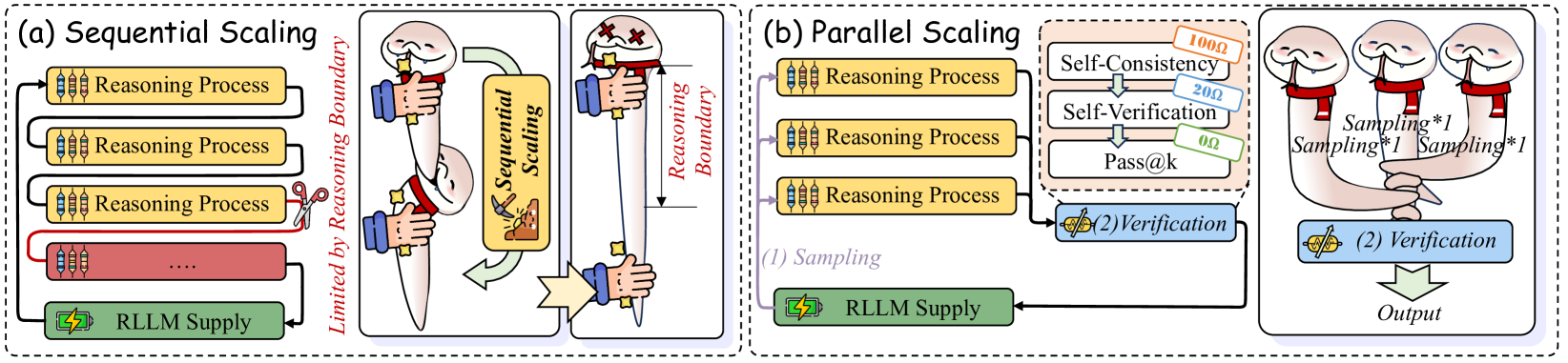
The image is a technical diagram comparing two approaches to scaling reasoning processes in AI systems, labeled as "(a) Sequential Scaling" and "(b) Parallel Scaling." It uses a combination of flowcharts and illustrative cartoons to contrast the limitations of a sequential approach with the proposed benefits of a parallel, verification-based approach.
### Components/Axes
The diagram is divided into two primary panels:
**Panel (a): Sequential Scaling (Left Side)**
* **Flowchart Components:**
* Three yellow rectangular blocks labeled **"Reasoning Process"**, each containing an icon of three stylized human figures.
* These blocks are connected in a linear, top-to-bottom chain by black arrows.
* A red line with a scissors icon cuts the connection between the third and a subsequent, partially obscured red block labeled **"...."**.
* A green rectangular block at the bottom labeled **"RLLM Supply"** with a battery icon, connected via an arrow to the chain of reasoning processes.
* Vertical red text to the right of the flowchart reads: **"Limited by Reasoning Boundary"**.
* **Illustrative Cartoon:**
* Depicts a hand gripping a sword. A second hand attempts to cut the sword with a smaller blade labeled **"Sequential Scaling"**.
* A vertical double-headed arrow next to the sword is labeled **"Reasoning Boundary"**.
* The cartoon visually represents the concept of a single point of failure or limitation in a sequential chain.
**Panel (b): Parallel Scaling (Right Side)**
* **Flowchart Components:**
* Three yellow **"Reasoning Process"** blocks (identical to those in panel a) arranged vertically but operating in parallel.
* Their outputs feed into a dashed box containing three verification methods, each with an associated resistance value:
* **"Self-Consistency"** (100Ω)
* **"Self-Verification"** (20Ω)
* **"Pass@k"** (0Ω)
* A blue block labeled **"(2) Verification"** with a crossed-out sword icon receives input from the verification methods.
* A green **"RLLM Supply"** block (same as in panel a) is connected to the system.
* A two-stage process is indicated: **"(1) Sampling"** (in purple text) leading to the reasoning processes, and **"(2) Verification"** leading to the final output.
* A final arrow points to the word **"Output"**.
* **Illustrative Cartoon:**
* Shows three hands, each holding a sword, working together. Each sword is labeled **"Sampling*1"**.
* Below them, a blue block labeled **"(2) Verification"** with the crossed-out sword icon is shown.
* An arrow points downward from this block to the word **"Output"**.
* This illustrates the concept of multiple parallel attempts ("sampling") followed by a verification step to produce a reliable result.
### Detailed Analysis
* **Sequential Scaling (a):** The model depicts a linear pipeline where reasoning processes depend on the completion of the previous one. The red scissors and cut line explicitly show this chain is vulnerable to interruption or failure at any point, which is defined as the **"Reasoning Boundary."** The system is powered by a single **"RLLM Supply."**
* **Parallel Scaling (b):** This model decouples generation from verification. The **"(1) Sampling"** phase generates multiple independent reasoning traces (the three parallel "Reasoning Process" blocks). These are then evaluated by a **"(2) Verification"** phase using methods like **Self-Consistency**, **Self-Verification**, and **Pass@k**. The decreasing resistance values (100Ω → 20Ω → 0Ω) metaphorically suggest that verification becomes less "costly" or difficult as the methods progress, with **Pass@k** having zero resistance. The final, verified result is the **"Output."**
### Key Observations
1. **Structural Contrast:** The core contrast is between a fragile, linear chain (a) and a robust, parallel-and-verify system (b).
2. **Visual Metaphors:** The sword imagery is central. In (a), a single sword is cut. In (b), multiple swords are combined and then verified, making the system more resilient.
3. **Terminology:** Key technical terms introduced are **"Reasoning Boundary"** (the limit of sequential processing) and the verification methods **"Self-Consistency," "Self-Verification,"** and **"Pass@k."**
4. **Resource Label:** Both systems are shown to be supported by an **"RLLM Supply,"** indicating a common resource or model foundation.
### Interpretation
This diagram argues for a paradigm shift in scaling AI reasoning capabilities. It posits that simply chaining reasoning steps (Sequential Scaling) hits an inherent **"Reasoning Boundary"**—a point where the process becomes too brittle or complex to continue linearly. The proposed solution is **Parallel Scaling**, which embraces a "generate-then-verify" workflow. By producing multiple candidate solutions (Sampling) and then applying rigorous, multi-faceted verification (Self-Consistency, etc.), the system can overcome the limitations of any single reasoning path. The metaphor of resistance decreasing to 0Ω implies that the verification stage, while adding a step, ultimately reduces the overall "friction" or error rate in reaching a correct output. The diagram is likely from a research paper or technical proposal advocating for verification-based architectures in large language models (LLMs) or reasoning systems.