## Diagram: Sequential vs. Parallel Scaling of Reasoning Processes
### Overview
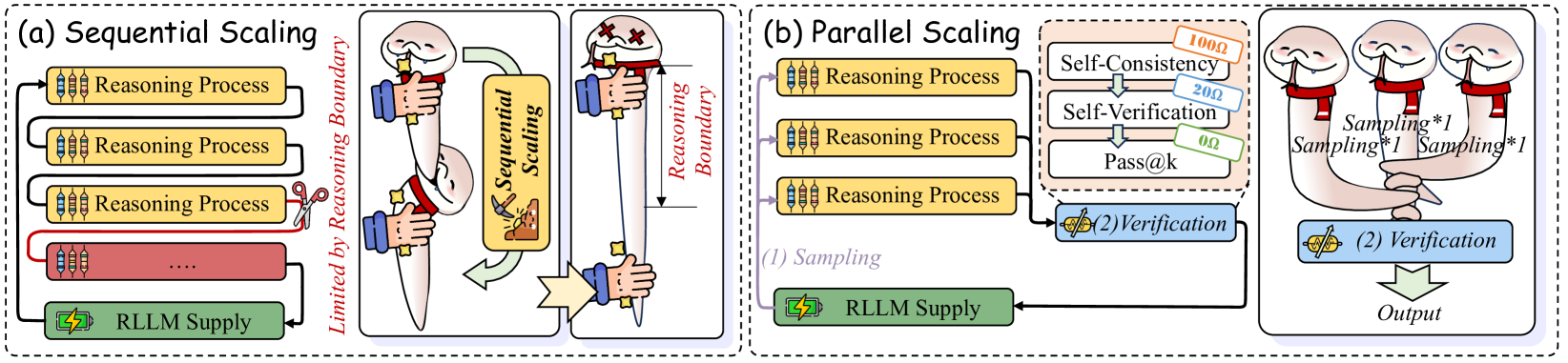
The diagram compares two scaling approaches for reasoning processes: **Sequential Scaling** (left) and **Parallel Scaling** (right). Both rely on an **RLLM Supply** (green battery icon) but differ in workflow, verification, and efficiency. Visual metaphors (e.g., hands, chains, verification gates) illustrate key concepts.
---
### Components/Axes
#### Sequential Scaling (Left)
- **Reasoning Process Blocks**: Four yellow blocks labeled "Reasoning Process" with battery icons (⚡), connected sequentially.
- **RLLM Supply**: Green battery icon at the bottom, feeding the chain.
- **Limitation**: Red arrow labeled "Limited by Reasoning Boundary" with a hand cutting a chain, symbolizing sequential constraints.
- **Visual Metaphor**: Two hands holding a chain, one cutting it with scissors.
#### Parallel Scaling (Right)
- **Reasoning Process Blocks**: Three yellow blocks labeled "Reasoning Process" with battery icons, connected to a verification system.
- **Verification System**:
- **Self-Consistency** (100Ω, orange tag)
- **Self-Verification** (20Ω, blue tag)
- **Pass@k** (0Ω, green tag)
- **Sampling & Verification**: Three hands labeled "Sampling*1" feeding into a verification gate (⚠️), producing "Output."
- **RLLM Supply**: Green battery icon at the bottom.
---
### Detailed Analysis
#### Sequential Scaling
- **Flow**: RLLM Supply → Reasoning Process 1 → Reasoning Process 2 → ... (truncated with "...").
- **Limitation**: The red arrow and chain-cutting metaphor emphasize that sequential scaling is bottlenecked by a single reasoning boundary.
- **Color Coding**: Yellow blocks (reasoning) and green RLLM supply.
#### Parallel Scaling
- **Flow**: RLLM Supply → Three parallel Reasoning Processes → Verification System → Output.
- **Verification Steps**:
1. **Self-Consistency** (100Ω): Highest confidence threshold.
2. **Self-Verification** (20Ω): Intermediate check.
3. **Pass@k** (0Ω): Final validation.
- **Sampling**: Three identical "Sampling*1" labels suggest identical sampling rates across processes.
- **Color Coding**: Yellow blocks (reasoning), blue verification tags, green RLLM supply.
---
### Key Observations
1. **Sequential Bottleneck**: The chain-cutting metaphor visually reinforces the limitation of sequential scaling.
2. **Parallel Efficiency**: Three reasoning processes operate concurrently, bypassing the single-boundary constraint.
3. **Verification Rigor**: Parallel scaling includes multi-stage verification (self-consistency → self-verification → Pass@k), implying higher reliability.
4. **Output**: Only parallel scaling produces a final "Output," suggesting sequential scaling may lack formal validation.
---
### Interpretation
The diagram argues that **parallel scaling** outperforms sequential scaling in three ways:
1. **Throughput**: Concurrent reasoning processes reduce dependency on a single boundary.
2. **Robustness**: Multi-stage verification (self-consistency, self-verification, Pass@k) ensures higher-quality outputs.
3. **Scalability**: The absence of a "Limited by Reasoning Boundary" label in parallel scaling implies better adaptability to increased workloads.
The use of Ω (ohm) symbols for verification steps is unconventional but may symbolize "resistance" to errors, with lower Ω values indicating stricter checks. The hands and chains serve as intuitive metaphors for human-like reasoning constraints and liberation through parallelization.