\n
## Charts: I/O Quantization and Scaling Performance
### Overview
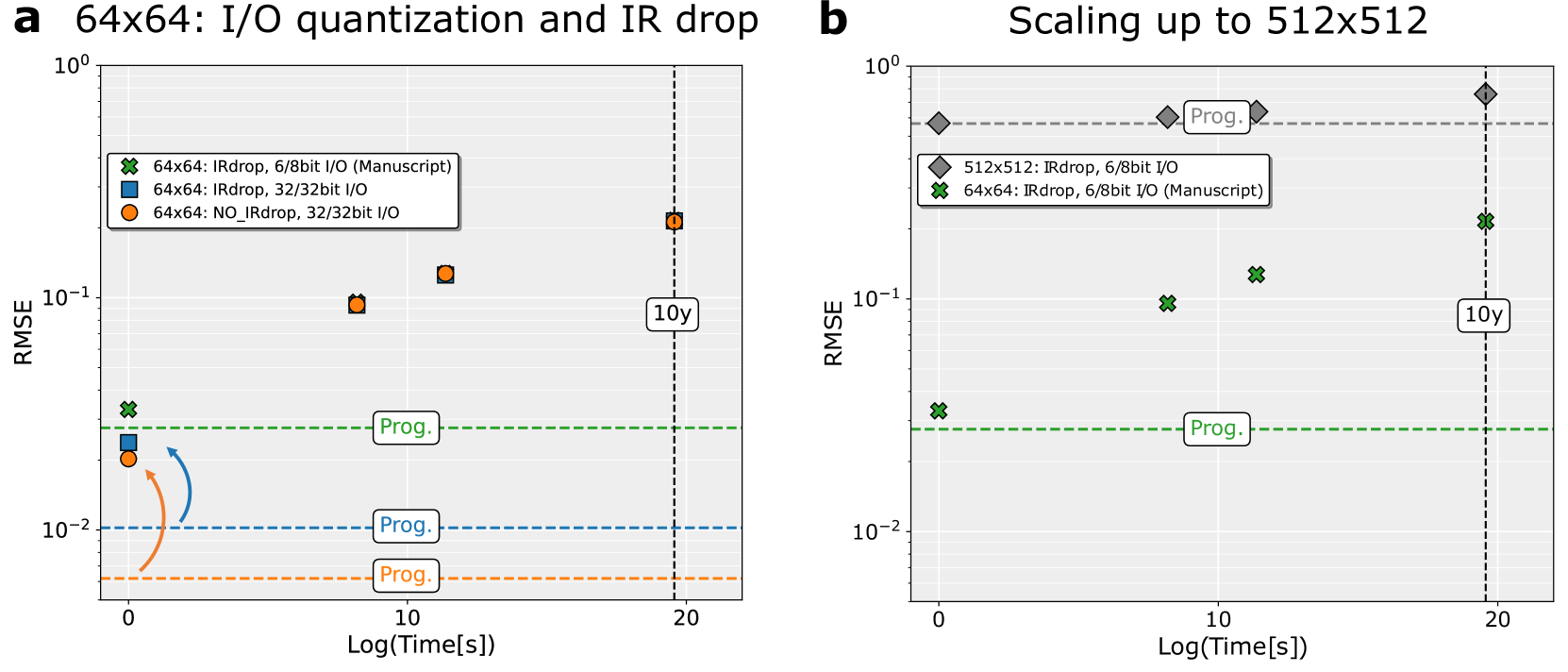
The image presents two charts (a and b) comparing the Root Mean Squared Error (RMSE) against the logarithm of time for different I/O configurations. Chart 'a' focuses on a 64x64 configuration with varying I/O quantization levels and IR drop considerations. Chart 'b' demonstrates scaling performance up to a 512x512 configuration. Both charts use a logarithmic scale for both the x and y axes.
### Components/Axes
**Common Elements:**
* **X-axis:** Log(Time[s]) - Logarithmic scale representing time in seconds. Ranges from approximately 0 to 20.
* **Y-axis:** RMSE - Root Mean Squared Error, representing the error magnitude. Logarithmic scale ranging from 10<sup>-2</sup> to 10<sup>0</sup>.
* **Annotation:** "10y" - Appears in the top-right corner of both charts, likely indicating a time scale or a reference point.
* **Annotation:** "Prog." - Appears in both charts, likely indicating a progress marker or a point of interest.
**Chart a (64x64: I/O quantization and IR drop):**
* **Title:** "64x64: I/O quantization and IR drop"
* **Legend:** Located in the top-left corner.
* Black Circle: "64x64: IRdrop, 6/8bit I/O (Manuscript)"
* Gray Square: "64x64: IRdrop, 32/32bit I/O"
* Orange Circle: "64x64: NO_IRdrop, 32/32bit I/O"
**Chart b (Scaling up to 512x512):**
* **Title:** "Scaling up to 512x512"
* **Legend:** Located in the top-left corner.
* Green Diamond: "512x512: IRdrop, 6/8bit I/O"
* Green Cross: "64x64: IRdrop, 6/8bit I/O (Manuscript)"
### Detailed Analysis or Content Details
**Chart a (64x64):**
* **Black Circle (IRdrop, 6/8bit I/O):** The line starts at approximately RMSE = 0.02 (2x10<sup>-2</sup>) at Log(Time) = 0, remains relatively stable until Log(Time) ≈ 10, then increases to approximately RMSE = 0.1 (1x10<sup>-1</sup>) at Log(Time) = 20.
* **Gray Square (IRdrop, 32/32bit I/O):** The line starts at approximately RMSE = 0.03 (3x10<sup>-2</sup>) at Log(Time) = 0, increases steadily to approximately RMSE = 0.12 (1.2x10<sup>-1</sup>) at Log(Time) = 10, and continues to increase to approximately RMSE = 0.2 (2x10<sup>-1</sup>) at Log(Time) = 20.
* **Orange Circle (NO_IRdrop, 32/32bit I/O):** The line starts at approximately RMSE = 0.01 (1x10<sup>-2</sup>) at Log(Time) = 0, increases to approximately RMSE = 0.03 (3x10<sup>-2</sup>) at Log(Time) = 10, and reaches approximately RMSE = 0.08 (8x10<sup>-2</sup>) at Log(Time) = 20.
**Chart b (Scaling up to 512x512):**
* **Green Diamond (512x512: IRdrop, 6/8bit I/O):** The line starts at approximately RMSE = 0.03 (3x10<sup>-2</sup>) at Log(Time) = 0, increases to approximately RMSE = 0.08 (8x10<sup>-2</sup>) at Log(Time) = 10, and reaches approximately RMSE = 0.15 (1.5x10<sup>-1</sup>) at Log(Time) = 20.
* **Green Cross (64x64: IRdrop, 6/8bit I/O):** The line starts at approximately RMSE = 0.02 (2x10<sup>-2</sup>) at Log(Time) = 0, increases to approximately RMSE = 0.05 (5x10<sup>-2</sup>) at Log(Time) = 10, and reaches approximately RMSE = 0.1 (1x10<sup>-1</sup>) at Log(Time) = 20.
### Key Observations
* In Chart a, the 32/32bit I/O configurations (both with and without IR drop) exhibit higher RMSE values compared to the 6/8bit I/O configuration. The configuration *without* IR drop performs best.
* In Chart b, the 512x512 configuration shows a higher RMSE than the 64x64 configuration across all time scales, indicating a performance degradation with scaling.
* Both charts show an increasing RMSE with increasing Log(Time), suggesting that the error accumulates over time.
* The "Prog." annotations appear at similar RMSE values in both charts, potentially indicating a performance threshold or a point of interest in the error behavior.
### Interpretation
The data suggests that I/O quantization and IR drop significantly impact the accuracy (as measured by RMSE) of the system. Lower bit-width I/O (6/8bit) generally results in lower RMSE values, especially when IR drop is considered. The absence of IR drop further improves performance.
Scaling the system from 64x64 to 512x512 introduces increased RMSE, indicating that the performance benefits of scaling are offset by increased error. This could be due to increased complexity, signal interference, or other factors associated with larger system sizes.
The consistent upward trend of RMSE with time suggests that the error is not static but accumulates over time, potentially due to drift or other time-dependent effects. The "Prog." annotations might represent a point where the error reaches an unacceptable level, triggering a corrective action or indicating a system limitation.
The charts provide valuable insights into the trade-offs between I/O configuration, system size, and accuracy. Optimizing I/O quantization and mitigating IR drop are crucial for maintaining low error rates, while scaling requires careful consideration of potential performance degradation.