## Diagram: AI Interaction Experiment
### Overview
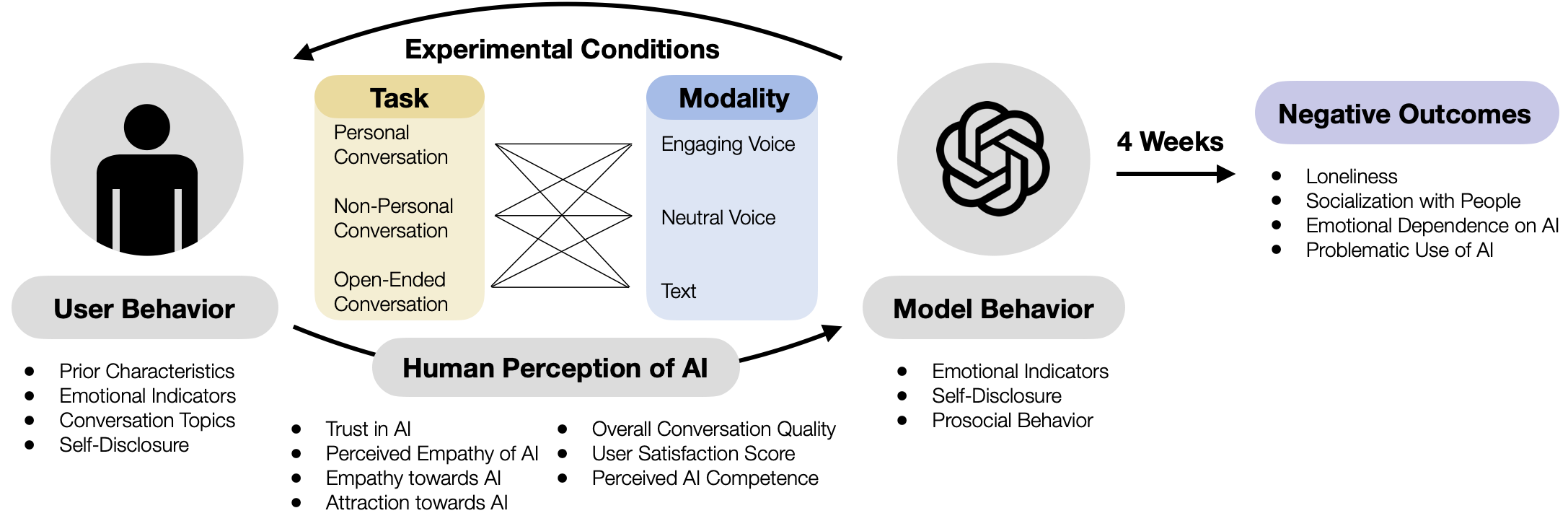
The diagram illustrates an experimental setup for studying the interaction between users and an AI model. It outlines the experimental conditions, user behavior, model behavior, human perception of AI, and potential negative outcomes. The diagram shows the flow of interaction and the factors being considered in the experiment.
### Components/Axes
* **User Behavior** (Left): This section focuses on the characteristics and behaviors of the user interacting with the AI.
* Prior Characteristics
* Emotional Indicators
* Conversation Topics
* Self-Disclosure
* **Experimental Conditions** (Top-Center): This section outlines the variables being manipulated in the experiment.
* **Task** (Yellow):
* Personal Conversation
* Non-Personal Conversation
* Open-Ended Conversation
* **Modality** (Blue):
* Engaging Voice
* Neutral Voice
* Text
* **Human Perception of AI** (Bottom-Center): This section focuses on how users perceive the AI.
* Trust in AI
* Perceived Empathy of AI
* Empathy towards AI
* Attraction towards AI
* Overall Conversation Quality
* User Satisfaction Score
* Perceived AI Competence
* **Model Behavior** (Center-Right): This section focuses on the behavior of the AI model.
* Emotional Indicators
* Self-Disclosure
* Prosocial Behavior
* **Negative Outcomes** (Right): This section lists potential negative consequences of interacting with the AI.
* Loneliness
* Socialization with People
* Emotional Dependence on AI
* Problematic Use of AI
* **Timeframe**: 4 Weeks (Indicates the duration of the experiment)
### Detailed Analysis or ### Content Details
* **User Behavior**: The diagram lists four aspects of user behavior that are being observed or measured: prior characteristics, emotional indicators, conversation topics, and self-disclosure.
* **Experimental Conditions**: The experiment manipulates two factors: the task and the modality. The task can be a personal conversation, a non-personal conversation, or an open-ended conversation. The modality can be an engaging voice, a neutral voice, or text. The diagram shows that each task is connected to each modality, indicating a factorial design.
* **Human Perception of AI**: The diagram lists seven aspects of human perception of AI: trust in AI, perceived empathy of AI, empathy towards AI, attraction towards AI, overall conversation quality, user satisfaction score, and perceived AI competence.
* **Model Behavior**: The diagram lists three aspects of model behavior that are being observed or measured: emotional indicators, self-disclosure, and prosocial behavior.
* **Negative Outcomes**: The diagram lists four potential negative outcomes of interacting with the AI: loneliness, socialization with people, emotional dependence on AI, and problematic use of AI.
* **Flow**: The diagram shows a circular flow from user behavior to experimental conditions to model behavior and back to user behavior, indicating a feedback loop. The human perception of AI is influenced by the experimental conditions and model behavior. The model behavior leads to negative outcomes after 4 weeks.
### Key Observations
* The diagram highlights the complex interplay between user behavior, experimental conditions, model behavior, and human perception of AI.
* The diagram suggests that the experiment is designed to investigate the potential negative consequences of interacting with AI.
* The diagram shows that the experiment is designed to investigate the impact of different tasks and modalities on user behavior and human perception of AI.
### Interpretation
The diagram represents a research framework for studying the effects of AI interaction on users. It suggests that the researchers are interested in understanding how different types of conversations (personal, non-personal, open-ended) and different modalities (engaging voice, neutral voice, text) affect user behavior, human perception of AI, and model behavior. The diagram also highlights the potential negative outcomes of interacting with AI, such as loneliness, emotional dependence, and problematic use. The experiment appears to be designed to identify the factors that contribute to these negative outcomes and to develop strategies for mitigating them. The 4-week timeframe suggests a longitudinal study to observe the long-term effects of AI interaction.