TECHNICAL ASSET FINGERPRINT
7932c22e1dac4883da906186
Click to view fullscreen
Press ESC or click to close
FOUND IN PAPERS
EXPERT: gemini-2.0-flash VERSION 1
RUNTIME: nugit/gemini/gemini-2.0-flash
INTEL_VERIFIED
## System Architecture Diagrams
### Overview
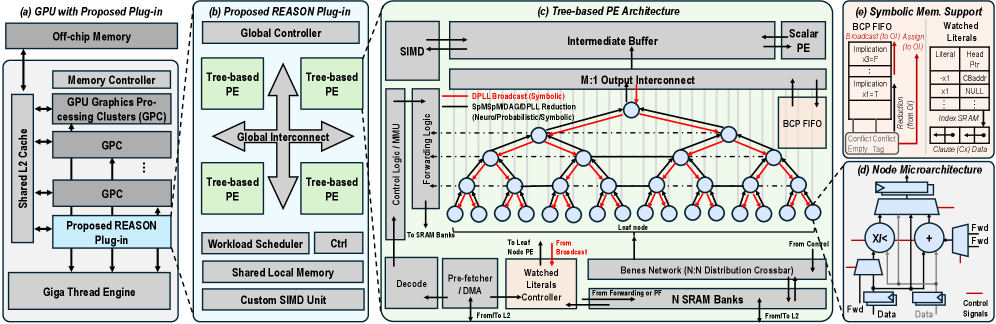
The image presents a set of diagrams illustrating the architecture and components of a system incorporating a "Proposed REASON Plug-in." It includes diagrams of a GPU with the plug-in, the plug-in itself, a tree-based processing element (PE) architecture, a node microarchitecture, and symbolic memory support.
### Components/Axes
* **(a) GPU with Proposed Plug-in:**
* **Components:** Off-chip Memory, Memory Controller, GPU Graphics Processing Clusters (GPC), Shared L2 Cache, Proposed REASON Plug-in, Giga Thread Engine.
* **Flow:** Arrows indicate data flow between components.
* **(b) Proposed REASON Plug-in:**
* **Components:** Global Controller, Tree-based PE (x4), Global Interconnect, Workload Scheduler, Ctrl, Shared Local Memory, Custom SIMD Unit.
* **Flow:** Arrows indicate data flow between components. The Global Interconnect has arrows pointing in all four cardinal directions.
* **(c) Tree-based PE Architecture:**
* **Components:** Intermediate Buffer, M:1 Output Interconnect, Tree structure with nodes, Leaf node, Control Logic/MMU, Forwarding Logic, Decode, Pre-fetcher/DMA, Watched Literals Controller, Benes Network (N:N Distribution Crossbar), N SRAM Banks.
* **Data Flow:**
* DPLL Broadcast (Symbolic) and SpMSPM/DAG/DPLL Reduction (Neuro/Probabilistic/Symbolic) flow through the tree structure.
* Red arrows indicate "From Broadcast".
* Black arrows indicate other data flow.
* "To Leaf Node PE" and "From Broadcast" are indicated at the bottom.
* "From/To L2" is indicated at the bottom.
* **(d) Node Microarchitecture:**
* **Components:** Logic gates, adders, multiplexers, Fwd, Data, Control Signals.
* **Flow:** Arrows indicate data flow and control signals.
* **(e) Symbolic Mem. Support:**
* **Components:** BCP FIFO, Watched Literals, Index SRAM, Clause (Cx) Data.
* **BCP FIFO:** Shows "Broadcast (to Ol) Assign (to Ol)" and "Reduction (from Ol)".
* **Watched Literals:** Table with columns "Literal" and "Head Ptr". Example entries: "-x1" with "C8addr", "x1" with "NULL".
### Detailed Analysis or Content Details
* **GPU with Proposed Plug-in:**
* The Proposed REASON Plug-in is positioned between the GPC and the Giga Thread Engine.
* The Shared L2 Cache connects to the Memory Controller and the GPCs.
* **Proposed REASON Plug-in:**
* The Global Controller is connected to four Tree-based PEs via the Global Interconnect.
* The Workload Scheduler and Ctrl are connected to the Shared Local Memory and Custom SIMD Unit.
* **Tree-based PE Architecture:**
* The tree structure has multiple layers of nodes, culminating in the Leaf nodes.
* The M:1 Output Interconnect connects the top node to the Intermediate Buffer.
* The Watched Literals Controller is connected to the N SRAM Banks via the Benes Network.
* **Node Microarchitecture:**
* The diagram shows a detailed view of a node, including logic gates, adders, and multiplexers.
* "XI<" is a key component.
* **Symbolic Mem. Support:**
* The BCP FIFO handles broadcast and reduction operations.
* The Watched Literals table stores literal and head pointer information.
* The Index SRAM and Clause (Cx) Data are used for clause data storage.
### Key Observations
* The Proposed REASON Plug-in is designed to integrate with a GPU architecture.
* The Tree-based PE Architecture is a key component of the plug-in.
* Symbolic memory support is provided through the BCP FIFO and Watched Literals.
* The Node Microarchitecture provides a detailed view of the processing elements.
### Interpretation
The diagrams illustrate a complex system architecture designed for specialized processing, likely related to symbolic computation or reasoning. The Proposed REASON Plug-in appears to be an accelerator designed to enhance the capabilities of a GPU. The tree-based architecture suggests a hierarchical processing approach, while the symbolic memory support indicates the system's ability to handle symbolic data. The node microarchitecture provides insight into the low-level operations performed by the processing elements. The integration of these components suggests a system optimized for tasks requiring both parallel processing and symbolic reasoning.
DECODING INTELLIGENCE...
EXPERT: gemini-3.1-flash-lite-preview-free VERSION 1
RUNTIME: google-free/gemini-3.1-flash-lite-preview
INTEL_VERIFIED
## Diagram: Architecture of Proposed REASON Plug-in for GPU
### Overview
This image illustrates a hierarchical hardware architecture design for a specialized "REASON" plug-in integrated into a GPU environment. The architecture is designed to accelerate symbolic logic processing, specifically SAT (Boolean Satisfiability) solving, as evidenced by terminology like "DPLL," "BCP," and "Watched Literals." The diagram is segmented into five distinct modules: (a) System-level integration, (b) Plug-in high-level organization, (c) Tree-based Processing Element (PE) architecture, (d) Node microarchitecture, and (e) Symbolic memory support.
---
### Components/Axes
#### (a) GPU with Proposed Plug-in
* **Position:** Far left column.
* **Components:**
* **Top:** Off-chip Memory.
* **Middle:** Memory Controller, GPU Graphics Processing Clusters (GPC) (multiple instances), and the "Proposed REASON Plug-in."
* **Side:** Shared L2 Cache (connected to Memory Controller, GPCs, and REASON Plug-in).
* **Bottom:** Giga Thread Engine.
* **Flow:** Bi-directional arrows indicate data exchange between the REASON Plug-in, the GPCs, and the Shared L2 Cache.
#### (b) Proposed REASON Plug-in
* **Position:** Second column from the left.
* **Components:**
* **Top:** Global Controller.
* **Center:** Four "Tree-based PE" blocks arranged in a 2x2 grid, connected by a central "Global Interconnect" (represented by a cross-shaped arrow).
* **Bottom:** Workload Scheduler, Ctrl (Control), Shared Local Memory, and Custom SIMD Unit.
#### (c) Tree-based PE Architecture
* **Position:** Large central block.
* **Components:**
* **Top:** Intermediate Buffer, Scalar PE, SIMD unit.
* **Middle:** M:1 Output Interconnect.
* **Center:** A binary tree structure of nodes (represented by circles).
* **Bottom:** Control Logic/MMU, Decode, Pre-fetcher/DMA, Watched Literals Controller, Benes Network (N:N Distribution Crossbar), and N SRAM Banks.
* **Legend/Flow Logic:**
* **Red Lines:** "DPLL Broadcast (Symbolic)" - Indicates upward/downward flow for broadcasting symbolic implications.
* **Black Lines:** "SpMSpM DAG/DPLL Reduction (Neuro/Probabilistic/Symbolic)" - Indicates flow for reduction operations.
#### (d) Node Microarchitecture
* **Position:** Bottom right.
* **Components:**
* Logic blocks: Comparator (XI<), Adder (+).
* Data paths: Fwd (Forward), Data, Control Signals.
* Flow: Inputs flow into the logic blocks, with outputs labeled "Fwd" and "Data."
#### (e) Symbolic Mem. Support
* **Position:** Top right.
* **Components:**
* **BCP FIFO:** Contains "Implication x3=F" and "Implication x1=T".
* **Watched Literals Table:** Columns for "Literal" (values -x1, x1) and "Head Ptr" (values C8addr, NULL).
* **Index SRAM:** Contains "Conflict Empty" and "Conflict Tag" blocks.
* **Clause (Cx) Data:** Bottom section.
* **Flow:** Arrows indicate "Broadcast (to OI)" and "Reduction (from OI)".
---
### Detailed Analysis
* **Tree Structure (c):** The central tree consists of 15 nodes (circles) arranged in 4 levels. The root is at the top (connected to the M:1 Output Interconnect), and the leaves are at the bottom. This structure is optimized for parallel reduction operations (black lines) and broadcasting (red lines).
* **Memory Hierarchy:** The architecture utilizes a multi-tiered memory approach: Off-chip memory -> Shared L2 Cache -> Shared Local Memory (in b) -> N SRAM Banks (in c) -> Symbolic Memory Support (in e).
* **Control Flow:** The "Global Controller" in (b) orchestrates the four Tree-based PEs. Within each PE, the "Watched Literals Controller" manages the symbolic memory structures, which is critical for efficient SAT solving (avoiding the need to check every clause).
* **Node Logic (d):** The node microarchitecture is a standard arithmetic/logic unit capable of comparison and addition, likely used for calculating clause satisfaction or literal propagation.
---
### Key Observations
1. **Specialized Accelerator:** The architecture is clearly a hardware accelerator for SAT solvers. The inclusion of "DPLL" (Davis-Putnam-Logemann-Loveland algorithm), "BCP" (Boolean Constraint Propagation), and "Watched Literals" are definitive markers of this domain.
2. **Hybrid Processing:** The mention of "Neuro/Probabilistic/Symbolic" in the legend of (c) suggests this architecture is designed to handle not just pure symbolic logic, but potentially hybrid workloads that combine neural/probabilistic inference with symbolic reasoning.
3. **Scalability:** The use of a "Benes Network (N:N Distribution Crossbar)" in (c) indicates a design intended to handle high-bandwidth, non-blocking data distribution between the SRAM banks and the processing tree.
---
### Interpretation
This diagram describes a **domain-specific hardware accelerator** designed to offload computationally expensive symbolic logic tasks from a standard GPU.
* **Why it matters:** Standard GPUs are optimized for dense linear algebra (floating-point operations). SAT solving is inherently sparse, branching, and logic-heavy, which performs poorly on standard GPU architectures. This "REASON" plug-in provides a dedicated, tree-based hardware structure to handle the specific data-flow patterns of SAT solvers (reduction and broadcast).
* **The "REASON" Logic:** The architecture uses a tree-based processing element (PE) to perform parallel reductions of logic clauses. By implementing the "Watched Literals" mechanism in hardware (e), the system significantly reduces the memory bandwidth required to check clause satisfaction, a common bottleneck in software-based SAT solvers.
* **Peircean Investigative Insight:** The integration of "Neuro/Probabilistic" alongside "Symbolic" suggests this is likely a **Neuro-Symbolic AI accelerator**. It is designed to bridge the gap between neural network-based probabilistic reasoning and traditional symbolic logic, allowing the system to perform complex reasoning tasks that require both pattern recognition (neural) and logical consistency (symbolic). The "Benes Network" is a sophisticated choice for the crossbar, implying the designers prioritized high-throughput, flexible routing to prevent the logic tree from becoming a bottleneck.
DECODING INTELLIGENCE...
EXPERT: nemotron-free VERSION 1
RUNTIME: free/nvidia/nemotron-nano-12b-v2-vl:free
INTEL_VERIFIED
## Diagram: GPU Architecture with Proposed REASON Plug-in and Tree-based Processing Elements
### Overview
The diagram illustrates a multi-component GPU architecture with a proposed REASON plug-in, tree-based processing elements (PEs), symbolic memory support, and microarchitecture details. It emphasizes hierarchical data flow, parallel processing, and specialized memory management.
---
### Components/Axes
#### (a) GPU with Proposed Plug-in
- **Components**:
- Off-chip Memory → Memory Controller → GPU Graphics Processing Clusters (GPC) → Shared L2 Cache → Proposed REASON Plug-in → Giga Thread Engine.
- **Flow**: Data moves from off-chip memory through GPCs to the REASON plug-in, which interfaces with the Giga Thread Engine.
#### (b) Proposed REASON Plug-in
- **Components**:
- Global Controller → Tree-based PEs (4 instances) → Global Interconnect → Workload Scheduler → Shared Local Memory → Custom SIMD Unit.
- **Flow**: The Global Controller orchestrates Tree-based PEs via Global Interconnect, with workload scheduling and local memory management.
#### (c) Tree-based PE Architecture
- **Components**:
- SIMD → Intermediate Buffer → Scalar PE → M:1 Output Interconnect → BCP FIFO → DPLL Broadcast → SpMpMDAGIDPLL Reduction → Control Logic → Forwarding Logic → SRAM Banks → Decode → Pre-fetcher/DMA → Watched Literals → Leaf Nodes → Bennes Network → N:1 Distribution Crossbar → N SRAM Banks.
- **Flow**: Data flows from SIMD through scalar PEs, hierarchical interconnects, and memory banks, with symbolic operations (e.g., DPLL Broadcast) and conflict resolution.
#### (d) Node Microarchitecture
- **Components**:
- Forwarding Control → Fwd Data → Fwd Signals → Control Signals → Data.
- **Flow**: Internal node operations manage data and control signals for parallel execution.
#### (e) Symbolic Memory Support
- **Components**:
- BCP FIFO → BCP FIFO Broadcast → Implication → Reduction → Conflict → Empty Tag → Watched Literals.
- **Flow**: Symbolic operations (e.g., implication, reduction) are managed via BCP FIFO, with conflict resolution and literal tracking.
---
### Detailed Analysis
#### (a) GPU Architecture
- **Key Connections**:
- Shared L2 Cache is directly connected to GPCs, enabling low-latency data sharing.
- The Proposed REASON Plug-in acts as a bridge between GPCs and the Giga Thread Engine, suggesting specialized processing capabilities.
#### (b) REASON Plug-in
- **Global Interconnect**: Links all Tree-based PEs, enabling synchronized operations.
- **Workload Scheduler**: Manages task distribution to PEs, optimizing parallelism.
- **Custom SIMD Unit**: Likely accelerates specific instructions (e.g., vectorized operations).
#### (c) Tree-based PE Architecture
- **Hierarchical Structure**:
- Scalar PEs feed into M:1 Output Interconnect, reducing parallelism for efficient output handling.
- BCP FIFO manages symbolic data (e.g., implications, reductions) with conflict resolution (Conflict/Empty Tag).
- **Watched Literals**: Tracked via Pre-fetcher/DMA, indicating dynamic memory access patterns.
- **Bennes Network**: Distributes data across N SRAM Banks, suggesting N-way parallelism.
#### (d) Node Microarchitecture
- **Signal Flow**:
- Fwd Data and Fwd Signals propagate through Control Signals, enabling real-time adjustments.
- Data is processed locally before being routed to SRAM Banks.
#### (e) Symbolic Memory Support
- **BCP FIFO Operations**:
- Implication (x3-F, x1-T) and Reduction (x3-T, x1-NULL) operations are prioritized.
- Conflict resolution flags (Conflict/Empty Tag) ensure data integrity.
- Watched Literals are indexed via SRAM, with clauses (Cx) and data (Dx) stored separately.
---
### Key Observations
1. **Hierarchical Parallelism**: Tree-based PEs and M:1 Output Interconnect suggest a focus on scalable parallelism with controlled data aggregation.
2. **Symbolic Data Handling**: BCP FIFO and conflict resolution mechanisms indicate support for complex, logic-based operations (e.g., probabilistic or neuro-symbolic computing).
3. **Memory Optimization**: Shared Local Memory and N SRAM Banks reduce off-chip memory access, improving latency.
4. **REASON Plug-in Integration**: The plug-in bridges traditional GPU components (GPCs) with advanced processing units (Tree-based PEs), enabling hybrid workloads.
---
### Interpretation
- **Purpose**: The architecture targets applications requiring parallel symbolic computation (e.g., AI, cryptography) by combining GPU efficiency with specialized processing elements.
- **Innovations**:
- The REASON Plug-in introduces a novel layer for managing tree-based PEs, decoupling them from traditional GPU workflows.
- Symbolic Memory Support (BCP FIFO) addresses challenges in handling logic-heavy data, critical for neuro-symbolic systems.
- **Trade-offs**:
- Complexity in control logic (e.g., Forwarding Logic, Conflict Resolution) may increase design overhead.
- Hierarchical interconnects (Global Interconnect, Bennes Network) could introduce latency if not optimized.
- **Outliers**: The Custom SIMD Unit’s role is unclear without context, but its placement suggests it handles low-level, repetitive tasks to offload PEs.
This architecture represents a shift toward domain-specific acceleration, blending GPU generality with PE specialization for emerging computational paradigms.
DECODING INTELLIGENCE...