## Grid Chart: Binary Pattern on 10x10 Coordinate Grid
### Overview
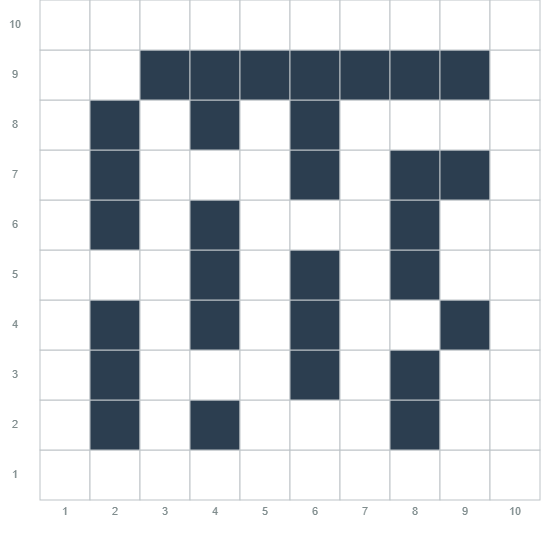
The image displays a 10x10 grid with a Cartesian coordinate system. The grid contains a pattern of filled (dark gray) and empty (white) cells, forming a specific, non-random arrangement. There is no title, legend, or explanatory text beyond the axis numbering.
### Components/Axes
- **X-Axis (Horizontal):** Labeled with integers from 1 to 10, increasing from left to right.
- **Y-Axis (Vertical):** Labeled with integers from 1 to 10, increasing from bottom to top.
- **Grid Cells:** Each cell is defined by an (x, y) coordinate pair. Cells are either filled with a solid dark gray color or are empty (white).
### Detailed Analysis
The pattern of filled cells is described below, row by row, starting from the top (y=10) and moving down to the bottom (y=1). The column numbers (x) where cells are filled are listed for each row.
* **Row y=10:** No filled cells.
* **Row y=9:** Filled cells at columns x=3, 4, 5, 6, 7, 8, 9. This forms a continuous horizontal bar spanning 7 cells.
* **Row y=8:** Filled cells at columns x=2, 4, 6.
* **Row y=7:** Filled cells at columns x=2, 6, 8, 9.
* **Row y=6:** Filled cells at columns x=2, 4, 8.
* **Row y=5:** Filled cells at columns x=4, 6, 8.
* **Row y=4:** Filled cells at columns x=2, 4, 9.
* **Row y=3:** Filled cells at columns x=2, 6, 8.
* **Row y=2:** Filled cells at columns x=2, 4, 8.
* **Row y=1:** No filled cells.
### Key Observations
1. **Symmetry:** The pattern exhibits approximate vertical symmetry around the central column (x=5.5). For example, the filled cells in row y=9 (x=3-9) are symmetric. Many other rows show mirrored or near-mirrored placements (e.g., row y=8 has x=2 and x=6 filled, which are equidistant from the center).
2. **Structural Elements:** The filled cells create distinct visual components:
* A solid horizontal bar at the top (y=9).
* Two vertical columns on the left (primarily x=2) and right (primarily x=8) sides, extending from y=2 to y=8.
* Internal vertical and horizontal segments connecting these elements, particularly in the center (x=4, x=6).
3. **Density:** The pattern is most dense in the central vertical band (columns x=4, x=6) and the outer columns (x=2, x=8). The corners (x=1, x=10) and the very top/bottom rows (y=1, y=10) are entirely empty.
### Interpretation
The image is a data visualization of a binary matrix or a pixel art design on a coordinate grid. The arrangement is intentional and structured, not random noise.
* **What it Suggests:** The pattern strongly resembles a stylized, symmetrical face or mask. The top bar (y=9) could represent a forehead or headband. The clusters of filled cells in rows y=8 through y=2 suggest eyes, a nose, and a mouth. The vertical columns on the sides (x=2, x=8) could be interpreted as the sides of the face or hair.
* **Relationship Between Elements:** The elements are interconnected to form a cohesive figure. The symmetry creates balance, while the internal variations (e.g., the filled cell at x=9 in rows y=7 and y=4) add detail and prevent perfect mirroring, giving the figure character.
* **Anomalies:** There are no data outliers in a traditional sense, as this is a categorical grid. The only "anomaly" is the slight break in perfect symmetry (e.g., row y=7 has x=9 filled but its mirror x=2 is also filled, while row y=4 has x=9 filled but its mirror x=2 is also filled, maintaining balance). This suggests a designed icon rather than a plot of empirical data.
**Conclusion:** This image is best described as a **pixel art icon or symbol** plotted on a 10x10 coordinate grid. It depicts a symmetrical, face-like figure using a binary (filled/empty) cell scheme. The primary information is the spatial arrangement of the filled cells, which has been fully extracted above.