## Neural Network Diagram: Global Workspace Model
### Overview
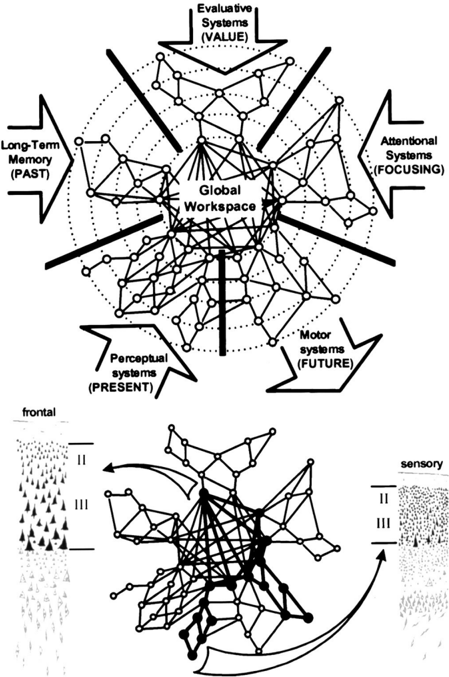
The image presents a diagram of a neural network model, specifically illustrating the concept of a "Global Workspace." The diagram depicts interconnected nodes representing different brain systems and their interactions. The top portion shows a high-level overview of the global workspace, while the bottom portion illustrates a more detailed interaction between frontal and sensory areas.
### Components/Axes
**Top Portion (Global Workspace):**
* **Central Node:** Labeled "Global Workspace" at the center.
* **Surrounding Systems (arranged radially around the Global Workspace):**
* Evaluative Systems (VALUE) - Located at the top.
* Attentional Systems (FOCUSING) - Located at the top-right.
* Motor Systems (FUTURE) - Located at the bottom-right.
* Perceptual Systems (PRESENT) - Located at the bottom-left.
* Long-Term Memory (PAST) - Located at the top-left.
* **Connections:** Nodes are interconnected with lines, indicating communication pathways. Line thickness varies, suggesting different strengths of connection.
* **Concentric Circles:** Dotted concentric circles surround the "Global Workspace," possibly representing levels of processing or influence.
* **Arrows:** Large arrows point from the system labels towards the network, indicating the flow of information into the global workspace.
**Bottom Portion (Frontal-Sensory Interaction):**
* **Frontal Area:** Labeled "frontal" on the left, with a schematic representation of cortical layers II and III.
* **Sensory Area:** Labeled "sensory" on the right, with a schematic representation of cortical layers II and III.
* **Network:** A smaller network of interconnected nodes, similar to the one in the top portion, but with some nodes highlighted in black.
* **Arrows:** Curved arrows indicate the flow of information between the frontal and sensory areas through the network.
### Detailed Analysis or ### Content Details
**Top Portion:**
* The "Global Workspace" is the central hub, receiving input from various systems.
* The systems are arranged in a circular fashion, suggesting a cyclical or iterative process.
* The connections between nodes are complex and interconnected, indicating a high degree of integration.
* The Evaluative Systems (VALUE) are positioned at the top, suggesting a role in prioritizing information.
* The Attentional Systems (FOCUSING) are positioned to the right, suggesting a role in selecting relevant information.
* The Motor Systems (FUTURE) are positioned at the bottom-right, suggesting a role in planning and executing actions.
* The Perceptual Systems (PRESENT) are positioned at the bottom-left, suggesting a role in processing sensory input.
* The Long-Term Memory (PAST) is positioned to the left, suggesting a role in retrieving relevant memories.
**Bottom Portion:**
* The frontal area is represented by a schematic diagram of cortical layers II and III, with triangles representing neurons.
* The sensory area is represented by a similar schematic diagram.
* The network connects the frontal and sensory areas, suggesting a pathway for communication between them.
* Some nodes in the network are highlighted in black, possibly indicating active or important nodes.
* The curved arrows indicate a bidirectional flow of information between the frontal and sensory areas.
### Key Observations
* The "Global Workspace" is the central hub of the network, integrating information from various systems.
* The frontal and sensory areas are interconnected, suggesting a close relationship between perception and action.
* The network is complex and interconnected, indicating a high degree of integration and communication.
### Interpretation
The diagram illustrates a model of how the brain integrates information from different systems to create a coherent representation of the world. The "Global Workspace" acts as a central hub, receiving input from evaluative, attentional, motor, perceptual, and memory systems. This integrated representation can then be used to guide behavior and decision-making. The bottom portion of the diagram highlights the interaction between frontal and sensory areas, suggesting that perception and action are closely linked. The highlighted nodes in the network may represent key areas involved in this interaction. The model suggests that consciousness arises from the integration of information in the "Global Workspace."