## Diagram: Global Workspace Theory Model
### Overview
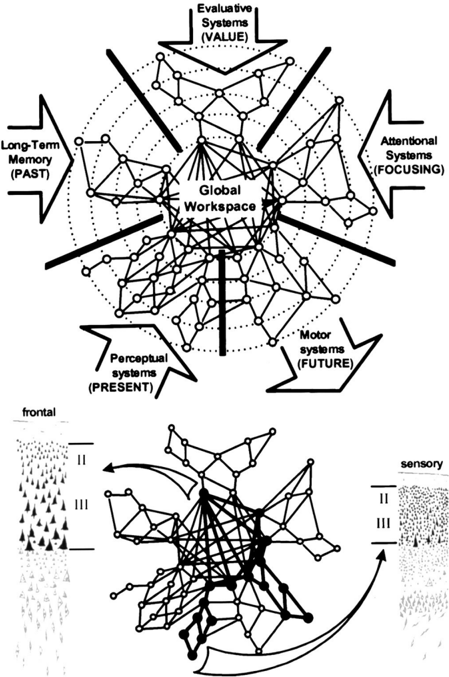
The image depicts a diagram illustrating the Global Workspace Theory (GWT) of consciousness. It shows a network of interconnected nodes representing different cognitive systems, with a central "Global Workspace" acting as a hub for information integration. The diagram is split into two main sections: a top section representing higher-level cognitive functions and a bottom section showing a more detailed network with labeled cortical layers. Arrows indicate the flow of information between these systems.
### Components/Axes
The diagram features the following key components:
* **Global Workspace:** Located at the center of the top section, labeled as "Global Workspace".
* **Cognitive Systems:** Surrounding the Global Workspace are several cognitive systems, including:
* "Evaluative Systems (VALUE)" – positioned at the top.
* "Attentional Systems (FOCUSING)" – positioned at the top-right.
* "Motor Systems (FUTURE)" – positioned at the bottom-right.
* "Perceptual Systems (PRESENT)" – positioned at the bottom-left.
* "Long-Term Memory (PAST)" – positioned at the top-left.
* **Cortical Layers:** The bottom section shows three layers labeled "I", "II", and "III". These are further divided into "frontal" (left) and "sensory" (right) areas.
* **Arrows:** Curved arrows indicate the direction of information flow between the cognitive systems and the Global Workspace. A large curved arrow in the bottom section indicates information flow between the cortical layers.
* **Nodes & Connections:** The diagram is composed of numerous nodes (circles) connected by lines, representing the network structure of the cognitive systems.
### Detailed Analysis or Content Details
The top section of the diagram shows a star-shaped network. The Global Workspace is a central node with numerous connections to the surrounding cognitive systems. The connections appear to be bidirectional, with arrows pointing both towards and away from the Global Workspace.
* **Evaluative Systems (VALUE):** Connected to the Global Workspace with multiple lines.
* **Attentional Systems (FOCUSING):** Connected to the Global Workspace with multiple lines.
* **Motor Systems (FUTURE):** Connected to the Global Workspace with multiple lines.
* **Perceptual Systems (PRESENT):** Connected to the Global Workspace with multiple lines.
* **Long-Term Memory (PAST):** Connected to the Global Workspace with multiple lines.
The bottom section shows a more detailed network of nodes and connections within the cortical layers. The connections are denser in the central region of the network.
* **Frontal Layers:** The frontal layers (I, II, III) show a dense network of connections, with a clear progression from layer I to layer III.
* **Sensory Layers:** The sensory layers (I, II, III) also show a dense network of connections, with a similar progression from layer I to layer III.
* **Layer Progression:** A curved arrow indicates information flow from the frontal layers to the sensory layers.
It is difficult to quantify the exact number of nodes and connections due to the complexity of the diagram. However, it is clear that the network is highly interconnected.
### Key Observations
* The Global Workspace appears to be a critical hub for information integration, receiving input from all the cognitive systems.
* The cortical layers show a hierarchical structure, with information flowing from the frontal layers to the sensory layers.
* The diagram suggests that consciousness arises from the global broadcasting of information within the Global Workspace.
* The density of connections in the cortical layers suggests a high degree of parallel processing.
### Interpretation
This diagram illustrates the Global Workspace Theory, which proposes that consciousness arises when information is globally broadcast within the brain. The Global Workspace acts as a central hub, integrating information from various cognitive systems, including perception, memory, attention, and evaluation. When information enters the Global Workspace, it becomes available to a wide range of cognitive processes, leading to conscious awareness.
The diagram highlights the importance of information integration in consciousness. The interconnected network of nodes and connections suggests that consciousness is not localized to a single brain region but rather emerges from the dynamic interaction of multiple cognitive systems. The hierarchical structure of the cortical layers suggests that information is processed in a sequential manner, with lower-level sensory information being integrated with higher-level cognitive processes.
The diagram also suggests that consciousness is not a passive process but rather an active one, involving attention, evaluation, and motor control. The attentional systems focus on relevant information, the evaluative systems assess its significance, and the motor systems prepare for action. This dynamic interplay of cognitive processes leads to a rich and nuanced conscious experience.
The diagram is a conceptual model and does not provide specific quantitative data. However, it offers a valuable framework for understanding the neural basis of consciousness. The diagram's complexity reflects the complexity of the phenomenon it attempts to explain.