TECHNICAL ASSET FINGERPRINT
797909c32742891069b66108
Click to view fullscreen
Press ESC or click to close
FOUND IN PAPERS
EXPERT: healer-alpha-free VERSION 1
RUNTIME: free/openrouter/healer-alpha
INTEL_VERIFIED
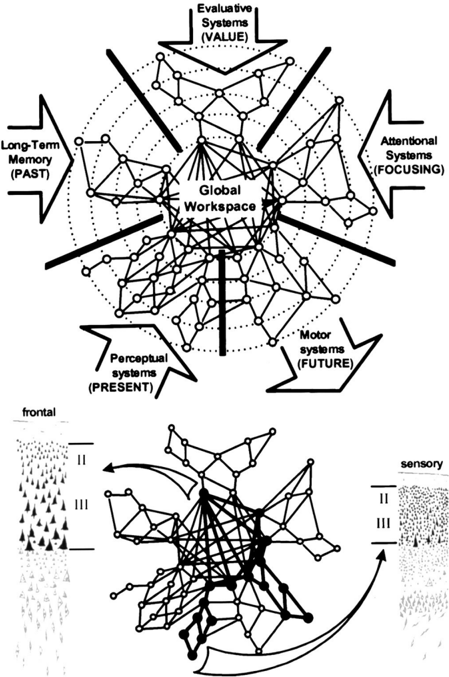
## Diagram: Cognitive Architecture Model with Global Workspace
### Overview
The image presents a two-part schematic diagram illustrating a theoretical cognitive architecture. The top section depicts a centralized "Global Workspace" model where multiple specialized systems interact. The bottom section shows a more detailed neural network representation of this workspace, with connections to "frontal" and "sensory" processing areas. The diagram is in black and white, using lines, nodes, arrows, and text labels to convey structure and information flow.
### Components/Axes
**Top Diagram - Central Workspace Model:**
* **Central Hub:** A dense, interconnected network of nodes labeled **"Global Workspace"**.
* **Surrounding Systems (with directional arrows):**
* **Top:** **"Evaluative Systems (VALUE)"** - Arrow points downward into the workspace.
* **Top-Left:** **"Long-Term Memory (PAST)"** - Arrow points inward/downward to the workspace.
* **Top-Right:** **"Attentional Systems (FOCUSING)"** - Arrow points inward/downward to the workspace.
* **Bottom-Left:** **"Perceptual systems (PRESENT)"** - Arrow points upward into the workspace.
* **Bottom-Right:** **"Motor systems (FUTURE)"** - Arrow points outward/downward from the workspace.
* **Structural Elements:** The workspace is encircled by concentric dashed circles. Thick black lines radiate from the center, dividing the space into sectors. The nodes (small circles) and connections (lines) form a complex web.
**Bottom Diagram - Network Detail:**
* **Central Network:** A detailed, irregular network of interconnected nodes (circles) and edges (lines). Some nodes are filled black, others are white.
* **Side Panels:**
* **Left Panel:** Labeled **"frontal"**. Contains vertical columns of symbols:
* Top: A sparse pattern of small dots.
* Middle: Labeled **"II"** and **"III"**. Contains rows of upward-pointing triangles (▲) and downward-pointing triangles (▼).
* Bottom: A sparse pattern of small dots.
* **Right Panel:** Labeled **"sensory"**. Contains vertical columns of symbols:
* Top: A dense pattern of small dots.
* Middle: Labeled **"II"** and **"III"**. Contains rows of upward-pointing triangles (▲) and downward-pointing triangles (▼).
* Bottom: A dense pattern of small dots.
* **Flow Arrows:** Two large, curved arrows indicate a cyclical process:
* One arrow flows from the **"frontal"** panel into the left side of the central network.
* Another arrow flows from the right side of the central network into the **"sensory"** panel.
### Detailed Analysis
**Top Diagram - Functional Relationships:**
The diagram posits a cognitive system where a central **Global Workspace** integrates information from five distinct functional systems:
1. **Evaluative Systems (VALUE):** Provides top-down value-based or motivational signals.
2. **Long-Term Memory (PAST):** Supplies stored information and past experiences.
3. **Attentional Systems (FOCUSING):** Directs cognitive resources and selects information for processing.
4. **Perceptual systems (PRESENT):** Delivers real-time sensory input from the environment.
5. **Motor systems (FUTURE):** Executes actions and plans based on the integrated information, oriented toward future outcomes.
The directional arrows are critical: Perceptual, Memory, Evaluative, and Attentional systems all **input** to the workspace. The Motor system is the primary **output** channel.
**Bottom Diagram - Structural/Process Flow:**
This section appears to model the neural or computational substrate of the workspace.
* The **"frontal"** panel likely represents prefrontal or executive regions, characterized by specific patterns (dots, triangles labeled II/III, possibly representing cortical layers or neuron types).
* The **"sensory"** panel represents primary sensory cortices, with a denser dot pattern suggesting higher input resolution.
* The central network is the **Global Workspace** itself, shown as a recurrently connected network where information from frontal and sensory areas converges and interacts.
* The cyclical arrows suggest a continuous loop: **Frontal (executive) processes -> Global Workspace integration -> Sensory processing -> back to Frontal.** This implies a dynamic, iterative cycle of perception, integration, and executive control.
### Key Observations
1. **Hierarchical vs. Distributed:** The top diagram suggests a hub-and-spoke hierarchy with the Global Workspace at the center. The bottom diagram reveals this hub is itself a complex, distributed network.
2. **Temporal Orientation:** The labels explicitly map systems to timeframes: **PAST** (Memory), **PRESENT** (Perception), **FUTURE** (Motor). Evaluative and Attentional systems are timeless modulators.
3. **Asymmetry in Flow:** The only clear output pathway from the integrated workspace is to the **Motor systems**. All other labeled systems are inputs or modulators.
4. **Symbolic Coding in Panels:** The "frontal" and "sensory" panels use abstract symbols (dots, triangles) and Roman numerals (II, III) to denote different components or layers, though their specific meaning is not defined in the image.
5. **Connectivity Density:** The central workspace in both diagrams is depicted with very high connectivity, emphasizing its role as an integration hub.
### Interpretation
This diagram illustrates a **Global Workspace Theory (GWT)** of consciousness or cognition. The core proposition is that conscious experience and integrated thought arise from a "workspace" where specialized, unconscious processors (memory, perception, attention, evaluation) compete for access. Once information enters this workspace, it is broadcast globally, making it available to all other systems, particularly the motor system for action.
* **What it Suggests:** The model argues against a single "command center" in the brain. Instead, it proposes a dynamic coalition. The "frontal" to "sensory" loop in the bottom diagram may represent the interplay between top-down expectations (from frontal cortex) and bottom-up sensory data, with the workspace resolving conflicts and generating a coherent percept.
* **Relationships:** The systems are not isolated; their functions are defined by their interaction with the workspace. Attention selects, memory contextualizes, perception provides data, evaluation assigns salience, and the motor system acts. The workspace is the stage where this play happens.
* **Anomalies/Notes:** The diagram is theoretical. The specific neural correlates of the "Global Workspace" and the exact nature of the "frontal" and "sensory" panel symbols are subjects of ongoing research in neuroscience and cognitive science. The model elegantly maps psychological functions (memory, attention) onto a proposed cognitive architecture.
DECODING INTELLIGENCE...