## Diagram: Cognitive Architecture Model
### Overview
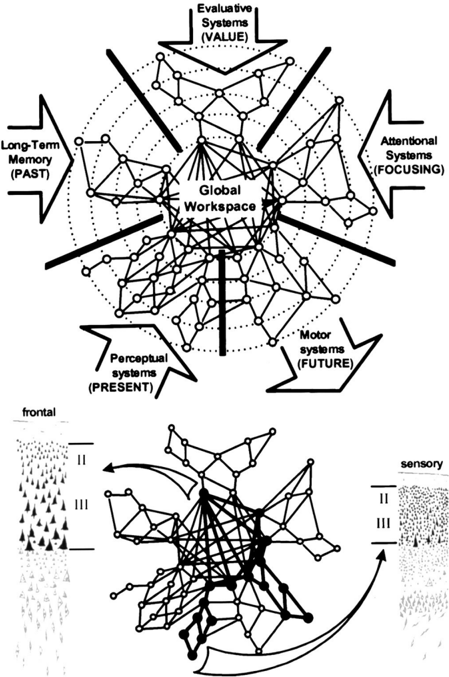
The diagram illustrates a cognitive architecture model centered around a "Global Workspace," which integrates multiple brain systems. Arrows indicate bidirectional communication between components, with labels specifying temporal (past, present, future) and functional (perceptual, motor, attentional) systems. A secondary network diagram at the bottom highlights frontal and sensory regions with directional flow.
### Components/Axes
1. **Central Node**:
- **Label**: "Global Workspace"
- **Position**: Center of the diagram.
2. **Primary Systems (Top Section)**:
- **Perceptual Systems (PRESENT)**:
- Arrows point to the Global Workspace.
- Label: "Perceptual systems (PRESENT)" (bottom-left).
- **Motor Systems (FUTURE)**:
- Arrows point to the Global Workspace.
- Label: "Motor systems (FUTURE)" (bottom-right).
- **Attentional Systems (FOCUSING)**:
- Arrows point to the Global Workspace.
- Label: "Attentional Systems (FOCUSING)" (top-right).
- **Evaluative Systems (VALUE)**:
- Arrows point to the Global Workspace.
- Label: "Evaluative Systems (VALUE)" (top-center).
- **Long-Term Memory (PAST)**:
- Arrows point to the Global Workspace.
- Label: "Long-Term Memory (PAST)" (top-left).
3. **Secondary Network (Bottom Section)**:
- **Frontal Region**:
- Label: "frontal" (left side).
- Arrows connect to sensory regions.
- **Sensory Region**:
- Label: "sensory" (right side).
- Arrows connect to frontal regions.
- **Nodes**:
- Represented as interconnected dots with lines.
### Detailed Analysis
- **Temporal Labels**:
- Systems are annotated with time references: "PRESENT" (perceptual), "FUTURE" (motor), "PAST" (long-term memory).
- **Functional Labels**:
- "FOCUSING" (attentional systems) and "VALUE" (evaluative systems) describe functional roles.
- **Connectivity**:
- All primary systems connect bidirectionally to the Global Workspace.
- Frontal and sensory regions show unidirectional flow (sensory → frontal) and feedback loops.
### Key Observations
- The Global Workspace acts as a hub for integrating information across time and function.
- Frontal and sensory regions exhibit hierarchical processing with feedback mechanisms.
- No numerical data or legends are present; the diagram emphasizes structural relationships.
### Interpretation
This model represents a dynamic cognitive framework where the Global Workspace synthesizes inputs from perceptual, motor, attentional, and memory systems. The temporal labels suggest a temporal scaffolding of cognition, with present-focused perception, future-oriented motor planning, and past-informed memory. The frontal-sensory network implies top-down (frontal) and bottom-up (sensory) processing, with feedback loops enabling adaptive behavior. The absence of numerical data prioritizes conceptual relationships over quantitative metrics, aligning with theoretical neuroscience models of consciousness and executive function.