TECHNICAL ASSET FINGERPRINT
7a1ae037a9dad40a2fb8fc04
Click to view fullscreen
Press ESC or click to close
FOUND IN PAPERS
EXPERT: gemini-2.0-flash VERSION 1
RUNTIME: nugit/gemini/gemini-2.0-flash
INTEL_VERIFIED
## Sequence Diagram: Behavioral Scenarios
### Overview
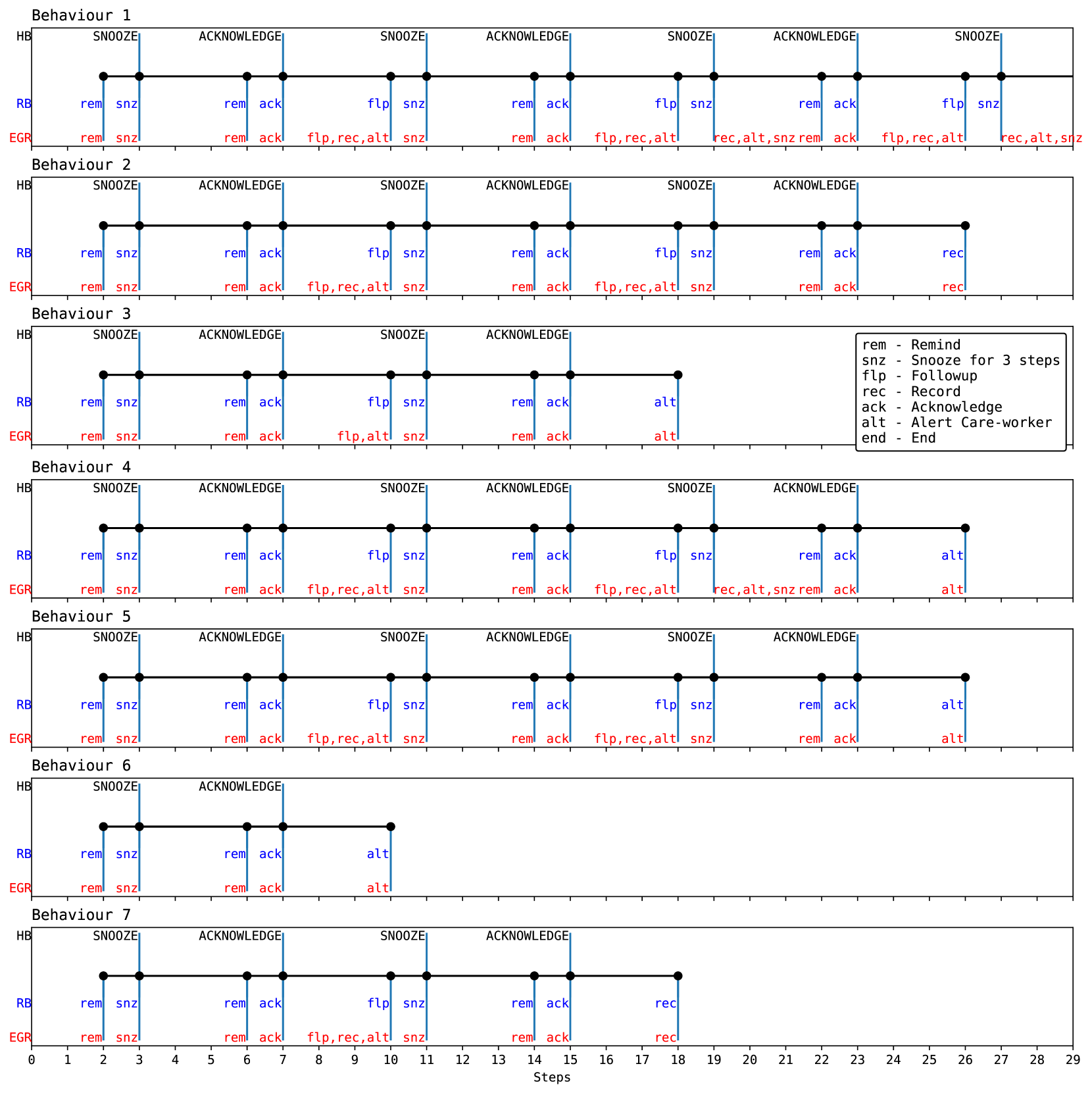
The image presents a series of sequence diagrams illustrating different behavioral scenarios. Each diagram depicts the interaction between three entities: HB (likely representing a Human Being), RB (likely representing a Robotic element), and EGR (likely representing an Environmental monitoring system). The diagrams show the sequence of actions or events over time ("Steps"), with specific actions triggered at certain points. A legend provides the meaning of the abbreviations used for the actions.
### Components/Axes
* **Title:** Each diagram is titled "Behaviour [Number]" (e.g., "Behaviour 1", "Behaviour 2", etc.). There are 7 behaviours shown.
* **Entities:**
* HB (Human Being)
* RB (Robotic element)
* EGR (Environmental monitoring system)
* **Timeline:** The horizontal axis represents "Steps," numbered from 0 to 29.
* **Actions:** Actions are represented by abbreviations, with their meanings defined in the legend:
* rem - Remind
* snz - Snooze for 3 steps
* flp - Followup
* rec - Record
* ack - Acknowledge
* alt - Alert Care-worker
* end - End
* **Visual Representation:**
* Entities are arranged vertically on the left.
* A horizontal line represents the timeline for each entity.
* Vertical blue lines indicate specific actions.
* Black dots mark the points where actions occur.
* Action abbreviations are placed near the vertical lines, with blue text for RB and red text for EGR.
### Detailed Analysis or ### Content Details
**Behaviour 1:**
* **HB:** Actions at steps 2, 6, 10, 14, 18, 22, and 26. The actions are "SNOOZE", "ACKNOWLEDGE", "SNOOZE", "ACKNOWLEDGE", "SNOOZE", "ACKNOWLEDGE", "SNOOZE".
* **RB:** Actions at steps 2, 6, 10, 14, 18, 22, and 26. The actions are "rem snz", "rem ack", "flp snz", "rem ack", "flp snz", "rem ack", "flp snz".
* **EGR:** Actions at steps 2, 6, 10, 14, 18, 22, and 26. The actions are "rem snz", "rem ack", "flp, rec, alt snz", "rem ack", "flp, rec, alt", "rec, alt, snz rem ack", "flp, rec, alt", "rec, alt, sz".
**Behaviour 2:**
* **HB:** Actions at steps 2, 6, 10, 14, 18, and 26. The actions are "SNOOZE", "ACKNOWLEDGE", "SNOOZE", "ACKNOWLEDGE", "SNOOZE", "ACKNOWLEDGE".
* **RB:** Actions at steps 2, 6, 10, 14, 18, and 26. The actions are "rem snz", "rem ack", "flp snz", "rem ack", "flp snz", "rem ack", "rec".
* **EGR:** Actions at steps 2, 6, 10, 14, 18, and 26. The actions are "rem snz", "rem ack", "flp, rec, alt snz", "rem ack", "flp, rec, alt snz", "rem ack", "rec".
**Behaviour 3:**
* **HB:** Actions at steps 2, 6, 10, and 14. The actions are "SNOOZE", "ACKNOWLEDGE", "SNOOZE", "ACKNOWLEDGE".
* **RB:** Actions at steps 2, 6, 10, and 14. The actions are "rem snz", "rem ack", "flp snz", "rem ack", "alt".
* **EGR:** Actions at steps 2, 6, 10, and 14. The actions are "rem snz", "rem ack", "flp, alt snz", "rem ack", "alt".
**Behaviour 4:**
* **HB:** Actions at steps 2, 6, 10, 14, 18, and 26. The actions are "SNOOZE", "ACKNOWLEDGE", "SNOOZE", "ACKNOWLEDGE", "SNOOZE", "ACKNOWLEDGE".
* **RB:** Actions at steps 2, 6, 10, 14, 18, and 26. The actions are "rem snz", "rem ack", "flp snz", "rem ack", "flp snz", "rem ack", "alt".
* **EGR:** Actions at steps 2, 6, 10, 14, 18, and 26. The actions are "rem snz", "rem ack", "flp, rec, alt snz", "rem ack", "flp, rec, alt", "rec, alt, snz rem ack", "alt".
**Behaviour 5:**
* **HB:** Actions at steps 2, 6, 10, 14, 18, and 26. The actions are "SNOOZE", "ACKNOWLEDGE", "SNOOZE", "ACKNOWLEDGE", "SNOOZE", "ACKNOWLEDGE".
* **RB:** Actions at steps 2, 6, 10, 14, 18, and 26. The actions are "rem snz", "rem ack", "flp snz", "rem ack", "flp snz", "rem ack", "alt".
* **EGR:** Actions at steps 2, 6, 10, 14, 18, and 26. The actions are "rem snz", "rem ack", "flp, rec, alt snz", "rem ack", "flp, rec, alt snz", "rem ack", "alt".
**Behaviour 6:**
* **HB:** Actions at steps 2, and 6. The actions are "SNOOZE", "ACKNOWLEDGE".
* **RB:** Actions at steps 2, and 6. The actions are "rem snz", "rem ack", "alt".
* **EGR:** Actions at steps 2, and 6. The actions are "rem snz", "rem ack", "alt".
**Behaviour 7:**
* **HB:** Actions at steps 2, 6, 10, and 14. The actions are "SNOOZE", "ACKNOWLEDGE", "SNOOZE", "ACKNOWLEDGE".
* **RB:** Actions at steps 2, 6, 10, and 14. The actions are "rem snz", "rem ack", "flp snz", "rem ack", "rec".
* **EGR:** Actions at steps 2, 6, 10, and 14. The actions are "rem snz", "rem ack", "flp, rec, alt snz", "rem ack", "rec".
### Key Observations
* **HB (Human Being):** The HB consistently initiates actions with "SNOOZE" and "ACKNOWLEDGE".
* **RB (Robotic element):** The RB's actions vary depending on the behavior, often involving "rem" (Remind), "snz" (Snooze), "flp" (Followup), "ack" (Acknowledge), "rec" (Record), and "alt" (Alert Care-worker).
* **EGR (Environmental monitoring system):** The EGR's actions are often more complex, involving combinations of "flp," "rec," and "alt," suggesting a more reactive role based on environmental conditions.
* **Repetitive Patterns:** Some behaviors exhibit repetitive patterns of actions, while others are more varied.
### Interpretation
The sequence diagrams illustrate different scenarios of interaction between a human being, a robotic element, and an environmental monitoring system. The diagrams likely represent different ways these entities might interact in a caregiving or assisted living environment.
* **Care Scenarios:** The behaviors likely represent different responses to events or alerts. For example, "Behaviour 1" might represent a scenario where the human repeatedly snoozes an alert, triggering a series of reminders and follow-ups.
* **Adaptive Response:** The EGR's complex actions suggest that it plays a role in adapting the system's response based on environmental conditions or the human's behavior.
* **Escalation:** The presence of "alt" (Alert Care-worker) indicates that the system can escalate situations when necessary, potentially when the human doesn't respond to reminders or follow-ups.
* **Customization:** The different behaviors suggest that the system can be customized or adapted to different user needs or preferences.
The diagrams provide a visual representation of how the system is designed to respond to different situations, highlighting the roles of each entity and the flow of actions over time.
DECODING INTELLIGENCE...
EXPERT: gemini-3.1-flash-lite-preview-free VERSION 1
RUNTIME: google-free/gemini-3.1-flash-lite-preview
INTEL_VERIFIED
## [Diagram Type]: Sequence Interaction Protocols (Behaviours 1-7)
### Overview
The image displays seven distinct timeline diagrams, labeled "Behaviour 1" through "Behaviour 7". Each diagram illustrates a sequence of interactions across three layers: **HB** (Human Behaviour/High-level), **RB** (Robot Behaviour), and **EGR** (EGR layer). The X-axis represents "Steps" from 0 to 29. The diagrams track events occurring at specific steps, with vertical lines connecting the three layers at each event point.
### Components/Axes
* **X-Axis:** "Steps" ranging from 0 to 29.
* **Y-Axis (per panel):** Three distinct levels:
* **HB (Top):** Displays high-level status labels (e.g., "SNOOZE", "ACKNOWLEDGE").
* **RB (Middle):** Displays blue text labels representing system actions.
* **EGR (Bottom):** Displays red text labels representing system actions.
* **Legend (Located in the top-right of the "Behaviour 3" panel):**
* `rem` - Remind
* `snz` - Snooze for 3 steps
* `flp` - Followup
* `rec` - Record
* `ack` - Acknowledge
* `alt` - Alert Care-worker
* `end` - End (Note: This label is present in the legend but does not appear in the charts).
### Detailed Analysis
The following data is extracted by analyzing the events at each step for every behavior.
#### Behaviour 1
* **Trend:** A repeating cycle of Snooze/Acknowledge loops.
* **Events:**
* Step 2: HB: SNOOZE | RB: rem | EGR: rem
* Step 3: RB: snz | EGR: snz
* Step 6: HB: ACKNOWLEDGE | RB: rem | EGR: rem
* Step 7: RB: ack | EGR: ack
* Step 10: HB: SNOOZE | RB: flp | EGR: flp,rec,alt
* Step 11: RB: snz | EGR: snz
* Step 14: HB: ACKNOWLEDGE | RB: rem | EGR: rem
* Step 15: RB: ack | EGR: ack
* Step 18: HB: SNOOZE | RB: flp | EGR: flp,rec,alt
* Step 19: RB: snz | EGR: snz
* Step 22: HB: ACKNOWLEDGE | RB: rem | EGR: rem
* Step 23: RB: ack | EGR: ack
* Step 26: HB: SNOOZE | RB: flp | EGR: flp,rec,alt
* Step 27: RB: snz | EGR: snz
#### Behaviour 2
* **Trend:** Similar to Behaviour 1 but ends with a "rec" action instead of a snooze loop.
* **Events:**
* Step 2: HB: SNOOZE | RB: rem | EGR: rem
* Step 3: RB: snz | EGR: snz
* Step 6: HB: ACKNOWLEDGE | RB: rem | EGR: rem
* Step 7: RB: ack | EGR: ack
* Step 10: HB: SNOOZE | RB: flp | EGR: flp,rec,alt
* Step 11: RB: snz | EGR: snz
* Step 14: HB: ACKNOWLEDGE | RB: rem | EGR: rem
* Step 15: RB: ack | EGR: ack
* Step 18: HB: SNOOZE | RB: flp | EGR: flp,rec,alt
* Step 19: RB: snz | EGR: snz
* Step 22: HB: ACKNOWLEDGE | RB: rem | EGR: rem
* Step 23: RB: ack | EGR: ack
* Step 26: RB: rec | EGR: rec
#### Behaviour 3
* **Trend:** Escalates to "alt" (Alert) earlier than previous behaviors.
* **Events:**
* Step 2: HB: SNOOZE | RB: rem | EGR: rem
* Step 3: RB: snz | EGR: snz
* Step 6: HB: ACKNOWLEDGE | RB: rem | EGR: rem
* Step 7: RB: ack | EGR: ack
* Step 10: HB: SNOOZE | RB: flp | EGR: flp,alt
* Step 11: RB: snz | EGR: snz
* Step 14: HB: ACKNOWLEDGE | RB: rem | EGR: rem
* Step 15: RB: alt | EGR: alt
#### Behaviour 4
* **Trend:** Similar to Behaviour 2, but ends with "alt" instead of "rec".
* **Events:**
* Step 2: HB: SNOOZE | RB: rem | EGR: rem
* Step 3: RB: snz | EGR: snz
* Step 6: HB: ACKNOWLEDGE | RB: rem | EGR: rem
* Step 7: RB: ack | EGR: ack
* Step 10: HB: SNOOZE | RB: flp | EGR: flp,rec,alt
* Step 11: RB: snz | EGR: snz
* Step 14: HB: ACKNOWLEDGE | RB: rem | EGR: rem
* Step 15: RB: ack | EGR: ack
* Step 18: HB: SNOOZE | RB: flp | EGR: flp,rec,alt
* Step 19: RB: snz | EGR: snz
* Step 22: HB: ACKNOWLEDGE | RB: rem | EGR: rem
* Step 23: RB: ack | EGR: ack
* Step 26: RB: alt | EGR: alt
#### Behaviour 5
* **Trend:** Identical structure to Behaviour 4.
* **Events:**
* Step 2: HB: SNOOZE | RB: rem | EGR: rem
* Step 3: RB: snz | EGR: snz
* Step 6: HB: ACKNOWLEDGE | RB: rem | EGR: rem
* Step 7: RB: ack | EGR: ack
* Step 10: HB: SNOOZE | RB: flp | EGR: flp,rec,alt
* Step 11: RB: snz | EGR: snz
* Step 14: HB: ACKNOWLEDGE | RB: rem | EGR: rem
* Step 15: RB: ack | EGR: ack
* Step 18: HB: SNOOZE | RB: flp | EGR: flp,rec,alt
* Step 19: RB: snz | EGR: snz
* Step 22: HB: ACKNOWLEDGE | RB: rem | EGR: rem
* Step 23: RB: ack | EGR: ack
* Step 26: RB: alt | EGR: alt
#### Behaviour 6
* **Trend:** Shortest sequence, terminating at step 10.
* **Events:**
* Step 2: HB: SNOOZE | RB: rem | EGR: rem
* Step 3: RB: snz | EGR: snz
* Step 6: HB: ACKNOWLEDGE | RB: rem | EGR: rem
* Step 7: RB: ack | EGR: ack
* Step 10: RB: alt | EGR: alt
#### Behaviour 7
* **Trend:** Similar to Behaviour 2, but terminates at step 18.
* **Events:**
* Step 2: HB: SNOOZE | RB: rem | EGR: rem
* Step 3: RB: snz | EGR: snz
* Step 6: HB: ACKNOWLEDGE | RB: rem | EGR: rem
* Step 7: RB: ack | EGR: ack
* Step 10: HB: SNOOZE | RB: flp | EGR: flp,rec,alt
* Step 11: RB: snz | EGR: snz
* Step 14: HB: ACKNOWLEDGE | RB: rem | EGR: rem
* Step 15: RB: ack | EGR: ack
* Step 18: RB: rec | EGR: rec
### Key Observations
* **Consistency:** Every behavior begins with the same sequence at steps 2, 3, 6, and 7 (Remind/Snooze/Acknowledge).
* **Snooze Loop:** The "snz" (Snooze) action consistently occurs at the step immediately following a "rem" (Remind) or "flp" (Followup) action, specifically at steps 3, 11, and 19.
* **Escalation:** The behaviors differ in how they handle the sequence after the initial steps. Some continue to loop (Behaviour 1), while others terminate early with "alt" (Alert) or "rec" (Record).
* **Layer Synchronization:** The RB (blue) and EGR (red) layers are almost perfectly synchronized in their actions, suggesting the EGR layer acts as a monitor or validator for the RB layer.
### Interpretation
These diagrams represent **state machine protocols** for an automated care-giving or monitoring system.
* **The Protocol:** The system initiates a "Remind" (rem) action. If the human (HB) snoozes, the system enters a 3-step snooze loop. If the human acknowledges, the system proceeds.
* **Escalation Logic:** The variation in behaviors (1-7) suggests different "paths" the system takes based on human compliance or system requirements.
* **Behaviour 1** represents a persistent loop where the system continues to remind/follow up indefinitely.
* **Behaviours 3 and 6** represent "failure" or "escalation" paths where the system gives up on the human and triggers an "Alert Care-worker" (alt) action.
* **Behaviours 2, 4, 5, and 7** represent paths where the system eventually transitions to a "Record" (rec) state, possibly indicating a successful data logging or task completion event.
* **Design Intent:** This is likely a technical specification for a robotic or automated assistant designed to manage medication or task reminders for elderly or vulnerable individuals, where "Snooze" is a user-controlled delay, and "Alert" is the safety fallback.
DECODING INTELLIGENCE...
EXPERT: nemotron-free VERSION 1
RUNTIME: free/nvidia/nemotron-nano-12b-v2-vl:free
INTEL_VERIFIED
## Sequence Diagram: Behavioral Workflow Analysis
### Overview
The image depicts a sequence diagram illustrating seven distinct behavioral workflows (Behavior 1–7) across a timeline of 29 steps. Each behavior is represented by a horizontal line with labeled actions (e.g., SNOOZE, ACKNOWLEDGE) at specific steps. The diagram uses color-coded labels (HB, RB, EGR) and action abbreviations to map interactions.
### Components/Axes
- **X-axis**: "Steps" (0–29), incrementing by 1.
- **Y-axis**: Labeled "Behavior 1" to "Behavior 7," each occupying a horizontal band.
- **Legend**: Located in the top-right corner, mapping colors to roles:
- **HB (Blue)**: Header
- **RB (Red)**: Reminder Bot
- **EGR (Black)**: Event Generator
- **Actions**: Defined in the legend with abbreviations:
- `rem` = Remind
- `sno` = Snooze for 3 steps
- `ack` = Acknowledge
- `flp` = Followup
- `rec` = Record
- `alt` = Alert Care-worker
- `end` = End
### Detailed Analysis
#### Behavior 1
- **Steps**: 0–28
- **Actions**:
- Step 1: `rem`, `sno`
- Step 4: `rem`, `ack`
- Step 7: `flp`, `rec`, `alt`
- Step 10: `flp`, `sno`
- Step 13: `rem`, `ack`
- Step 16: `flp`, `rec`, `alt`
- Step 19: `flp`, `sno`
- Step 22: `rem`, `ack`
- Step 25: `flp`, `rec`, `alt`
- Step 28: `flp`, `sno`
#### Behavior 2
- **Steps**: 0–28
- **Actions**:
- Step 1: `rem`, `sno`
- Step 4: `rem`, `ack`
- Step 7: `flp`, `sno`
- Step 10: `rem`, `ack`
- Step 13: `flp`, `rec`, `alt`
- Step 16: `flp`, `sno`
- Step 19: `rem`, `ack`
- Step 22: `flp`, `rec`, `alt`
- Step 25: `flp`, `sno`
- Step 28: `rem`, `ack`
#### Behavior 3
- **Steps**: 0–18
- **Actions**:
- Step 1: `rem`, `sno`
- Step 4: `rem`, `ack`
- Step 7: `flp`, `sno`
- Step 10: `rem`, `ack`
- Step 13: `flp`, `rec`, `alt`
- Step 16: `flp`, `sno`
- Step 18: `rem`, `ack`
#### Behavior 4
- **Steps**: 0–28
- **Actions**:
- Step 1: `rem`, `sno`
- Step 4: `rem`, `ack`
- Step 7: `flp`, `sno`
- Step 10: `rem`, `ack`
- Step 13: `flp`, `rec`, `alt`
- Step 16: `flp`, `sno`
- Step 19: `rem`, `ack`
- Step 22: `flp`, `rec`, `alt`
- Step 25: `flp`, `sno`
- Step 28: `rem`, `ack`
#### Behavior 5
- **Steps**: 0–28
- **Actions**:
- Step 1: `rem`, `sno`
- Step 4: `rem`, `ack`
- Step 7: `flp`, `sno`
- Step 10: `rem`, `ack`
- Step 13: `flp`, `rec`, `alt`
- Step 16: `flp`, `sno`
- Step 19: `rem`, `ack`
- Step 22: `flp`, `rec`, `alt`
- Step 25: `flp`, `sno`
- Step 28: `rem`, `ack`
#### Behavior 6
- **Steps**: 0–13
- **Actions**:
- Step 1: `rem`, `sno`
- Step 4: `rem`, `ack`
- Step 7: `flp`, `sno`
- Step 10: `rem`, `ack`
- Step 13: `alt`
#### Behavior 7
- **Steps**: 0–18
- **Actions**:
- Step 1: `rem`, `sno`
- Step 4: `rem`, `ack`
- Step 7: `flp`, `sno`
- Step 10: `rem`, `ack`
- Step 13: `flp`, `rec`, `alt`
- Step 16: `flp`, `sno`
- Step 18: `rem`, `ack`
### Key Observations
1. **Repetitive Cycles**: All behaviors follow a recurring pattern of `rem` → `sno` → `ack` → `flp`/`rec`/`alt` → `sno`, with variations in step counts.
2. **Early Termination**: Behavior 6 ends abruptly at step 13 with `alt`, deviating from the full 28-step cycle.
3. **Action Density**: Behaviors 1–5 and 7 have dense action sequences, while Behavior 6 is sparse.
4. **Color Consistency**: HB (blue) and RB (red) labels align with their respective roles across all behaviors.
### Interpretation
The diagram models a cyclical workflow system where:
- **HB (Header)** and **RB (Reminder Bot)** initiate actions (`rem`, `sno`) at the start of each behavior.
- **EGR (Event Generator)** triggers `ack` (acknowledge) and subsequent follow-up actions (`flp`, `rec`, `alt`).
- The `snooze` action (`sno`) introduces a 3-step delay, creating temporal gaps between interactions.
- **Behavior 6**’s early termination suggests an anomaly or edge case where the workflow is intentionally shortened.
- The repetition of `flp`, `rec`, and `alt` across behaviors implies these actions are critical for escalation or resolution in the system.
This structure likely represents a protocol for managing user interactions, such as reminders, acknowledgments, and escalations in a care-worker or automated system. The variations in step counts and actions highlight conditional logic or branching paths within the workflow.
DECODING INTELLIGENCE...