TECHNICAL ASSET FINGERPRINT
7a1ae037a9dad40a2fb8fc04
Click to view fullscreen
Press ESC or click to close
FOUND IN PAPERS
EXPERT: gemini-3.1-flash-lite-preview-free VERSION 1
RUNTIME: google-free/gemini-3.1-flash-lite-preview
INTEL_VERIFIED
## [Diagram Type]: Sequence Interaction Protocols (Behaviours 1-7)
### Overview
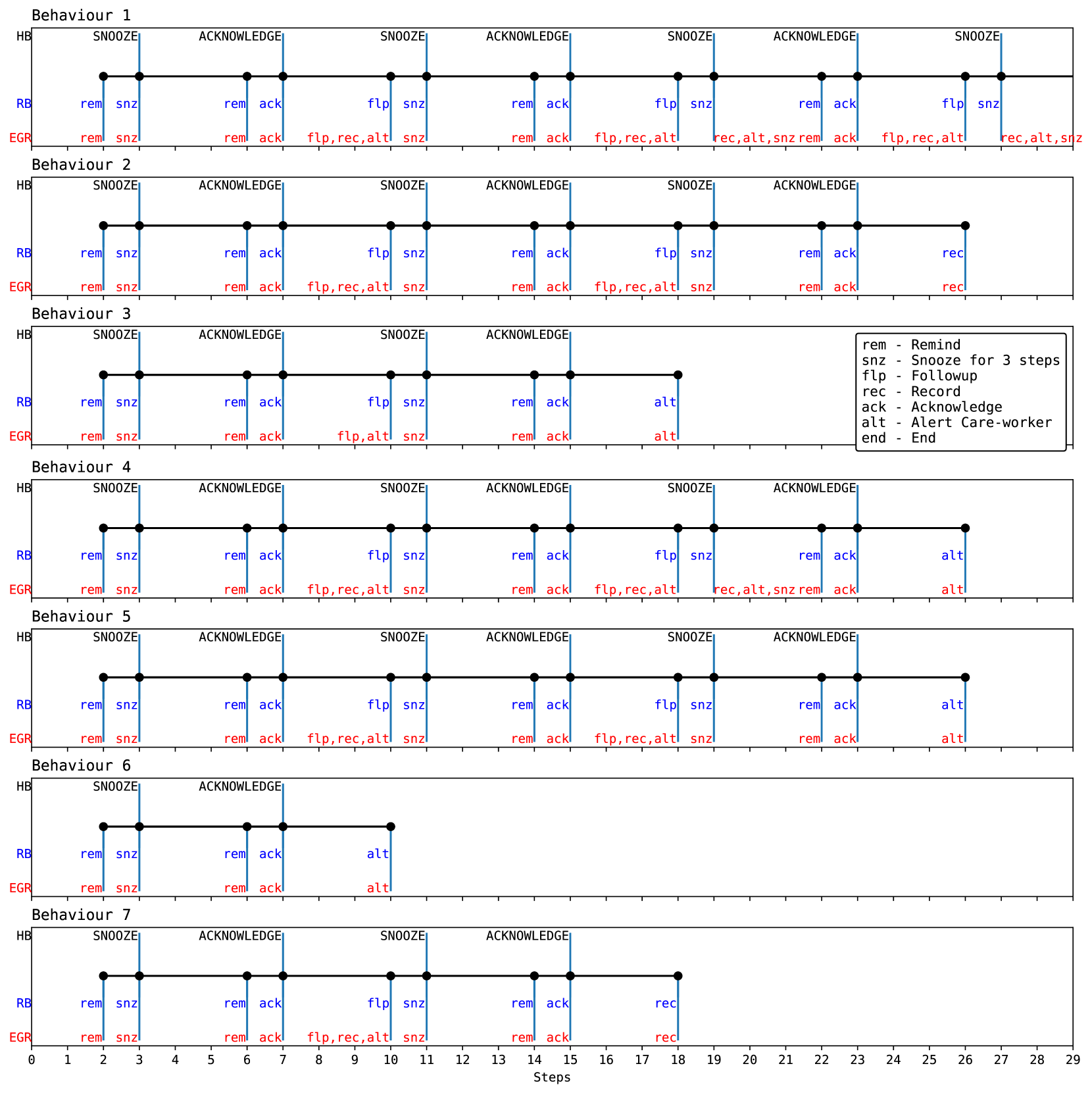
The image displays seven distinct timeline diagrams, labeled "Behaviour 1" through "Behaviour 7". Each diagram illustrates a sequence of interactions across three layers: **HB** (Human Behaviour/High-level), **RB** (Robot Behaviour), and **EGR** (EGR layer). The X-axis represents "Steps" from 0 to 29. The diagrams track events occurring at specific steps, with vertical lines connecting the three layers at each event point.
### Components/Axes
* **X-Axis:** "Steps" ranging from 0 to 29.
* **Y-Axis (per panel):** Three distinct levels:
* **HB (Top):** Displays high-level status labels (e.g., "SNOOZE", "ACKNOWLEDGE").
* **RB (Middle):** Displays blue text labels representing system actions.
* **EGR (Bottom):** Displays red text labels representing system actions.
* **Legend (Located in the top-right of the "Behaviour 3" panel):**
* `rem` - Remind
* `snz` - Snooze for 3 steps
* `flp` - Followup
* `rec` - Record
* `ack` - Acknowledge
* `alt` - Alert Care-worker
* `end` - End (Note: This label is present in the legend but does not appear in the charts).
### Detailed Analysis
The following data is extracted by analyzing the events at each step for every behavior.
#### Behaviour 1
* **Trend:** A repeating cycle of Snooze/Acknowledge loops.
* **Events:**
* Step 2: HB: SNOOZE | RB: rem | EGR: rem
* Step 3: RB: snz | EGR: snz
* Step 6: HB: ACKNOWLEDGE | RB: rem | EGR: rem
* Step 7: RB: ack | EGR: ack
* Step 10: HB: SNOOZE | RB: flp | EGR: flp,rec,alt
* Step 11: RB: snz | EGR: snz
* Step 14: HB: ACKNOWLEDGE | RB: rem | EGR: rem
* Step 15: RB: ack | EGR: ack
* Step 18: HB: SNOOZE | RB: flp | EGR: flp,rec,alt
* Step 19: RB: snz | EGR: snz
* Step 22: HB: ACKNOWLEDGE | RB: rem | EGR: rem
* Step 23: RB: ack | EGR: ack
* Step 26: HB: SNOOZE | RB: flp | EGR: flp,rec,alt
* Step 27: RB: snz | EGR: snz
#### Behaviour 2
* **Trend:** Similar to Behaviour 1 but ends with a "rec" action instead of a snooze loop.
* **Events:**
* Step 2: HB: SNOOZE | RB: rem | EGR: rem
* Step 3: RB: snz | EGR: snz
* Step 6: HB: ACKNOWLEDGE | RB: rem | EGR: rem
* Step 7: RB: ack | EGR: ack
* Step 10: HB: SNOOZE | RB: flp | EGR: flp,rec,alt
* Step 11: RB: snz | EGR: snz
* Step 14: HB: ACKNOWLEDGE | RB: rem | EGR: rem
* Step 15: RB: ack | EGR: ack
* Step 18: HB: SNOOZE | RB: flp | EGR: flp,rec,alt
* Step 19: RB: snz | EGR: snz
* Step 22: HB: ACKNOWLEDGE | RB: rem | EGR: rem
* Step 23: RB: ack | EGR: ack
* Step 26: RB: rec | EGR: rec
#### Behaviour 3
* **Trend:** Escalates to "alt" (Alert) earlier than previous behaviors.
* **Events:**
* Step 2: HB: SNOOZE | RB: rem | EGR: rem
* Step 3: RB: snz | EGR: snz
* Step 6: HB: ACKNOWLEDGE | RB: rem | EGR: rem
* Step 7: RB: ack | EGR: ack
* Step 10: HB: SNOOZE | RB: flp | EGR: flp,alt
* Step 11: RB: snz | EGR: snz
* Step 14: HB: ACKNOWLEDGE | RB: rem | EGR: rem
* Step 15: RB: alt | EGR: alt
#### Behaviour 4
* **Trend:** Similar to Behaviour 2, but ends with "alt" instead of "rec".
* **Events:**
* Step 2: HB: SNOOZE | RB: rem | EGR: rem
* Step 3: RB: snz | EGR: snz
* Step 6: HB: ACKNOWLEDGE | RB: rem | EGR: rem
* Step 7: RB: ack | EGR: ack
* Step 10: HB: SNOOZE | RB: flp | EGR: flp,rec,alt
* Step 11: RB: snz | EGR: snz
* Step 14: HB: ACKNOWLEDGE | RB: rem | EGR: rem
* Step 15: RB: ack | EGR: ack
* Step 18: HB: SNOOZE | RB: flp | EGR: flp,rec,alt
* Step 19: RB: snz | EGR: snz
* Step 22: HB: ACKNOWLEDGE | RB: rem | EGR: rem
* Step 23: RB: ack | EGR: ack
* Step 26: RB: alt | EGR: alt
#### Behaviour 5
* **Trend:** Identical structure to Behaviour 4.
* **Events:**
* Step 2: HB: SNOOZE | RB: rem | EGR: rem
* Step 3: RB: snz | EGR: snz
* Step 6: HB: ACKNOWLEDGE | RB: rem | EGR: rem
* Step 7: RB: ack | EGR: ack
* Step 10: HB: SNOOZE | RB: flp | EGR: flp,rec,alt
* Step 11: RB: snz | EGR: snz
* Step 14: HB: ACKNOWLEDGE | RB: rem | EGR: rem
* Step 15: RB: ack | EGR: ack
* Step 18: HB: SNOOZE | RB: flp | EGR: flp,rec,alt
* Step 19: RB: snz | EGR: snz
* Step 22: HB: ACKNOWLEDGE | RB: rem | EGR: rem
* Step 23: RB: ack | EGR: ack
* Step 26: RB: alt | EGR: alt
#### Behaviour 6
* **Trend:** Shortest sequence, terminating at step 10.
* **Events:**
* Step 2: HB: SNOOZE | RB: rem | EGR: rem
* Step 3: RB: snz | EGR: snz
* Step 6: HB: ACKNOWLEDGE | RB: rem | EGR: rem
* Step 7: RB: ack | EGR: ack
* Step 10: RB: alt | EGR: alt
#### Behaviour 7
* **Trend:** Similar to Behaviour 2, but terminates at step 18.
* **Events:**
* Step 2: HB: SNOOZE | RB: rem | EGR: rem
* Step 3: RB: snz | EGR: snz
* Step 6: HB: ACKNOWLEDGE | RB: rem | EGR: rem
* Step 7: RB: ack | EGR: ack
* Step 10: HB: SNOOZE | RB: flp | EGR: flp,rec,alt
* Step 11: RB: snz | EGR: snz
* Step 14: HB: ACKNOWLEDGE | RB: rem | EGR: rem
* Step 15: RB: ack | EGR: ack
* Step 18: RB: rec | EGR: rec
### Key Observations
* **Consistency:** Every behavior begins with the same sequence at steps 2, 3, 6, and 7 (Remind/Snooze/Acknowledge).
* **Snooze Loop:** The "snz" (Snooze) action consistently occurs at the step immediately following a "rem" (Remind) or "flp" (Followup) action, specifically at steps 3, 11, and 19.
* **Escalation:** The behaviors differ in how they handle the sequence after the initial steps. Some continue to loop (Behaviour 1), while others terminate early with "alt" (Alert) or "rec" (Record).
* **Layer Synchronization:** The RB (blue) and EGR (red) layers are almost perfectly synchronized in their actions, suggesting the EGR layer acts as a monitor or validator for the RB layer.
### Interpretation
These diagrams represent **state machine protocols** for an automated care-giving or monitoring system.
* **The Protocol:** The system initiates a "Remind" (rem) action. If the human (HB) snoozes, the system enters a 3-step snooze loop. If the human acknowledges, the system proceeds.
* **Escalation Logic:** The variation in behaviors (1-7) suggests different "paths" the system takes based on human compliance or system requirements.
* **Behaviour 1** represents a persistent loop where the system continues to remind/follow up indefinitely.
* **Behaviours 3 and 6** represent "failure" or "escalation" paths where the system gives up on the human and triggers an "Alert Care-worker" (alt) action.
* **Behaviours 2, 4, 5, and 7** represent paths where the system eventually transitions to a "Record" (rec) state, possibly indicating a successful data logging or task completion event.
* **Design Intent:** This is likely a technical specification for a robotic or automated assistant designed to manage medication or task reminders for elderly or vulnerable individuals, where "Snooze" is a user-controlled delay, and "Alert" is the safety fallback.
DECODING INTELLIGENCE...