\n
## Diagram: Behavioural Response Over Time
### Overview
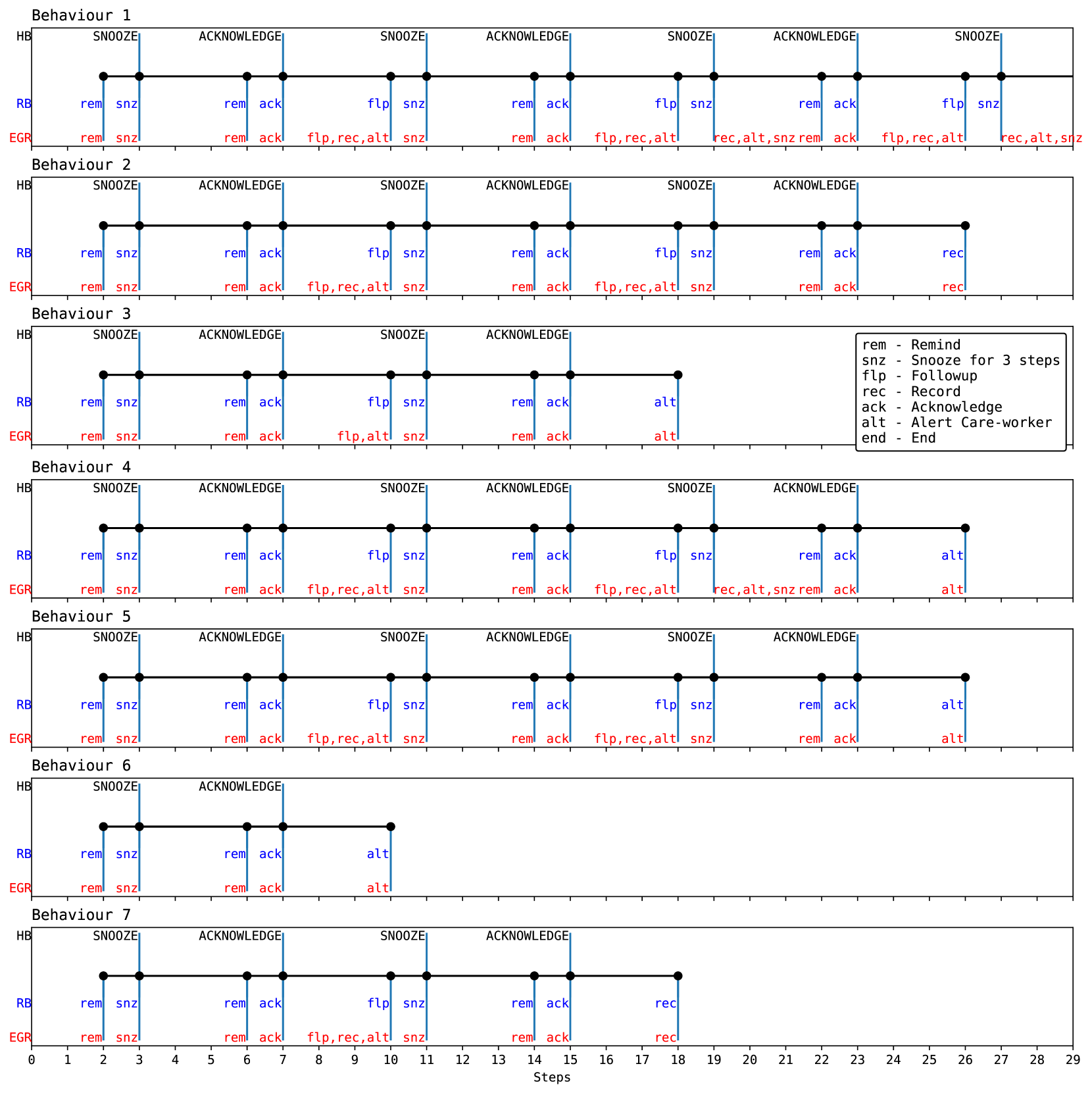
The image presents a diagram illustrating behavioural responses (HB, RB, EGR) over time, across seven different behaviours (1-7). The diagram appears to track the progression of actions like "Snooze", "Acknowledge", "Follow-up", "Record", and "Alert" in relation to a reminder system. The x-axis represents time, and the diagram uses coloured rectangles to indicate the occurrence and duration of each action.
### Components/Axes
* **X-axis:** Time, ranging from 0 to 28, with markers at integer values.
* **Y-axis:** Seven behaviours, labelled 1 through 7, stacked vertically.
* **Rows:** Each row represents a different behaviour.
* **Columns:** Each column represents a stage in the behaviour, with labels "SNOOZE", "ACKNOWLEDGE", "SNOOZE", "ACKNOWLEDGE", "SNOOZE", "ACKNOWLEDGE", "SNOOZE".
* **Legend:** Located in the bottom-right corner, defining the colour-coding for different actions:
* rem: Remind (Blue)
* snz: Snooze for 3 steps (Light Blue)
* flp: Followup (Green)
* rec: Record (Red)
* ack: Acknowledge (Yellow)
* alt: Alert Care-worker (Orange)
* end: End (Black)
* **Behaviour Labels:** "Behaviour 1" through "Behaviour 7" are placed to the left of each row.
* **Response Labels:** "HB", "RB", and "EGR" are placed to the left of each behaviour row.
### Detailed Analysis or Content Details
Let's analyze each behaviour individually, noting the sequence and duration of actions based on the coloured rectangles.
**Behaviour 1:**
* HB: Snooze (0-2)
* RB: Remind, Snooze (0-2), Remind, Acknowledge (2-4), Follow-up, Snooze (4-6), Remind, Acknowledge (6-8), Follow-up, Snooze (8-10)
* EGR: Remind, Snooze (0-2), Remind, Acknowledge (2-4), Follow-up, Record, Alert (4-6), Follow-up, Record, Alert, Snooze (6-8), Remind, Acknowledge (8-10)
**Behaviour 2:**
* HB: Snooze (0-2)
* RB: Remind, Snooze (0-2), Remind, Acknowledge (2-4), Follow-up, Snooze (4-6), Remind, Acknowledge (6-8), Follow-up, Record, Alert, Snooze (8-10)
* EGR: Remind, Snooze (0-2), Remind, Acknowledge (2-4), Follow-up, Record, Alert, Snooze (4-6), Remind, Acknowledge (6-8), Record (8-10)
**Behaviour 3:**
* HB: Snooze (0-2)
* RB: Remind, Snooze (0-2), Remind, Acknowledge (2-4), Follow-up, Snooze (4-6), Remind, Acknowledge (6-8), Alert (8-10)
* EGR: Remind, Snooze (0-2), Remind, Acknowledge (2-4), Follow-up, Record, Alert, Snooze (4-6), Remind, Acknowledge (6-8), Record (8-10)
**Behaviour 4:**
* HB: Snooze (0-2)
* RB: Remind, Snooze (0-2), Remind, Acknowledge (2-4), Follow-up, Snooze (4-6), Remind, Acknowledge (6-8), Follow-up, Record, Alert, Snooze (8-10)
* EGR: Remind, Snooze (0-2), Remind, Acknowledge (2-4), Follow-up, Record, Alert, Snooze (6-8), Remind, Acknowledge (8-10)
**Behaviour 5:**
* HB: Snooze (0-2)
* RB: Remind, Snooze (0-2), Remind, Acknowledge (2-4), Follow-up, Snooze (4-6), Remind, Acknowledge (6-8), Follow-up, Record, Alert, Snooze (8-10)
* EGR: Remind, Snooze (0-2), Remind, Acknowledge (2-4), Follow-up, Record, Alert, Snooze (6-8), Remind, Acknowledge (8-10)
**Behaviour 6:**
* HB: Snooze (0-2)
* RB: Remind, Snooze (0-2), Remind, Acknowledge (2-4), Alert (4-6)
* EGR: Remind, Snooze (0-2), Remind, Acknowledge (2-4), Follow-up, Record, Alert, Snooze (4-6)
**Behaviour 7:**
* HB: Snooze (0-2)
* RB: Remind, Snooze (0-2), Remind, Acknowledge (2-4), Alert (4-6)
* EGR: Remind, Snooze (0-2), Follow-up, Record, Alert, Snooze (4-6), Remind, Acknowledge (6-8), Record (8-10)
### Key Observations
* The "Snooze" action is consistently the first action taken by HB across all behaviours.
* RB and EGR responses are more varied, involving sequences of Remind, Acknowledge, Follow-up, Record, and Alert.
* The "Record" action appears more frequently in EGR responses than in RB responses.
* The "Alert" action is more common in later stages of the behaviours.
* Behaviours 1-5 follow a similar pattern, while behaviours 6 and 7 show more deviation.
### Interpretation
This diagram likely represents a workflow or decision tree for a reminder system, potentially in a healthcare or caregiving context. The different behaviours represent different patient or client scenarios. The diagram illustrates how the system responds to a reminder, with options for the user to "Snooze", "Acknowledge", or trigger further actions like "Follow-up", "Record", and "Alert".
The consistent "Snooze" response from HB suggests a default or initial reaction to the reminder. The subsequent actions taken by RB and EGR indicate a more complex response, potentially based on the user's needs or the severity of the situation. The increasing use of "Record" and "Alert" actions over time suggests that the system is escalating the response if the initial reminder is not acknowledged or addressed.
The variations in behaviours 6 and 7 could represent edge cases or specific scenarios that require different handling. The diagram provides a visual representation of the system's logic and helps to understand how it adapts to different situations. The diagram is a useful tool for analyzing the system's performance and identifying areas for improvement. The diagram does not provide any quantitative data, but rather a qualitative overview of the behavioural responses.