## Sequence Diagram: Behavioral Workflow Analysis
### Overview
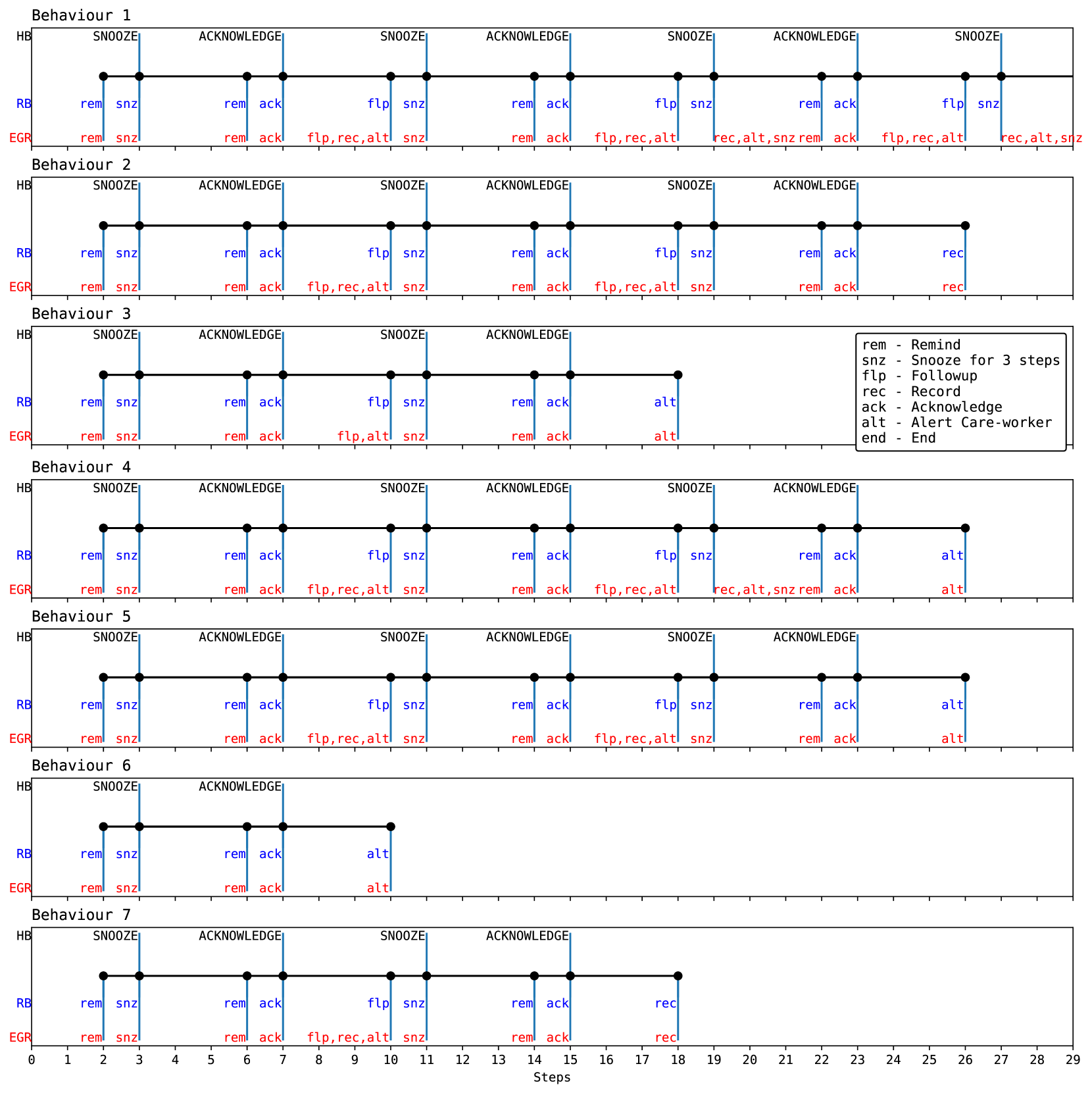
The image depicts a sequence diagram illustrating seven distinct behavioral workflows (Behavior 1–7) across a timeline of 29 steps. Each behavior is represented by a horizontal line with labeled actions (e.g., SNOOZE, ACKNOWLEDGE) at specific steps. The diagram uses color-coded labels (HB, RB, EGR) and action abbreviations to map interactions.
### Components/Axes
- **X-axis**: "Steps" (0–29), incrementing by 1.
- **Y-axis**: Labeled "Behavior 1" to "Behavior 7," each occupying a horizontal band.
- **Legend**: Located in the top-right corner, mapping colors to roles:
- **HB (Blue)**: Header
- **RB (Red)**: Reminder Bot
- **EGR (Black)**: Event Generator
- **Actions**: Defined in the legend with abbreviations:
- `rem` = Remind
- `sno` = Snooze for 3 steps
- `ack` = Acknowledge
- `flp` = Followup
- `rec` = Record
- `alt` = Alert Care-worker
- `end` = End
### Detailed Analysis
#### Behavior 1
- **Steps**: 0–28
- **Actions**:
- Step 1: `rem`, `sno`
- Step 4: `rem`, `ack`
- Step 7: `flp`, `rec`, `alt`
- Step 10: `flp`, `sno`
- Step 13: `rem`, `ack`
- Step 16: `flp`, `rec`, `alt`
- Step 19: `flp`, `sno`
- Step 22: `rem`, `ack`
- Step 25: `flp`, `rec`, `alt`
- Step 28: `flp`, `sno`
#### Behavior 2
- **Steps**: 0–28
- **Actions**:
- Step 1: `rem`, `sno`
- Step 4: `rem`, `ack`
- Step 7: `flp`, `sno`
- Step 10: `rem`, `ack`
- Step 13: `flp`, `rec`, `alt`
- Step 16: `flp`, `sno`
- Step 19: `rem`, `ack`
- Step 22: `flp`, `rec`, `alt`
- Step 25: `flp`, `sno`
- Step 28: `rem`, `ack`
#### Behavior 3
- **Steps**: 0–18
- **Actions**:
- Step 1: `rem`, `sno`
- Step 4: `rem`, `ack`
- Step 7: `flp`, `sno`
- Step 10: `rem`, `ack`
- Step 13: `flp`, `rec`, `alt`
- Step 16: `flp`, `sno`
- Step 18: `rem`, `ack`
#### Behavior 4
- **Steps**: 0–28
- **Actions**:
- Step 1: `rem`, `sno`
- Step 4: `rem`, `ack`
- Step 7: `flp`, `sno`
- Step 10: `rem`, `ack`
- Step 13: `flp`, `rec`, `alt`
- Step 16: `flp`, `sno`
- Step 19: `rem`, `ack`
- Step 22: `flp`, `rec`, `alt`
- Step 25: `flp`, `sno`
- Step 28: `rem`, `ack`
#### Behavior 5
- **Steps**: 0–28
- **Actions**:
- Step 1: `rem`, `sno`
- Step 4: `rem`, `ack`
- Step 7: `flp`, `sno`
- Step 10: `rem`, `ack`
- Step 13: `flp`, `rec`, `alt`
- Step 16: `flp`, `sno`
- Step 19: `rem`, `ack`
- Step 22: `flp`, `rec`, `alt`
- Step 25: `flp`, `sno`
- Step 28: `rem`, `ack`
#### Behavior 6
- **Steps**: 0–13
- **Actions**:
- Step 1: `rem`, `sno`
- Step 4: `rem`, `ack`
- Step 7: `flp`, `sno`
- Step 10: `rem`, `ack`
- Step 13: `alt`
#### Behavior 7
- **Steps**: 0–18
- **Actions**:
- Step 1: `rem`, `sno`
- Step 4: `rem`, `ack`
- Step 7: `flp`, `sno`
- Step 10: `rem`, `ack`
- Step 13: `flp`, `rec`, `alt`
- Step 16: `flp`, `sno`
- Step 18: `rem`, `ack`
### Key Observations
1. **Repetitive Cycles**: All behaviors follow a recurring pattern of `rem` → `sno` → `ack` → `flp`/`rec`/`alt` → `sno`, with variations in step counts.
2. **Early Termination**: Behavior 6 ends abruptly at step 13 with `alt`, deviating from the full 28-step cycle.
3. **Action Density**: Behaviors 1–5 and 7 have dense action sequences, while Behavior 6 is sparse.
4. **Color Consistency**: HB (blue) and RB (red) labels align with their respective roles across all behaviors.
### Interpretation
The diagram models a cyclical workflow system where:
- **HB (Header)** and **RB (Reminder Bot)** initiate actions (`rem`, `sno`) at the start of each behavior.
- **EGR (Event Generator)** triggers `ack` (acknowledge) and subsequent follow-up actions (`flp`, `rec`, `alt`).
- The `snooze` action (`sno`) introduces a 3-step delay, creating temporal gaps between interactions.
- **Behavior 6**’s early termination suggests an anomaly or edge case where the workflow is intentionally shortened.
- The repetition of `flp`, `rec`, and `alt` across behaviors implies these actions are critical for escalation or resolution in the system.
This structure likely represents a protocol for managing user interactions, such as reminders, acknowledgments, and escalations in a care-worker or automated system. The variations in step counts and actions highlight conditional logic or branching paths within the workflow.