# Technical Document Extraction: Diagram Analysis
## Diagram Overview
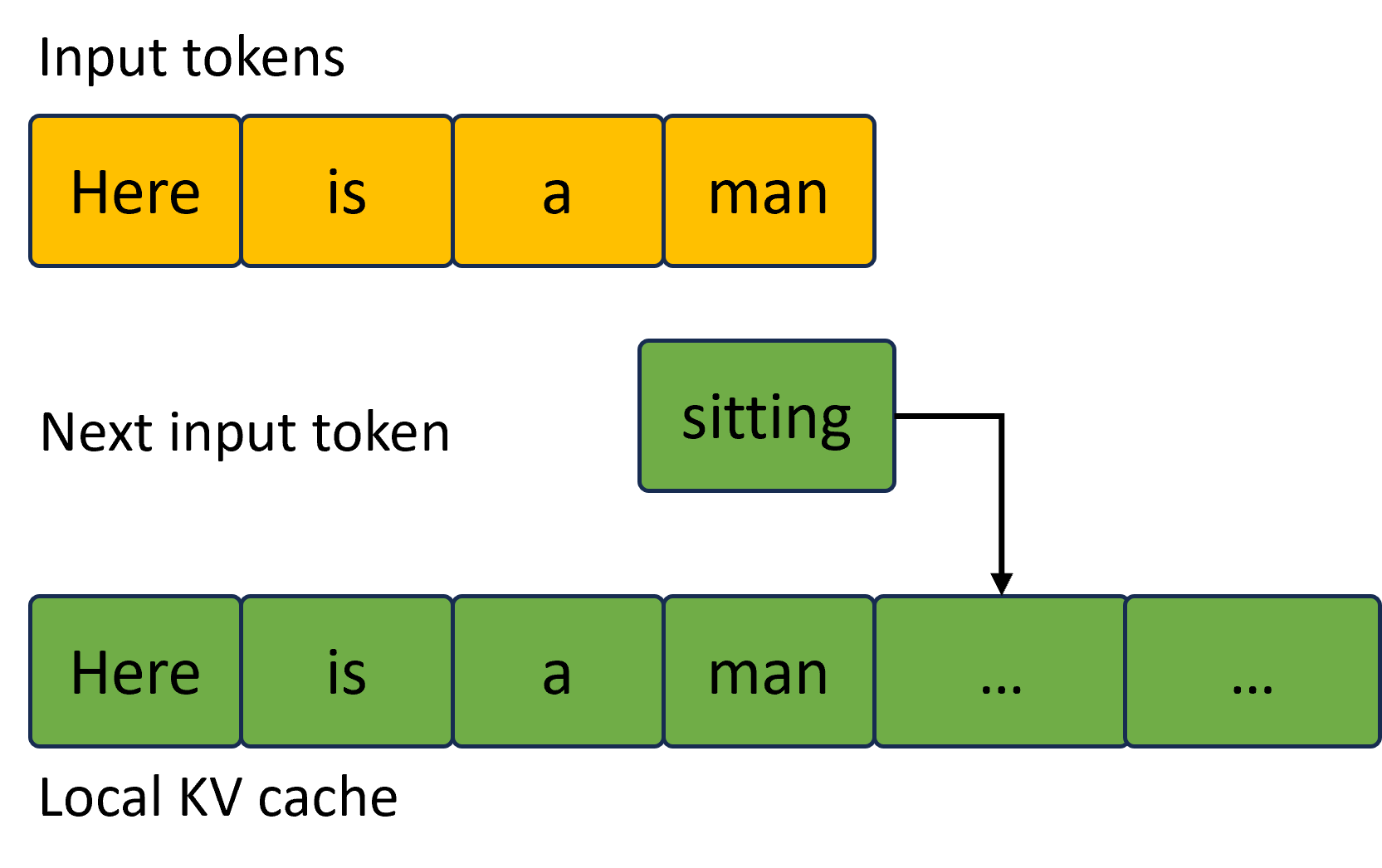
The image depicts a sequence processing workflow with three distinct components, using color-coded blocks to represent different stages. The diagram uses **orange** for initial input tokens, **green** for subsequent processing, and includes an arrow indicating data flow.
---
### 1. Input Tokens (Orange Blocks)
- **Label**: "Input tokens" (top-left header)
- **Components**:
- Four horizontally aligned orange blocks containing:
- "Here"
- "is"
- "a"
- "man"
- **Spatial Grounding**:
- Positioned at the top of the diagram
- Blocks are left-aligned and adjacent
---
### 2. Next Input Token (Green Block)
- **Label**: "Next input token" (middle-left header)
- **Components**:
- Single green block containing:
- "sitting"
- Arrow (black, downward) connects this block to the Local KV cache
- **Spatial Grounding**:
- Positioned below the Input Tokens section
- Arrow originates from the center-right of the green block
---
### 3. Local KV Cache (Green Blocks)
- **Label**: "Local KV cache" (bottom-left header)
- **Components**:
- Six horizontally aligned green blocks containing:
- "Here"
- "is"
- "a"
- "man"
- "..."
- "..."
- The first four blocks match the Input Tokens exactly
- Last two blocks contain ellipsis (`...`) indicating continuation
- **Spatial Grounding**:
- Positioned at the bottom of the diagram
- Blocks extend beyond the width of the Input Tokens section
---
### Key Observations
1. **Color Coding**:
- Orange = Initial input tokens
- Green = Processed/extended sequence
2. **Data Flow**:
- The arrow from "sitting" to the Local KV cache indicates token insertion/append operation
3. **Sequence Extension**:
- The ellipsis (`...`) suggests the cache maintains a rolling window of tokens
4. **Token Preservation**:
- Original tokens ("Here", "is", "a", "man") are preserved in the cache
---
### Diagram Structure