## Screenshot: Annotation Interface with Climate Text
### Overview
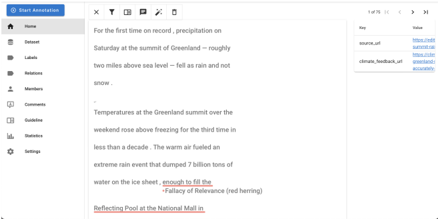
This image is a screenshot of a web-based annotation or document review interface. The primary content is a text passage discussing extreme weather events at the Greenland summit. The interface includes a navigation sidebar, a main content area with the text, a top toolbar, and a metadata panel on the right.
### Components/Axes
**1. Top Toolbar (Header Region):**
* **Left:** A blue button labeled "Start Annotation".
* **Center:** A series of icons (from left to right: an 'X', a checkmark, a comment bubble, a tag, a pencil/edit icon, a share icon, and a three-dot menu).
* **Right:** Text indicating "1 / 15" (likely page or item number) and navigation arrows.
**2. Left Sidebar (Navigation Region):**
A vertical menu with the following items, each accompanied by an icon:
* Home
* Dataset
* Labels
* Relations
* Members
* Comments
* Guidelines
* Statistics
* Settings
**3. Main Content Area (Center Region):**
Contains the primary text passage. Key visual formatting includes:
* A phrase "enough to fill the" is underlined in red.
* A comment or annotation is attached to this underlined phrase, displayed in a light red box: "Fallacy of Relevance (red herring)".
* A hyperlink at the bottom: "Reflecting Pool at the National Mall in...".
**4. Right Panel (Metadata Region):**
A panel titled "Key" and "Value" displaying metadata, likely for the document being viewed.
* **Key:** `source_url` | **Value:** `https://www.washingtonpost.com/climate-environment/2023/08/15/greenland-rain-snow-climate-change/`
* **Key:** `climate_feedback_url` | **Value:** `https://climatefeedback.org/evaluation/...` (URL is truncated in the image).
### Detailed Analysis / Content Details
**Transcription of Main Text Passage:**
> "For the first time on record, precipitation on Saturday at the summit of Greenland — roughly two miles above sea level — fell as rain and not snow.
>
> Temperatures at the Greenland summit over the weekend rose above freezing for the third time in less than a decade. The warm air fueled an extreme rain event that dumped 7 billion tons of water on the ice sheet, **enough to fill the** [Annotation: Fallacy of Relevance (red herring)] Reflecting Pool at the National Mall in..."
**Spatial Grounding & Element Relationships:**
* The annotation "Fallacy of Relevance (red herring)" is positioned directly below and connected to the underlined text "enough to fill the" in the main body.
* The metadata panel on the right is contextually linked to the main text, providing source URLs for the content being analyzed.
* The sidebar provides navigation for the broader application, while the toolbar offers actions related to the current document (e.g., annotating, saving, sharing).
### Key Observations
1. **Content Focus:** The text describes a significant and anomalous climate event: rainfall instead of snow at the high-altitude Greenland ice sheet summit, which is a rare occurrence.
2. **Active Annotation:** The interface is in an active state of analysis. Someone has flagged a specific rhetorical phrase ("enough to fill the") as a potential logical fallacy, specifically a "red herring," suggesting it may be an irrelevant detail meant to distract.
3. **Source Attribution:** The text is sourced from a Washington Post article, and it is being cross-referenced or evaluated by the organization "Climate Feedback," as indicated by the metadata URLs.
4. **Interface State:** The "1 / 15" indicator suggests this is the first of multiple items (documents, claims, or pages) queued for review or annotation.
### Interpretation
This screenshot captures a moment of critical media or scientific analysis. The underlying data in the text presents factual observations about a climate anomaly (rain on the Greenland ice sheet) linked to warming trends. However, the annotation reveals a layer of rhetorical scrutiny. The evaluator is questioning whether the vivid comparison to the Reflecting Pool is a relevant piece of evidence or a persuasive but logically fallacious diversion from the core scientific data.
The image thus demonstrates a workflow where factual reporting is being dissected for both its scientific content and its argumentative structure. The presence of the Climate Feedback URL strongly suggests this is part of a fact-checking or credibility assessment process, where claims from media articles are analyzed by experts. The interface itself is designed to facilitate this detailed, line-by-line review and annotation.