## Screenshot: Text Annotation Tool Interface
### Overview
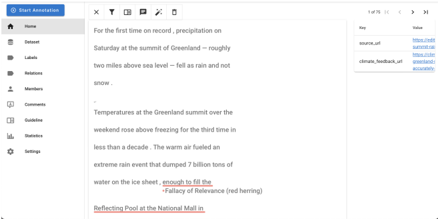
The image depicts a user interface for a text annotation tool. The layout includes a left sidebar with navigation options, a central text area with highlighted annotations, and a right panel displaying metadata. The interface appears to support collaborative annotation and metadata management.
### Components/Axes
#### Left Sidebar (Navigation)
- **Menu Items**:
- Home (highlighted)
- Dataset
- Labels
- Relations
- Members
- Comments
- Guideline
- Statistics
- Settings
#### Central Text Area
- **Text Content**:
- Passage about precipitation at Greenland’s summit:
> "For the first time on record, precipitation on Saturday at the summit of Greenland — roughly two miles above sea level — fell as rain and not snow. Temperatures at the Greenland summit over the weekend rose above freezing for the third time in less than a decade. The warm air fueled an extreme rain event that dumped 7 billion tons of water on the ice sheet, enough to fill the — Fallacy of Relevance (red herring)."
- Annotations:
- Underlined phrases:
- "enough to fill the"
- "Reflecting Pool at the National Mall in"
#### Right Panel (Metadata)
- **Key-Value Pairs**:
- `source_url`: [https://www.surfer.com](https://www.surfer.com)
- `climate_feedback_url`: [https://www.climatefeedback.org](https://www.climatefeedback.org)
### Detailed Analysis
- **Sidebar**: Organized vertically with icons and labels for navigation.
- **Text Area**: Contains a news excerpt about climate-related precipitation at Greenland’s summit, with annotations highlighting specific phrases.
- **Metadata Panel**: Displays URLs linked to the source and climate feedback, suggesting external references.
### Key Observations
1. The tool supports inline annotations (e.g., underlined text) for collaborative editing.
2. Metadata fields (`source_url`, `climate_feedback_url`) are structured for traceability.
3. The text discusses climate change impacts, with annotations flagging potential logical fallacies.
### Interpretation
The interface is designed for annotating and contextualizing textual data, likely for research or collaborative analysis. The annotations suggest critical engagement with the source material, such as identifying red herrings. The metadata panel ensures transparency by linking to external sources. This setup aligns with workflows in data journalism, academic research, or climate science communication, where precision and traceability are critical.