## Screenshot: Technical Document on Symbolic Regression for Periodic Hill Turbulence Modeling
### Overview
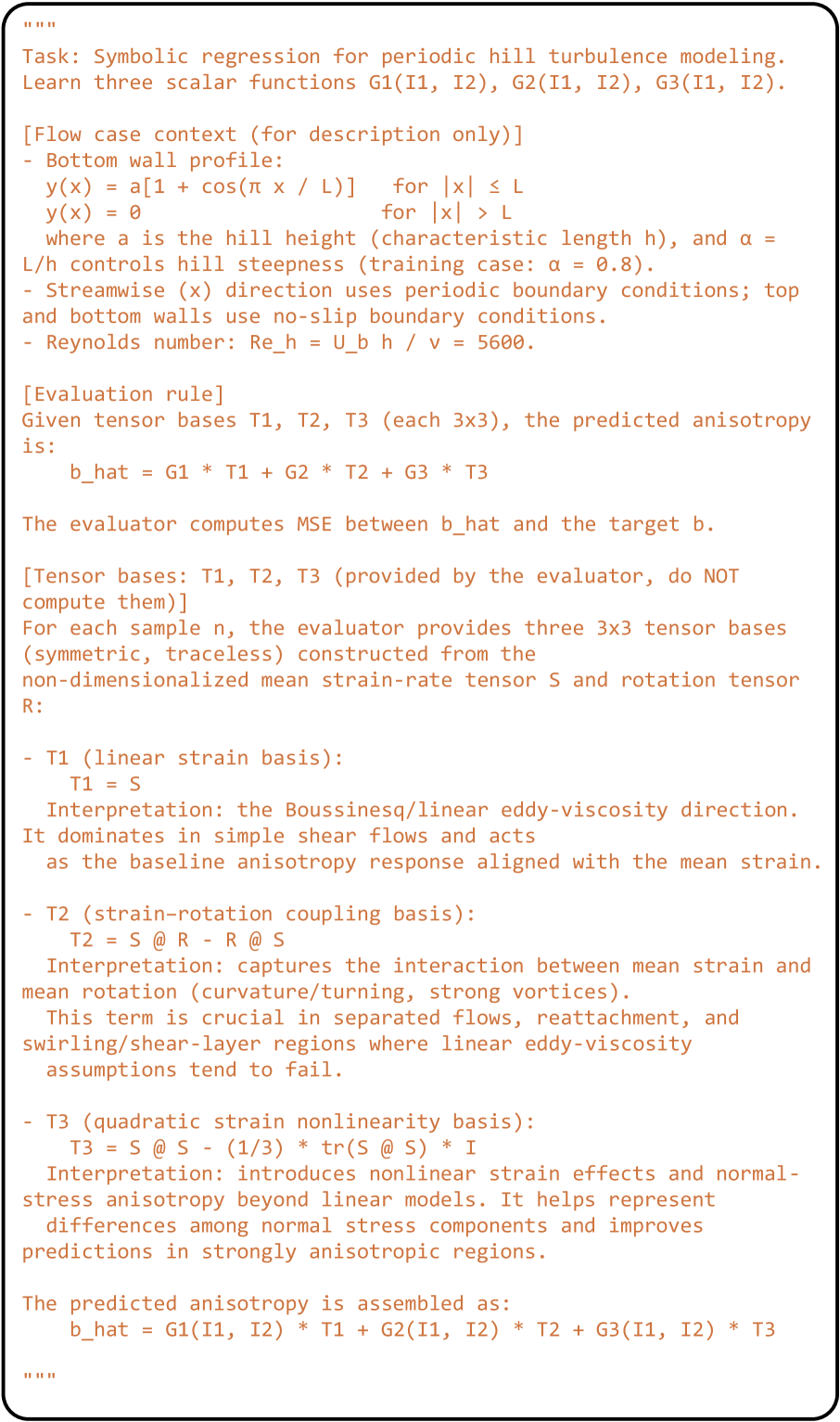
The image displays a technical document outlining a symbolic regression framework for modeling periodic hill turbulence. It includes flow case context, evaluation rules, tensor basis definitions, and a final equation for predicted anisotropy.
### Components/Axes
- **Sections**:
1. **Task**: Symbolic regression for periodic hill turbulence modeling.
2. **Flow case context**: Describes bottom wall profile equations and boundary conditions.
3. **Evaluation rule**: Defines predicted anisotropy using tensor bases.
4. **Tensor bases**: Describes T1 (linear strain), T2 (strain-rotation coupling), and T3 (quadratic strain nonlinearity).
5. **Final equation**: Combines tensor bases with coefficients G1, G2, G3.
### Detailed Analysis
- **Flow case context**:
- Bottom wall profile:
- \( y(x) = a[1 + \cos(\pi x / L)] \) for \( |x| \leq L \)
- \( y(x) = 0 \) for \( |x| > L \)
- \( a \) = hill height (characteristic length \( h \)), \( \alpha = L/h \) controls steepness (training case: \( \alpha = 0.8 \)).
- Reynolds number: \( Re_h = 5600 \).
- Boundary conditions: No-slip at bottom wall, periodic at top wall.
- **Tensor bases**:
- **T1 (linear strain basis)**:
- \( T1 = S \) (Boussinesq/linear eddy-viscosity direction).
- Dominates in simple shear flows; baseline anisotropy aligned with mean strain.
- **T2 (strain-rotation coupling basis)**:
- \( T2 = S @ R - R @ S \) (interaction between mean strain and rotation).
- Critical in separated flows, reattachment, and swirling regions.
- **T3 (quadratic strain nonlinearity basis)**:
- \( T3 = S @ S - \frac{1}{3} \cdot \text{tr}(S @ S) \cdot I \).
- Captures nonlinear strain effects and normal-stress anisotropy.
- **Final equation**:
- Predicted anisotropy:
\[
b_{\text{hat}} = G1(II, I2) \cdot T1 + G2(II1, I2) \cdot T2 + G3(II1, I2) \cdot T3
\]
- Coefficients \( G1, G2, G3 \) are learned via symbolic regression.
### Key Observations
- The model uses symbolic regression to learn scalar functions \( G1, G2, G3 \) that weight tensor bases.
- Tensor bases are constructed from the non-dimensionalized mean strain-rate tensor \( S \) and rotation tensor \( R \).
- T2 and T3 address limitations of linear eddy-viscosity models in complex flow regions.
### Interpretation
This framework extends linear turbulence modeling by incorporating nonlinear and rotational effects through tensor bases. The symbolic regression approach allows data-driven optimization of coefficients \( G1, G2, G3 \), enabling the model to adapt to specific flow conditions (e.g., hill steepness \( \alpha \)). The inclusion of T2 and T3 suggests an emphasis on capturing anisotropic turbulence in regions with strong vortices or separation, where linear models fail. The Reynolds number \( Re_h = 5600 \) indicates a moderately turbulent flow regime.