\n
## Textual Document: Comparison of Model Responses to a Math Problem
### Overview
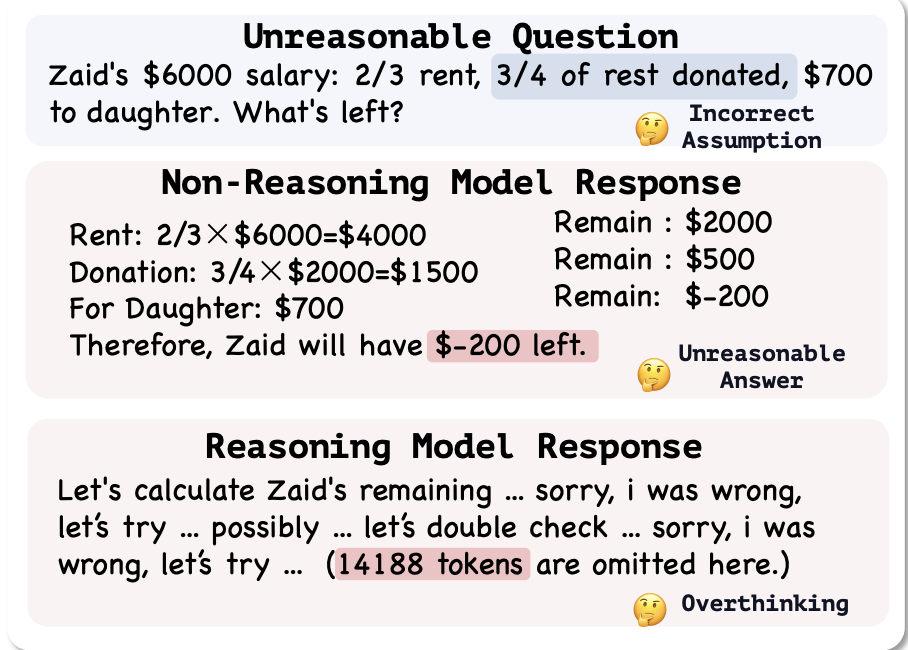
The image presents a comparison between the responses of a "Non-Reasoning Model" and a "Reasoning Model" to a word problem. The problem involves calculating the remaining amount of money after expenses (rent, donation, and a gift to a daughter) are deducted from a salary. The image also highlights issues with both responses, labeling the Non-Reasoning Model's answer as "Unreasonable" and the Reasoning Model's process as "Overthinking".
### Components/Axes
The document is divided into three main sections:
1. **Unreasonable Question:** The original word problem.
2. **Non-Reasoning Model Response:** The calculation and answer provided by the first model.
3. **Reasoning Model Response:** The calculation process (truncated) provided by the second model.
There are also visual cues:
* Emoji faces indicating issues with the responses.
* Text labels for each section.
### Detailed Analysis or Content Details
**Unreasonable Question:**
* Zaid's salary: $6000
* Rent: 2/3 of salary
* Donation: 3/4 of the remaining amount after rent
* Gift to daughter: $700
* Question: What's left?
**Non-Reasoning Model Response:**
* Rent: (2/3) * $6000 = $4000
* Donation: (3/4) * $2000 = $1500 (Remaining after rent is $6000 - $4000 = $2000)
* For Daughter: $700
* Therefore, Zaid will have $-200 left.
* Remain after Rent: $2000
* Remain after Donation: $500
* Remain after Daughter: -$200
**Reasoning Model Response:**
* "Let's calculate Zaid's remaining ... sorry, I was wrong, let's try ... possibly ... let's double check ... sorry, I was wrong, let's try ... (14188 tokens are omitted here.)"
### Key Observations
* The Non-Reasoning Model provides a direct answer but arrives at a negative remaining amount, which is logically incorrect in the context of the problem.
* The Reasoning Model demonstrates a process of trial and error, indicated by repeated apologies and attempts to recalculate, but the full response is truncated.
* The image highlights the difference between a model that attempts to directly solve the problem and one that attempts to reason through it, even if it struggles.
* The emoji faces visually emphasize the flaws in each model's approach.
### Interpretation
The image serves as a critique of different approaches to problem-solving in AI models. The "Non-Reasoning Model" exemplifies a system that can perform calculations but lacks the ability to assess the reasonableness of its results. The "Reasoning Model" demonstrates an attempt at a more nuanced approach, but its process is flawed and incomplete, leading to an inability to arrive at a correct answer. The truncation of the Reasoning Model's response suggests that even with reasoning capabilities, models can get stuck in loops or require significant computational resources to solve even relatively simple problems. The image suggests that simply performing calculations is insufficient for intelligent problem-solving; a model must also be able to reason about the context and validity of its results. The "Unreasonable Answer" and "Overthinking" labels are critical commentary on the limitations of current AI approaches.