## Screenshot: System Status Log
### Overview
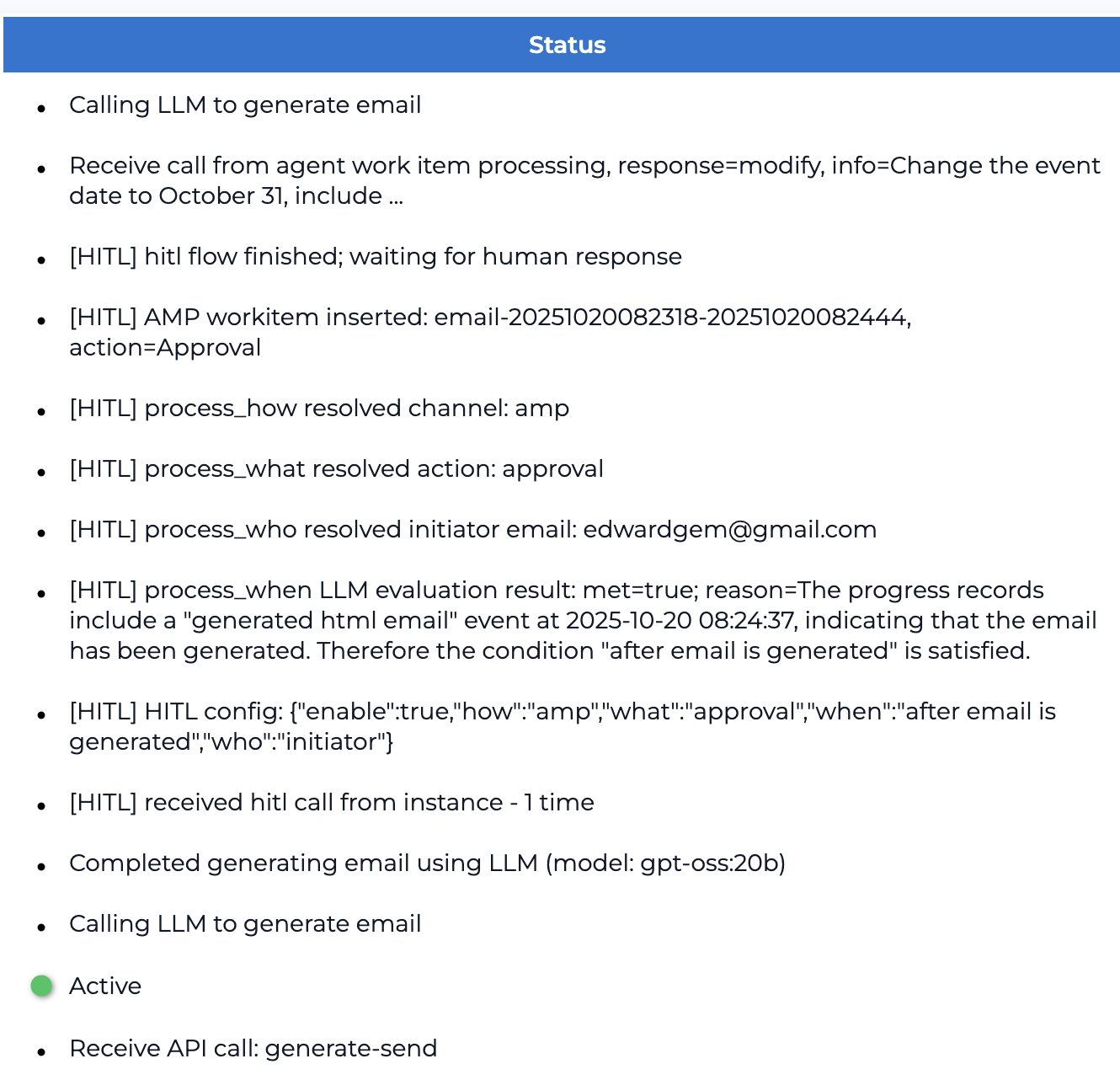
The image displays a system status log, presented as a bulleted list of events and actions, indicating the progress and state of an automated process involving email generation and human-in-the-loop (HITL) intervention. The overall status of the system is indicated as "Active".
### Components/Axes
The image is structured into three main regions:
1. **Header (Top-center):** A blue bar with white text displaying "Status".
2. **Main Content (Center):** A vertically stacked, bulleted list of chronological events or log entries. Each entry is a plain text string.
3. **Status Indicator (Bottom-left):** A green circular icon followed by the text "Active". This is followed by one more bulleted log entry.
### Detailed Analysis
The main content consists of 14 distinct log entries, presented as a bulleted list:
* **Calling LLM to generate email**
* *Description:* Initiates the process of using a Large Language Model (LLM) for email creation.
* **Receive call from agent work item processing, response=modify, info=Change the event date to October 31, include ...**
* *Description:* An agent work item processing system has requested a modification, specifically to change an event date to October 31. The "..." suggests further details were omitted or truncated.
* **[HITL] hitl flow finished; waiting for human response**
* *Description:* Indicates that the Human-in-the-Loop (HITL) workflow has completed its automated steps and is now paused, awaiting input or decision from a human.
* **[HITL] AMP workitem inserted: email-20251020082318-20251020082444, action=Approval**
* *Description:* An AMP (likely an internal system or channel) work item has been created within the HITL process. The work item is identified by "email-20251020082318-20251020082444" and requires an "Approval" action. The date embedded in the ID is 2025-10-20.
* **[HITL] process_how resolved channel: amp**
* *Description:* Within the HITL process, the method or channel used for resolution was "amp".
* **[HITL] process_what resolved action: approval**
* *Description:* Within the HITL process, the specific action that resolved the item was "approval".
* **[HITL] process_who resolved initiator email: edwardgem@gmail.com**
* *Description:* The initiator of the resolution within the HITL process is identified by the email address "edwardgem@gmail.com".
* **[HITL] process_when LLM evaluation result: met=true; reason=The progress records include a "generated html email" event at 2025-10-20 08:24:37, indicating that the email has been generated. Therefore the condition "after email is generated" is satisfied.**
* *Description:* This entry details the outcome of an LLM evaluation within the HITL process. The condition "after email is generated" was met because a "generated html email" event was recorded at 2025-10-20 08:24:37.
* **[HITL] HITL config: {"enable":"true","how":"amp","what":"approval","when":"after email is generated","who":"initiator"}**
* *Description:* This provides the configuration parameters for the HITL process in a JSON-like format:
* `"enable"`: `"true"` (HITL is enabled)
* `"how"`: `"amp"` (The channel for HITL)
* `"what"`: `"approval"` (The action required for HITL)
* `"when"`: `"after email is generated"` (The trigger condition for HITL)
* `"who"`: `"initiator"` (The role responsible for HITL action)
* **[HITL] received hitl call from instance - 1 time**
* *Description:* The system received a call related to the HITL process from a specific instance, occurring "1 time".
* **Completed generating email using LLM (model: gpt-oss:20b)**
* *Description:* The email generation task using an LLM has been successfully completed. The specific LLM model used is identified as "gpt-oss:20b".
* **Calling LLM to generate email**
* *Description:* This is a repeat of the first entry, indicating a new or subsequent request to the LLM for email generation.
* **Active** (preceded by a green circle icon)
* *Description:* This indicates the current operational status of the system or process.
* **Receive API call: generate-send**
* *Description:* The system has received an API call with the instruction to "generate-send", likely related to the email generation and dispatch.
### Key Observations
* The process involves an iterative or multi-step workflow.
* Large Language Models (LLMs) are central to email generation.
* Human-in-the-Loop (HITL) is an integral part of the workflow, specifically for "approval" actions, triggered "after email is generated".
* The "AMP" channel is consistently used for HITL interactions.
* Specific timestamps (2025-10-20 08:23:18, 2025-10-20 08:24:44, 2025-10-20 08:24:37) and an email address (edwardgem@gmail.com) provide concrete data points.
* The LLM model `gpt-oss:20b` is explicitly mentioned.
* The repetition of "Calling LLM to generate email" suggests either a new task initiated immediately after completion of the previous one, or a retry mechanism, or a continuous process.
* The system is currently "Active".
### Interpretation
This status log provides a granular view into an automated system designed for email generation, likely in a business or customer service context, given the mention of "agent work item processing" and "event date modification". The core functionality relies on an LLM to draft emails.
The presence of a "Human-in-the-Loop" (HITL) component is critical. It indicates that while the LLM automates the initial email generation, human oversight and approval are required before the email is finalized or sent. This suggests a need for quality control, compliance, or complex decision-making that current LLMs might not fully handle autonomously. The HITL configuration clearly defines *when* (after email generation), *how* (via AMP channel), *what* (approval), and *who* (initiator) is involved in this human intervention.
The sequence of events suggests:
1. An LLM is tasked with generating an email.
2. An external system (agent work item processing) might request modifications (e.g., changing an event date).
3. The HITL process is engaged, waiting for human input.
4. An AMP work item is created for approval.
5. A human (edwardgem@gmail.com) provides the "approval" via the "amp" channel.
6. The LLM's output is evaluated, and the condition "after email is generated" is met, confirming the email's creation.
7. The email generation by the LLM is completed.
8. A new cycle or a subsequent email generation task is initiated ("Calling LLM to generate email" again).
9. Finally, an API call to "generate-send" indicates the ultimate goal of the process: to generate and dispatch the email.
The system appears to be robust, incorporating both AI automation and human validation, which is a common pattern in critical applications leveraging generative AI. The "Active" status confirms the system is operational and processing tasks. The specific LLM model `gpt-oss:20b` points to a particular implementation or version of the language model being used. The detailed logging, including timestamps and specific actions, is crucial for debugging, auditing, and understanding the flow of operations within this hybrid AI-human system.