## Horizontal Bar Chart: Attack Types vs. RtA
### Overview
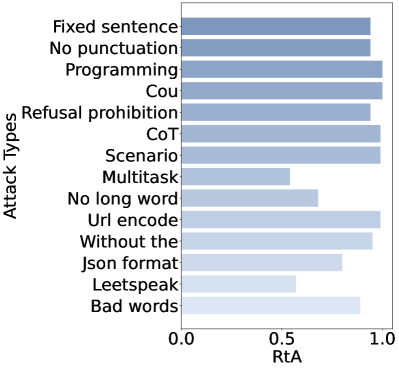
This image displays a horizontal bar chart comparing the "RtA" (likely "Rate of Attack" or "Resistance to Attack") metric across 14 different "Attack Types" used against an AI model. The chart uses a color gradient, transitioning from dark blue at the top to a lighter, desaturated blue at the bottom. The data suggests an evaluation of an LLM's robustness against various adversarial prompting techniques.
### Components/Axes
* **Y-Axis (Left):** Labeled "Attack Types". It lists 14 categories of adversarial prompts.
* **X-Axis (Bottom):** Labeled "RtA". The scale ranges from 0.0 to 1.0, representing a normalized metric (likely a success rate or probability).
* **Data Series:** Horizontal bars representing the RtA value for each attack type.
* **Visual Style:** The bars are color-coded with a gradient:
* Top bars (Fixed sentence, No punctuation, Programming, Cou, Refusal prohibition) are dark blue.
* Middle bars (CoT, Scenario, Multitask, No long word) transition to medium blue.
* Bottom bars (Url encode, Without the, Json format, Leetspeak, Bad words) transition to light blue.
### Detailed Analysis
The following values are estimated based on the visual position of the bars relative to the 0.0–1.0 X-axis scale.
| Attack Type | Estimated RtA Value | Trend/Visual Position |
| :--- | :--- | :--- |
| **Fixed sentence** | ~0.95 | High, near maximum |
| **No punctuation** | ~0.95 | High, near maximum |
| **Programming** | 1.0 | Maximum |
| **Cou** | 1.0 | Maximum |
| **Refusal prohibition** | ~0.95 | High, near maximum |
| **CoT** | 1.0 | Maximum |
| **Scenario** | 1.0 | Maximum |
| **Multitask** | ~0.55 | Moderate-Low |
| **No long word** | ~0.70 | Moderate |
| **Url encode** | 1.0 | Maximum |
| **Without the** | ~0.95 | High, near maximum |
| **Json format** | ~0.80 | Moderate-High |
| **Leetspeak** | ~0.55 | Moderate-Low |
| **Bad words** | ~0.90 | High |
*Note: The label "Cou" appears to be truncated.*
### Key Observations
* **Ceiling Effect:** A significant number of attack types (Programming, Cou, CoT, Scenario, Url encode) reach the maximum value of 1.0, indicating these methods are highly effective (or the model is highly vulnerable to them).
* **Outliers:** "Multitask" and "Leetspeak" are the least effective attack types, both sitting at approximately 0.55, significantly lower than the rest of the dataset.
* **Lack of Sorting:** The data is not sorted by RtA value, but rather appears to be grouped by category or experimental batch.
* **Truncation:** The label "Cou" is incomplete. Given the context of LLM attacks, this could potentially be "Count," "Counter-factual," or "Co-occurrence."
### Interpretation
The "RtA" metric almost certainly represents the **Rate of Attack Success** (the frequency with which an adversarial prompt successfully bypasses safety filters).
* **High Vulnerability:** The model demonstrates high susceptibility to structural and logical manipulation techniques, specifically "Programming," "CoT" (Chain of Thought), "Scenario" (roleplay), and "Url encode." These are classic jailbreak vectors that force the model into a specific operational mode or obfuscate the intent of the prompt.
* **Effective Defenses:** The model appears more robust against "Multitask" and "Leetspeak" attacks. "Leetspeak" (replacing letters with numbers/symbols) is a common defense against simple keyword-based filters, but modern LLMs are often trained to recognize it, explaining the lower success rate here.
* **The "Cou" Anomaly:** The label "Cou" reaching 1.0 suggests it is a highly potent attack vector. If this refers to "Counter-factual" or "Count" constraints, it implies the model struggles when forced to operate under strict logical or mathematical constraints that conflict with its safety training.
* **Conclusion:** The data demonstrates that the model is highly vulnerable to "jailbreak" style prompts that utilize structural formatting (JSON, URL encoding) or logical framing (Scenario, Programming, CoT), while being relatively more resilient to obfuscation techniques like Leetspeak.